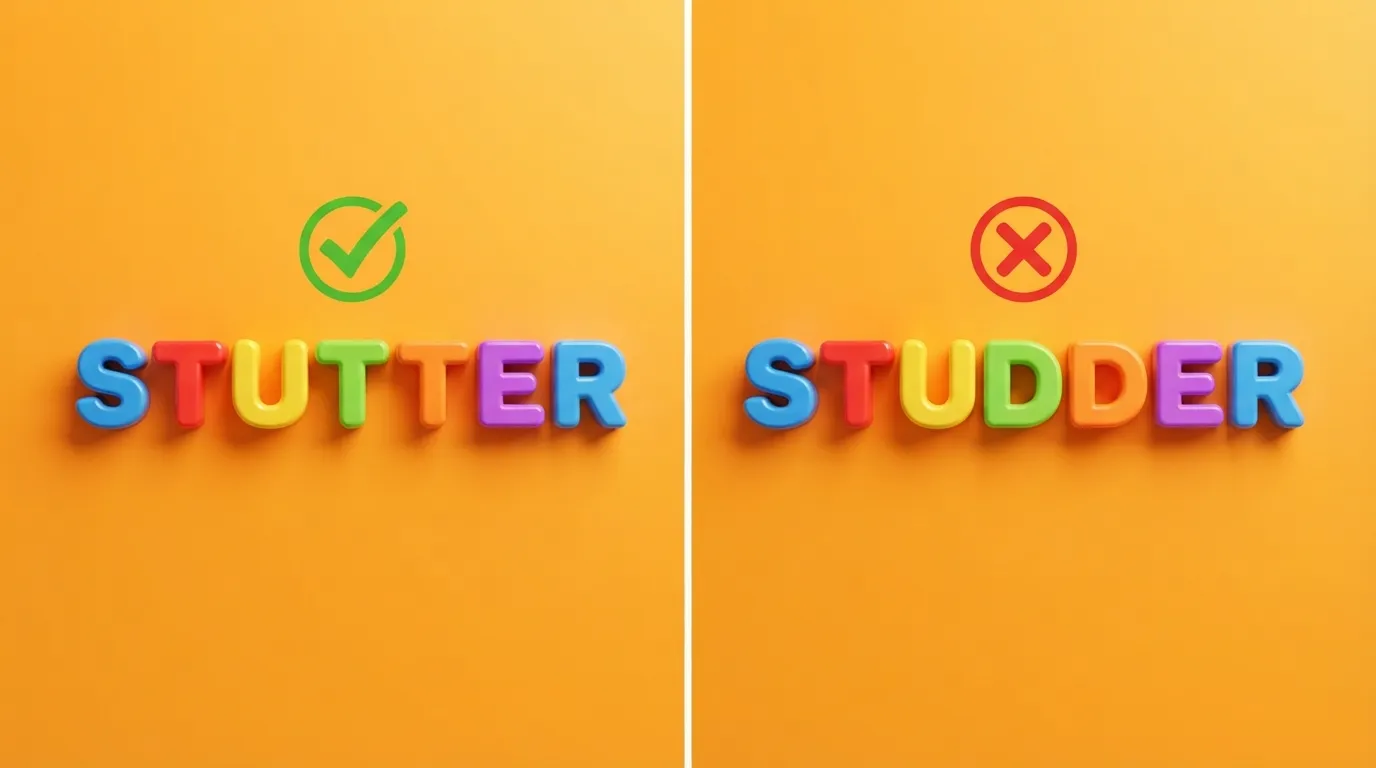
Stutter is the correct spelling. Studder is a common misspelling that shows up in casual writing, texts, and search bars, but it does not appear in any standard dictionary.
I once read a message from a friend describing her nephew’s “studder” during a school presentation. I paused, reread it twice, and genuinely wondered if I had missed a new word somewhere.
I had not. She simply typed the word the way it sounds when spoken quickly, and autocorrect never stepped in to fix it.
That small moment shows exactly why this mix up happens so often. Stutter is a word people hear far more than they read, so the spelling drifts the moment someone tries to type it from memory.
This guide clears up the confusion completely. You will learn the correct spelling, why studder keeps showing up anyway, and how to use the real word with confidence in any type of writing.
Studder or Stutter: Quick Answer
Stutter is the accepted spelling for the speech pattern involving repeated sounds, syllables, or words, and it also describes any repeated, uneven motion, like an engine that stutters before starting.
Studder is not a recognized word. It typically appears as a phonetic guess or a simple typing slip, not as an intentional alternate spelling.
Example: “He began to stutter during the interview” is correct. “He began to studder during the interview” would be flagged by any dictionary or careful editor as a spelling mistake.
The Origin and Background of Stutter
Stutter comes from Middle English, likely tracing back to older Germanic root words connected to stumbling or stammering speech. Language historians note that words describing repeated or hesitant speech patterns have existed across many European languages for centuries, often built from sounds that mimic the hesitation itself.
The confusion around studder likely comes from how the word sounds when spoken casually. English speakers often soften the middle consonant sound in stutter, which can make it sound closer to studder in fast, everyday conversation.
Typing from sound rather than memory causes most spelling mistakes like this one. Since stutter is usually heard far more than it is read, especially by younger writers or non native English speakers, the ear driven spelling naturally drifts.
Spellcheck tools complicate this further. Many autocorrect systems recognize studder as close enough to stutter and either leave it alone or suggest an unrelated word entirely, which allows the mistake to slip through unnoticed.
Stutter Explained: Correct Usage and Common Variations
| Term | Meaning | When to Use | Region/Context |
|---|---|---|---|
| Stutter | Repeated or hesitant speech, or uneven mechanical motion | All writing, formal and casual | Standard across English speaking regions |
| Stammer | Similar meaning to stutter, more common in British English | Formal or descriptive writing | More frequent in UK English |
| Studder | Not a standard word | Never intentionally | Appears only as a misspelling |
Stutter and stammer share a very similar meaning and are often used interchangeably. Studder does not belong in that group at all, since it is not a genuine variant, just an error.
Which Spelling Should You Use?
Students and Academic Writing
Always use stutter. Teachers, textbooks, and grammar checkers expect this exact spelling in essays and assignments.
Healthcare and Speech Therapy Writing
Use stutter, since it is the term recognized by speech language professionals, medical literature, and diagnostic resources.
Journalists and Content Writers
Use stutter for consistency and credibility. A misspelled core term can undermine trust in an otherwise well researched article.
Casual Writing and Text Messages
Stutter still works best here too. Since studder carries no accepted meaning, using it risks confusing your reader, even in informal writing.
Global or Neutral Audiences
Choose stutter every time. It reads correctly across American English, British English, and every major style guide worldwide.
If you remember only one rule, remember this: stutter is always correct, and studder is always a mistake.
Common Mistakes with Stutter and Studder
Mistake 1: Typing the Word Based on How It Sounds
Correction: Picture the written word stutter rather than sounding it out letter by letter while typing.
Mistake 2: Assuming Spellcheck Will Catch the Error
Correction: Some spellcheck tools do not flag studder, since it resembles a real word closely enough to slip through unnoticed.
Mistake 3: Confusing Stutter with Shudder or Sputter
Correction: These are three separate words. Shudder means to tremble, sputter means to make short bursts of sound, and stutter means repeated hesitation in speech or motion.
Mistake 4: Using Studder in Professional or Medical Writing
Correction: Always default to stutter in formal, academic, or healthcare related writing, since studder has no recognized definition in these fields.
Mistake 5: Believing Studder Is a Regional or Informal Variant
Correction: Studder is not tied to any dialect or informal usage. It is simply an unintentional misspelling.
Each of these mistakes happens because stutter sounds slightly different depending on speed and accent, which makes the written form easy to guess incorrectly.
Stutter in Real World Examples
Professional Email
“The therapist noted a significant improvement in the client’s stutter after six months of consistent sessions.”
News Headline
“New Research Explores Early Signs of Childhood Stutter and Effective Treatment Options”
Social Media Post
“So proud of my son for reading his poem out loud today, stutter and all. He did not let it stop him.”
Formal Document
“This evaluation form assesses stutter frequency, duration, and severity across three separate speaking tasks.”
Notice how stutter fits naturally into every tone, from clinical language to a proud parent’s casual post. That flexibility is part of why the correct spelling matters so much.
Stutter and Studder: Data, Trends, and Usage
Searches comparing stutter and studder happen consistently throughout the year, often from parents researching childhood speech development or from writers double checking spelling before publishing.
Speech therapists, educators, and healthcare writers make up a meaningful share of searches, since accuracy matters significantly more in medical and educational contexts.
This search falls almost entirely into the informational category. Readers want a fast, reliable answer, not a lengthy linguistic breakdown.
Awareness campaigns around speech disorders continue to grow, which keeps interest in correct terminology steady, especially among parents and educators searching for reliable, respectful language.
Standalone Comparison Table
| Term/Variant | Meaning | Region/Context | Best Used When |
|---|---|---|---|
| Stutter | Repeated or hesitant speech, or uneven motion | Global standard | Any writing situation, formal or casual |
| Stammer | Same general meaning as stutter | More common in British English | Formal or descriptive contexts |
| Studder | No accepted meaning | Appears only as an error | Never appropriate |
Frequently Asked Questions
What does stutter mean?
Stutter means repeating or prolonging sounds, syllables, or words while speaking, often involuntarily. It can also describe uneven, repeated motion, like a car engine stuttering before it starts smoothly.
How do you use stutter correctly in a sentence?
Use stutter as a verb describing the action, such as “he began to stutter,” or as a noun describing the pattern itself, such as “her stutter became less noticeable with practice.”
Studder vs stutter, what is the actual difference?
There is no real difference in meaning, because studder is not an accepted word at all. Stutter is the only correct spelling for this concept.
Is studder ever acceptable in formal writing?
No. Studder should never appear in formal, academic, or professional writing. Stutter is the expected and correct spelling in every context.
Which version is correct, stutter or studder?
Stutter is correct. Studder is a misspelling that likely comes from typing the word based on pronunciation rather than spelling.
Where does the word stutter come from?
Stutter traces back to older Germanic and Middle English roots connected to stumbling or hesitant speech, a pattern that appears across many older European languages.
Can stutter describe something other than speech?
Yes. Stutter can describe any repeated, uneven motion or sound, such as an engine that stutters before it runs smoothly or a light that stutters before turning fully on.
Final Thoughts
Stutter is the spelling you should use every single time, whether you are writing casually, academically, or professionally. Studder simply is not a recognized word, no matter how natural it might look after hearing the term spoken quickly.
Remember the core lesson here. When a word sounds unclear, picture its written form instead of typing purely from memory of the sound. That habit alone prevents most spelling slips like this one.
Bookmark this guide so you never second guess this word again, and share it with anyone who has ever paused mid sentence, unsure which spelling looked right.
See More: Ambience or Ambiance: The Complete Spelling Guide

I’m Zain. I got interested in commonly confused words while helping non-native English speakers prep for writing exams, where a single misused word could cost real marks. That experience shaped how I write now: I try to explain not just which spelling is correct, but why the confusion exists in the first place, since understanding the reason is what actually makes it stick.