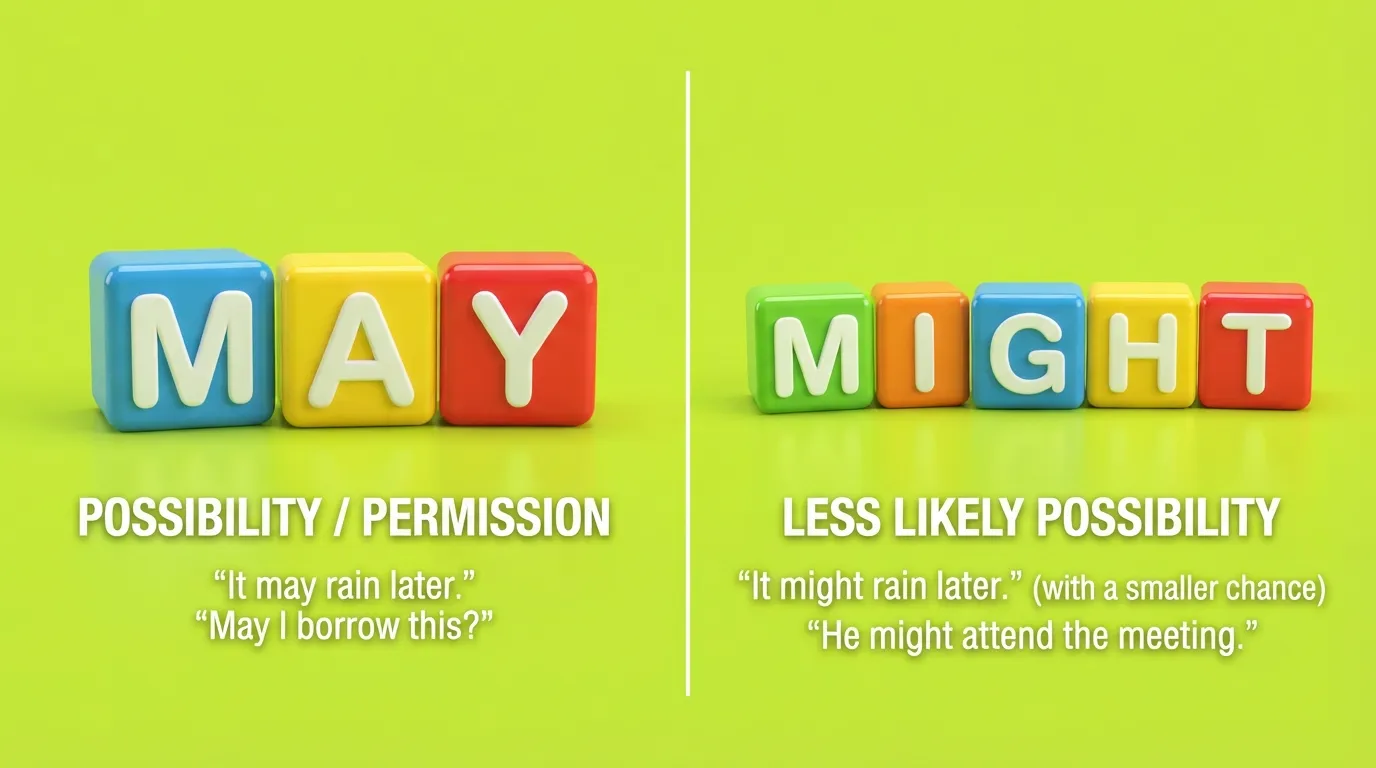
May and might are both used to show possibility, but may suggests a stronger chance while might suggests something less certain or more hypothetical.
Last month I texted a friend “I may come to the party” and she assumed I was basically confirmed. When I didn’t show up, she was confused. I meant to say I might come, meaning it was only a slim possibility.
That small mix up taught me something. Most people use may and might as if they mean the exact same thing. They don’t, and that tiny difference can completely change how confident your sentence sounds.
This guide will finally clear up when to use each word. You will learn the grammar rule, the everyday exceptions, and how to sound naturally correct in speech and writing. Once you see the pattern, you will never mix them up again.
May or Might Quick Answer
May expresses a stronger, more likely possibility, while might expresses a weaker, more uncertain one.
For example, “I may go to the gym today” sounds fairly likely. “I might go to the gym today” sounds more doubtful. The words share meaning, but the confidence level shifts.
That subtle shift in certainty is really the whole rule in a nutshell.
The Origin and Background of May and Might
Both words come from Old English. May descended from “magan,” meaning to be able or to have power. Might came from the past tense form of that same word, “meahte” or “mihte.”
Originally, might simply functioned as the past tense of may. Over centuries, English speakers began using might on its own to express hypothetical or less certain situations, even when not referring to the past.
This shared history explains why the two words feel so similar today. They grew from the same root, then slowly split into two related but distinct shades of meaning.
May and Might Explained: Key Differences and Variations
| Term | Meaning | When to Use | Region or Context |
| May | Stronger possibility or formal permission | Present or future events with decent likelihood | Standard across all English dialects |
| Might | Weaker possibility or hypothetical situation | Uncertain events or past tense reported speech | Standard across all English dialects |
| Maybe | Casual adverb meaning possibly | Informal speech and quick responses | Everyday conversation |
May also carries a second job. It can politely ask for or grant permission, like “May I leave early today.” Might rarely gets used this way, since it sounds oddly indirect for a simple request.
Which Word Should You Use?
For formal writing and emails, use may when describing a likely outcome or requesting permission politely.
For casual conversations about uncertain plans, might feels more natural, since it softens the statement and avoids overpromising.
For past tense storytelling, might works better, especially when describing something that could have happened but didn’t, like “He might have called, but he never did.”
For global or neutral writing, either word works fine as long as you match the confidence level to what you actually mean.
Common Mistakes with May and Might
Mistake 1: Using may and might interchangeably without thinking about certainty level.
Correction: Choose may for likely outcomes and might for uncertain or hypothetical ones.
Mistake 2: Using may in past tense reported speech.
Correction: Might usually works better here, such as “She said she might be late,” not “She said she may be late.”
Mistake 3: Asking permission with might instead of may.
Correction: Use may for polite permission requests, like “May I ask a question.”
Mistake 4: Overusing might in formal writing, making statements sound weak or unsure.
Correction: Switch to may when you actually feel confident about the outcome.
Mistake 5: Confusing might with the noun “might,” meaning strength or power.
Correction: Context usually makes this clear, but remember “might” as a noun refers to physical or political strength.
Most of these mistakes happen because native speakers rarely notice the subtle certainty gap. Once you start paying attention, the difference becomes obvious.
May and Might in Real World Examples
A professional email might read like this: “We may need to reschedule the meeting depending on client availability.”
News headlines often use lines such as: “Interest Rates Might Rise Again Before Year End, Analysts Say”
Social media captions sometimes include phrases like: “Might skip the gym today, feeling a bit under the weather.”
Formal documents frequently state: “Applicants may submit additional documents if required by the review committee.”
Each example shows how the confidence level shifts naturally depending on which word the writer chooses.
May and Might Data, Trends and Usage
Search data shows steady, year round interest in “may or might,” especially among students studying English grammar and non native speakers preparing for exams. Most searches fall into the informational category, since people mainly want a clear grammar explanation.
Teachers, writers, and ESL learners search this term most often, since the distinction rarely gets taught clearly in basic grammar lessons. Business professionals also search it when drafting careful, precise emails.
This distinction matters more today because written communication often replaces tone of voice. Choosing the wrong word can accidentally make a statement sound more certain or less certain than intended.
May vs Might Comparison Table
| Term or Variant | Meaning | Region or Context | Best Used When |
| May | Higher likelihood or formal permission | Standard English, formal and informal | Confident predictions or polite requests |
| Might | Lower likelihood or hypothetical situation | Standard English, formal and informal | Uncertain outcomes or past tense speech |
| Could | Possibility based on ability or circumstance | Standard English | Describing capability rather than likelihood |
May and Might Frequently Asked Questions
What does may mean?
May expresses a fairly likely possibility or grants formal permission. It suggests the speaker feels reasonably confident about the outcome.
How do you use might correctly in a sentence?
Use might to describe something uncertain or hypothetical, such as “I might visit my parents this weekend, but nothing is confirmed yet.”
May vs might, what is the real difference?
May signals a stronger chance of something happening, while might signals a weaker or more doubtful chance. Both describe possibility, just at different confidence levels.
Is might acceptable in formal writing?
Yes, might works fine in formal writing, especially when describing uncertain outcomes or hypothetical scenarios that need careful, cautious language.
Which version is correct, may or might?
Both are correct grammatically. The right choice depends on how certain you feel about the situation you are describing.
Where do the words may and might come from?
Both trace back to Old English, sharing the root word “magan,” meaning to have power or ability. Might originally served as the past tense of may.
Can might be used to ask permission?
Technically yes, though it sounds unusually formal or old fashioned. May remains the standard, natural choice for permission requests today.
Why do so many people confuse may and might?
The confusion happens because both words describe possibility, and most native speakers never learned the certainty difference explicitly in school.
Final Thoughts on May or Might
May and might both express possibility, but the confidence level sets them apart. May signals a stronger chance, while might signals something more uncertain or hypothetical.
Remember the permission rule too. May asks politely, while might rarely fits that role. Once you internalize these small distinctions, your writing will feel more precise and intentional.
Bookmark this guide so you never second guess may or might again. Share it with a student, coworker, or writer who could use a clearer explanation of this everyday grammar rule.
Read More: Ambience or Ambiance: The Complete Spelling Guide

Hey, I’m Ayeza. I started this site because I kept hitting the same wall over and over: typing a word, freezing, and not trusting my own instinct on the spelling. Now I research these mix-ups properly so you don’t have to, and I write every guide the way I wish these explanations had been written for me.