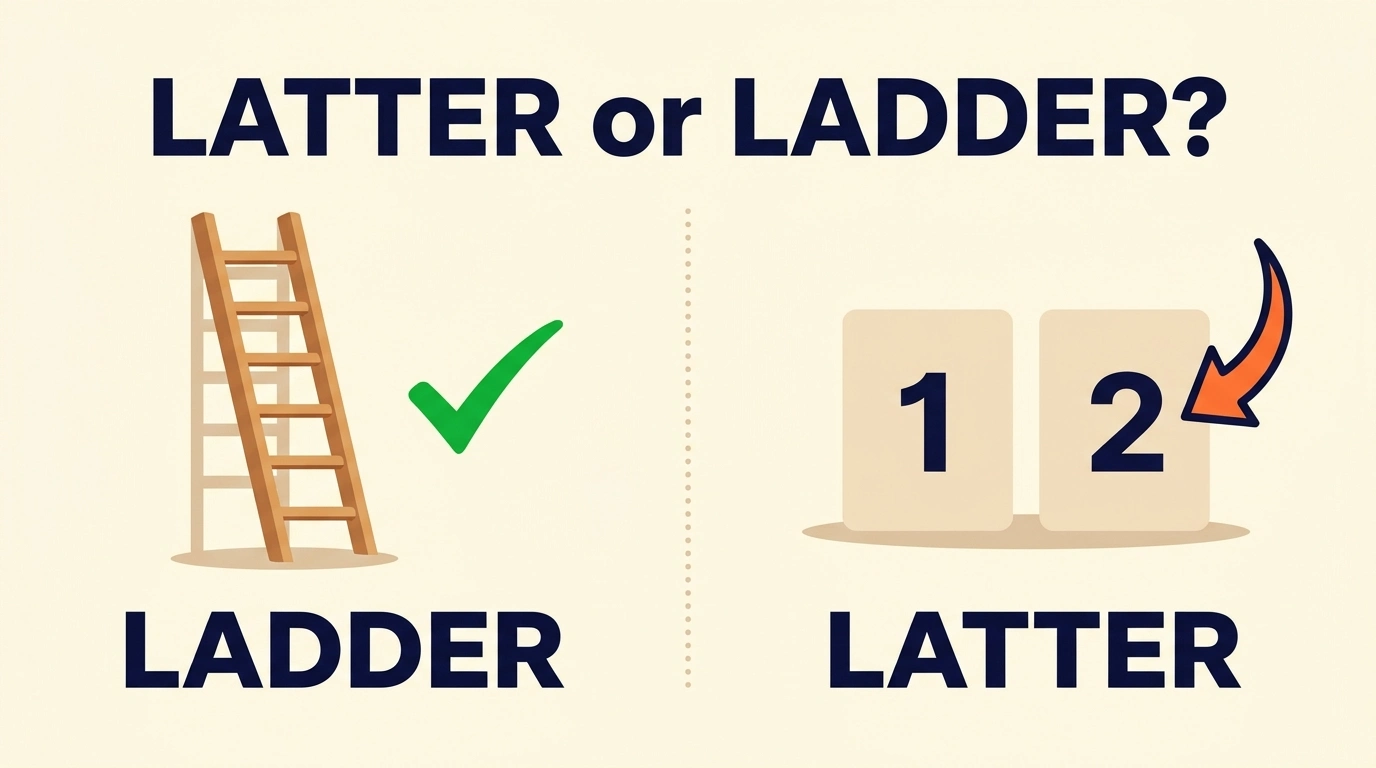
Latter means the second of two things you just mentioned. Ladder is the climbing tool with rungs. They sound almost the same in American English, but they are different words.
I once graded a stack of essays that included this sentence: “I chose the ladder option.” The student had picked between two topics. There was no climbing involved.
I smiled, then I stopped. I had made the same slip years earlier in an email to my boss. Nobody told me. I found out much later.
This mix up is easy to make. In American speech, both words sound almost identical. Your ear says they match, but your eyes should say otherwise.
This guide fixes that. You will learn what each word means, why they sound alike, and how to pick the right one fast. There is also a cheat sheet to save. Let us start with the short version.
Latter or Ladder: Quick Answer
Latter is an adjective and a noun. It points to the second of two items, or to the end part of something.
Ladder is a noun. It names a frame with steps for climbing. It also works as a symbol for progress, as in “the career ladder.”
Two quick examples:
- We had tea or coffee. I picked the latter.
- He climbed the ladder to fix the roof.
If your sentence is about choosing between two things, use latter. If it is about climbing or moving up, use ladder.
Why Latter and Ladder Sound So Alike
In American English, a t between two vowels often sounds like a soft d. Linguists call this a flap sound. So latter and ladder can sound almost the same in casual speech.
- Latter is written /ˈlætər/ in American English.
- Ladder is written /ˈlædər/ in American English.
In British English, people often say the t more clearly, so the gap is easier to hear. Still, the safest habit is to check the meaning, not the sound.
The Origin of Latter and Ladder
Both words come from Old English, which is why they feel so ordinary.
Latter comes from an Old English form related to the word late. It is a comparative form, like “later.” Over time, English kept “later” for time and “latter” for order in a pair.
Ladder comes from an Old English word for the same climbing tool. The meaning has stayed steady for a very long time.
Here is the fun part. People also use ladder in everyday sayings like “climb the corporate ladder.” That is a picture of moving up, step by step.
Latter or Ladder Explained: Key Differences
Think of this as a quick map.
| Term | Meaning | When to Use | Region or Context |
| Latter | The second of two things mentioned | Choosing between two options | Worldwide, mostly in writing |
| Ladder | A tool with rungs for climbing | Physical climbing or career progress | Worldwide |
| Later | At a time after now | Talking about time | Worldwide |
| Former | The first of two things mentioned | Pairing with latter | Worldwide, mostly in writing |
Latter
Use it when you have exactly two items. It pairs with former, which means the first one.
- Example: Sam can offer a refund or a replacement. The former is faster. The latter is free.
Ladder
Use it for the object, or for a picture of rising up.
- Example: Please hold the ladder while I climb.
Latter Part or Latter Half
Latter can also mean the end part of something. You will see it in phrases like “the latter half of the year.”
- Example: The weather improved in the latter part of the week.
Which Word Should You Use?
Here is the direct advice.
For Students and Writers
Ask one question. Am I choosing between two things I already named? If yes, use latter. If you mean a climbing tool, use ladder.
For Bloggers and Editors
Use latter with care. Many readers find it formal and a little stiff. Plain wording such as “the second option” often reads better.
For Everyday Speech
Most people say “the second one” in conversation. Save the latter for writing, emails, and reports.
For global or neutral use, both words are standard everywhere. Just match the word to the meaning.
Common Mistakes with Latter and Ladder
Let us look at the errors people make most. Each one has a reason.
Writing Ladder When You Mean Latter
- Wrong: I picked the ladder of the two plans.
- Right: I picked the latter of the two plans.
- Why it happens: The sounds match, so the ear accepts it.
Using Latter for Three or More Items
- Wrong: We visited Rome, Paris, and Madrid. I loved the latter.
- Right: We visited Rome, Paris, and Madrid. I loved the last one.
- Why it happens: Writers think latter means “last.” It really means the second of two.
Mixing Up Latter and Later
- Wrong: I will call you latter.
- Right: I will call you later.
- Why it happens: The two words differ by only one letter.
Writing Latter for a Climbing Tool
- Wrong: He leaned the latter against the wall.
- Right: He leaned the ladder against the wall.
- Why it happens: Fast typing and autocomplete.
Adding an S to Latter
- Wrong: The latters were cheaper.
- Right: The latter was cheaper.
- Why it happens: Writers treat it like a regular noun. Latter does not take a plural in this use.
Latter or Ladder in Real World Examples
Seeing the words in action helps them stick.
In a Professional Email
“We can meet Monday or Friday. The latter suits my schedule better.”
In a News Headline
“Firefighters Rescue Worker Stuck on Ladder Above Busy Street”
In a Social Media Post
“Option one is tacos. Option two is pizza. I’m going with the latter. #dinnerdecisions”
In a Formal Report
“Of the two methods tested, the latter produced fewer errors. Staff also used a ladder to inspect the roof.”
Notice how each word stays in its own lane. That is the goal.
Latter or Ladder: Data, Trends, and Usage
People search this pair for a few clear reasons. Students check spelling for homework. Writers want to know which word suits a formal sentence. Others look up the grammar rule for former and latter.
The search intent is mostly informational. Readers want a quick answer, a meaning, or an example. A smaller group has a commercial angle, such as shopping for a ladder, but that group usually has no spelling confusion.
Interest rises during school terms, when students write essays and take tests. Many people also search before sending a formal email.
Why does this matter now? Autocomplete and voice typing can swap similar sounding words without warning. A quick check protects your credibility.
Latter vs Ladder Cheat Sheet
Save this for later.
| Term or Variant | Meaning | Region or Context | Best Used When |
| Latter | Second of two items | Worldwide, formal writing | You compare exactly two things |
| Ladder | Climbing tool, or step by step progress | Worldwide | You talk about climbing or careers |
| Later | After now | Worldwide | You talk about time |
| Former | First of two items | Worldwide, formal writing | You pair it with latter |
Memory trick: Ladder has a d, like down and up. Latter has two ts, like the two items you compare.
Three second check:
- Are you picking between two named things? Use latter.
- Are you climbing, or talking about steps up? Use ladder.
- Are you talking about time? Use later.
FAQ
Q: What does latter mean? A: Latter means the second of two things already mentioned. It can also mean the end part of something, as in “the latter half of the month.”
Q: How do you use latter correctly? A: Use it only when you have exactly two items. Pair it with former for the first item. Write “the latter” when it stands alone.
Q: Latter vs ladder: what is the difference? A: Latter points to the second of two things. Ladder is a climbing tool. They sound alike in American speech but have no shared meaning.
Q: Is latter acceptable in formal writing? A: Yes. It is common in reports, essays, and legal or business writing. In casual talk, many people say “the second one” instead.
Q: Which version is correct, latter or ladder? A: Both are correct words, but they serve different jobs. Use latter for a choice between two, and ladder for a climbing tool.
Q: Where does the word ladder come from? A: It comes from Old English. The word has described the same climbing tool for a very long time.
Q: Can latter be used for three items? A: No. With three or more items, use “the last one” or “the final item.” Latter is for pairs only.
Conclusion
Let us wrap up. Here are the key points to remember:
- Latter means the second of two things.
- Ladder is a climbing tool and a symbol for progress.
- Later is about time, so do not mix it up with latter.
- Use latter only for pairs, never for three or more items.
My final advice is simple. When you see two options in your sentence, use latter. When you see steps and rungs, use ladder. You will sound clear and careful.
That student essay taught me something. Even small sound twins can change a sentence. Now you know the difference too.
Now you know exactly how to use latter or ladder. Go try it in your next email or essay. Better yet, share this guide with someone who has been unsure about it. They will thank you.
Read More: Kimchee or Kimchi: The Real Spelling Answer Made Easy

My name is Ayesha Sadiqah, the writer behind this website. I write in-depth articles on English spelling, word comparisons, grammar, and vocabulary to help learners make better language choices. Every guide is designed to provide accurate, practical, and easy-to-understand information.






1 thought on “Latter or Ladder: The Simple Spelling Guide”