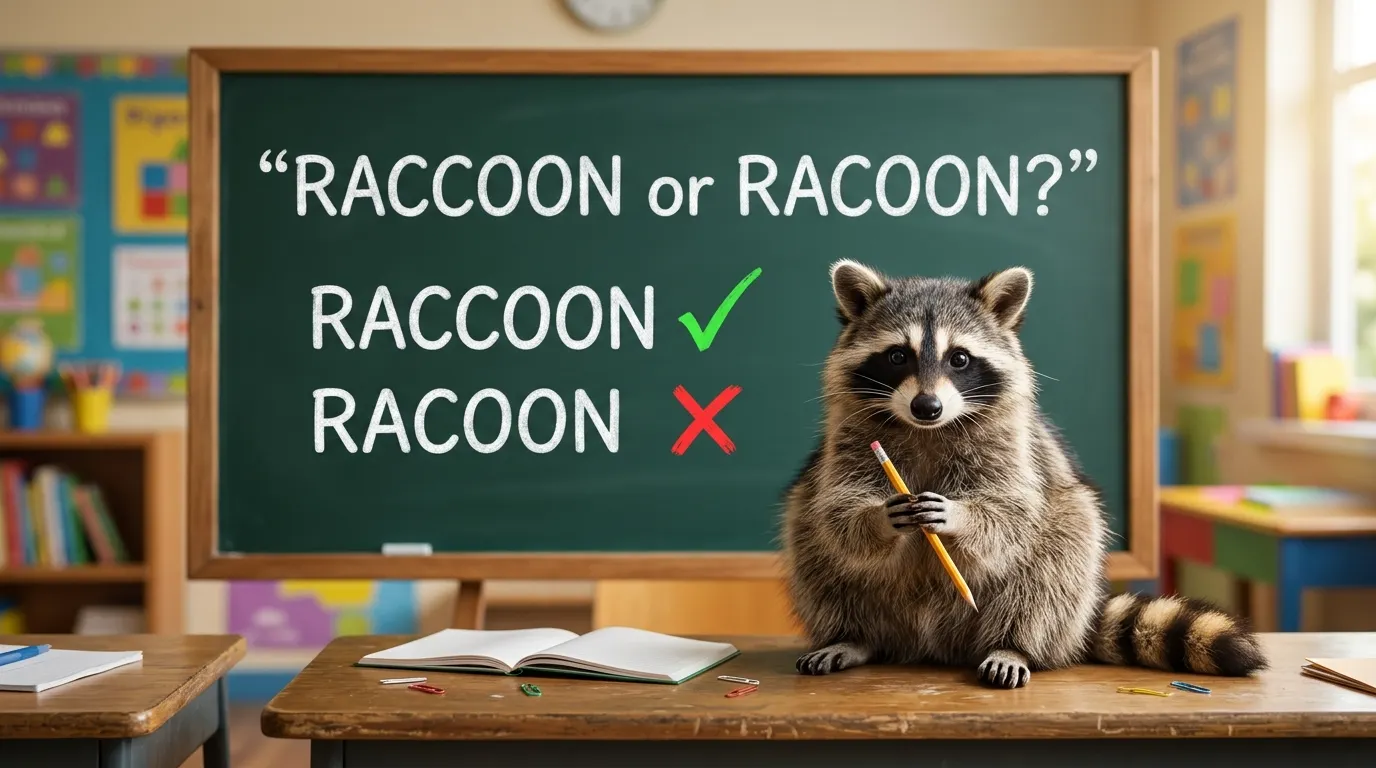
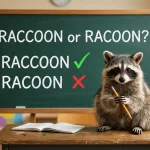
Raccoon is the standard spelling in American and British English. Racoon is a rarer variant that some dictionaries list, but you should use raccoon with double c in almost every case.
Years ago, I marked a stack of fourth grade essays. One student wrote about a “racoon” raiding his trash can. Another wrote “raccoon.” Both were proud of their work. Both asked me which one was right.
I froze. I had always written it one way. But I had never checked why.
So I looked it up. The answer was simpler than I expected, and the story behind it was fun. Many people search this word because it just looks odd. Where does that double c come from? Is the single c wrong?
This guide gives you the answer fast. You will learn the meaning, the origin, the common mistakes, and which spelling to pick. There is also a cheat sheet you can save. Let us start with the short version.
Racoon or Raccoon: Quick Answer
Raccoon is the correct and common spelling. It names a small North American mammal with a black mask and a ringed tail.
Racoon shows up as a variant. Some dictionaries list it as an acceptable alternate, but most editors will change it.
Here are two simple examples:
- A raccoon tipped over our garbage bin last night.
- The zoo has a baby raccoon that loves marshmallows.
If you want zero risk, write raccoon.
The Origin of Raccoon
The word comes from a Native American language. Powhatan people lived near what is now Virginia. English settlers heard their word for the animal and tried to write it down.
Captain John Smith wrote an early version in 1608. He spelled it something like aroughcun. Another early spelling was arocoune. The word is often explained as meaning “one who rubs, scrubs, and scratches with its hands.”
That fits well. Raccoons use their front paws like little hands.
So why the confusion? The settlers had no standard spelling. They wrote what they heard. Over time, English shortened the word to raccoon. Some writers dropped one c and wrote racoon. Both forms survived, but the double c won.
Fun fact: the scientific name is Procyon lotor. The word lotor means “washer” in Latin. Raccoons often dip food in water, so people thought they were washing it.
Raccoon Explained: Key Differences and Variations
Think of this as a spelling map. One word, a few forms.
| Term | Meaning | When to Use | Region or Context |
| Raccoon | The masked mammal | Almost always | US, UK, Canada, Australia |
| Racoon | Same animal, variant spelling | Rarely, if ever | Older texts, some informal writing |
| Coon | Short form of the word | Avoid it | Often considered offensive today |
| Procyon lotor | Scientific name | Science writing | Biology and research |
A quick warning. The shortened word “coon” carries a painful racist history when used toward people. Many readers find it offensive even when it refers to the animal. Stick with the full word raccoon.
Which Spelling Should You Use?
Here is the direct advice.
- For students: Use raccoon. Teachers and spell checkers expect it.
- For bloggers and SEO writers: Use raccoon. It is the form people search and the form search engines know best.
- For journalists and editors: Use raccoon. Major style guides follow it.
- For global or neutral writing: Use raccoon. It works everywhere.
You will not lose points with the double c. You might lose them with the single c.
Common Mistakes with Raccoon
Let us look at the errors people make most. Each one has a reason.
Mistake 1: Dropping one c
- Wrong: The racoon ate my sandwich.
- Right: The raccoon ate my sandwich.
- Why it happens: The word sounds like it has one “k” sound. The brain skips the extra letter.
Mistake 2: Adding an extra o or letter
- Wrong: raccon
- Right: raccoon
- Why it happens: People forget the double o. Say it as “rack COON” and count both vowels.
Mistake 3: Using the offensive short form
- Wrong: a coon in the yard
- Right: a raccoon in the yard
- Why it happens: People shorten words in casual speech. In writing, use the full word.
Mistake 4: Mixing spellings in one piece
- Wrong: One raccoon… then two racoons.
- Right: Pick one spelling and keep it everywhere.
- Why it happens: Writers type fast and do not reread.
Mistake 5: Mixing up the plural
- Wrong: raccoones
- Right: raccoons
- Why it happens: Writers think of words like “tomatoes.” Just add s.
Raccoon in Real World Examples
Seeing the word in action helps it stick.
A professional email
“Hi team, a raccoon got into the supply shed last night. Please lock the door after use.”
A news headline
“Raccoon Found Inside City Library Returns to the Wild”
A social media post
“Caught this little raccoon washing a grape at 2 a.m. Nature is wild. #raccoon”
A formal report
“The study tracked 40 urban raccoon populations over three years to measure changes in diet.”
Notice how the spelling stays the same every time. That is the goal.
Raccoon: Data, Trends, and Usage
People search this word for a few clear reasons. Students check spelling for homework. Homeowners look up how to deal with a backyard visitor. Pet curious readers want to know if raccoons make good pets. (They usually do not.)
The search intent is mostly informational. Readers want a quick fact, a spelling check, or a basic explanation. Some searches lean commercial, such as pest control or trash can locks.
Interest tends to rise in warm months and in autumn, when raccoons grow bold and hunt for food. Cities with lots of green space, such as Toronto and Cincinnati, are known for their raccoon populations.
Why does this matter now? More wildlife moves into cities every year. More people meet raccoons face to face, and more people need to write about them correctly.
Standalone Cheat Sheet and Comparison Table
Save this for later.
| Term or Variant | Meaning | Region or Context | Best Used When |
| Raccoon | Masked North American mammal | Worldwide standard | You write anything at all |
| Racoon | Variant spelling | Older or informal text | Quoting an old source only |
| Raccoons | More than one raccoon | Worldwide standard | You mean several animals |
| Procyon lotor | Scientific name | Science and research | You write a biology paper |
Memory trick: A raccoon has double of everything. Two eyes with masks, two hands, and two c’s. Double c, double o.
Three second check:
- Count the c’s. You need two.
- Count the o’s. You need two.
- Add s for plural.
FAQ
Q: What does raccoon mean?
A: A raccoon is a medium sized mammal from North America. It has gray fur, a black face mask, and a ringed tail. It is known for clever paws and night time habits.
Q: How do you spell raccoon correctly?
A: Spell it r a c c o o n. That is two c’s and two o’s. This is the form used by most dictionaries and style guides.
Q: Racoon vs raccoon: what is the difference?
A: There is no difference in meaning. Racoon is a rarer variant with one c. Raccoon is the standard form, so choose it.
Q: Is racoon acceptable in formal writing?
A: Not really. Some dictionaries list it, but editors and teachers prefer raccoon. Use the double c for school, work, and publishing.
Q: Which version is correct, racoon or raccoon?
A: Raccoon is correct. It is the safest choice in the US, UK, Canada, and Australia.
Q: Where does the word raccoon come from?
A: It comes from a Powhatan word recorded by English settlers in the early 1600s. Early spellings like aroughcun slowly became the word we use now.
Q: Can raccoon be used in a science paper?
A: Yes. Write raccoon in the text. You may add the scientific name Procyon lotor on first mention.
Conclusion
Let us wrap up. Here are the key points to remember:
- Raccoon is the standard spelling. Use it.
- Racoon is a rare variant. Skip it.
- The word came from a Powhatan term heard by early English settlers.
- Avoid the short form “coon.” It can be offensive.
My final advice is simple. When in doubt, write raccoon with double c and double o. You will look careful, confident, and correct.
That fourth grader taught me something. Even small words have big stories. Now you know the story too.
Now you know exactly how to spell raccoon. Go use it in your next piece of writing. Better yet, share this guide with someone who has been confused about it. They will thank you.
Read More: Afterward or Afterwards: Which Is Correct?

Hi, I’m Zara. Words that look almost identical but mean different things have always fascinated me, and that is what pulled me into writing about spelling and usage. Every guide gives you the answer first, then explains it clearly enough that you won’t need to look it up again.






1 thought on “Racoon or Raccoon: The Real Spelling Answer Made Easy”