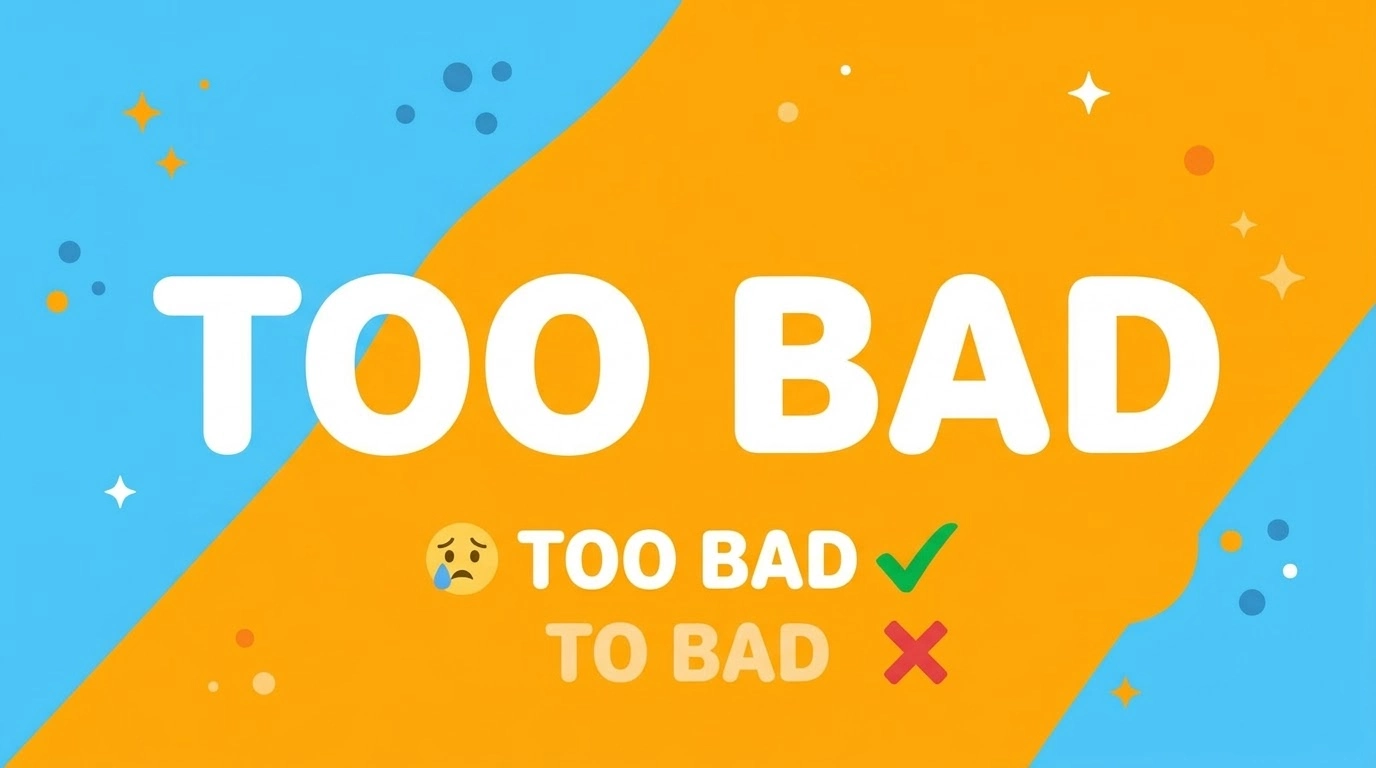
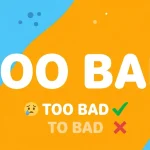
The correct phrase is too bad, with two Os. It means “that is unfortunate,” or sometimes “that is your problem.” To bad is only right when “to” is a separate word, as in “from good to bad.”
Last spring I helped a friend fix a message to her customers. She runs a small online shop. Her email said, “It is to bad your order is late.”
I read it twice. The mistake was tiny, but the tone felt cold. Her customers were already upset. A typo made her sorry note look careless.
She asked me, “Which one is right? They sound the same.”
She was right to ask. Too and to sound exactly alike. Your ear cannot help you here. Only your eye can.
That is why so many people search for too bad or to bad. One missing letter can change how a message feels. In a text, an email, or a school essay, it matters.
This guide gives you the answer in seconds. You will learn what the phrase means and why the spelling gets mixed up. You will also get a simple test and cheat sheets to save. Let’s start with the short answer.
Too Bad or To Bad Quick Answer
Too bad is a set phrase. It has two common jobs.
First, it shows sympathy. You feel sorry about something. Second, it shows that you do not plan to help. That use sounds dismissive.
Here are two quick examples:
- Too bad you missed the concert. It was great. (sympathy)
- “I need more time.” “Too bad. The deadline is today.” (dismissive)
The word too adds the idea of “unfortunate” to the word bad. The word to cannot do that job.
The Origin of Too Bad and Why To Gets Mixed Up
Here is a fun fact. Too and to were once the same word.
Etymonline explains that “too” began as an early Modern English variant of “to.” Writers used it when the word was stressed. In Old English, “to” already meant “in addition.” The sense of “more than enough” appeared around 1300.
The double O became the normal spelling in the 16th century. It helped readers spot the stressed, extra meaning.
The phrase too bad is old too. Dictionary.com lists its origin in the late 1500s. It has meant “unfortunate” for a very long time.
So the confusion has a root. Two words that began as one still sound the same today. Your brain hears the same sound and picks the shorter spelling.
Too Bad or To Bad Explained: Key Differences
Read this table once. It shows every form you may meet.
| Term | Meaning | When to Use | Region or Context |
|---|---|---|---|
| Too bad | Unfortunate, or “that is your problem” | To show sympathy or to brush something off | All English |
| Not too bad | Fairly good, or okay | For a casual, mild reply | All English, informal |
| Too bad about | A sorry note about one thing | To share sympathy for an event | All English |
| Too bad that | A sorry note with a full idea | When you explain what went wrong | All English |
| To bad | “To” plus “bad” as two words | Only when “to” has its own job, like “from good to bad” | All English |
| Two bad | A number plus bad | When you mean the number two, like “two bad habits” | All English |
Two meanings of too bad
Merriam Webster lists two senses. The first shows that you are sorry. The second is ironic. It shows that you are not sorry at all.
Tone decides which one you mean. A warm voice sounds kind. A flat voice sounds cold.
The “not too bad” use
You may also see “not too bad” in daily talk. It means “pretty good.” Dictionary.com marks this casual use as separate. For example: “The soup wasn’t too bad.”
Which Spelling Should You Use?
Use too bad for the phrase. Here is advice by reader.
- For students: Write too bad in essays. Teachers mark to bad as a spelling error.
- For customer service teams: Use “We are sorry that” in sad moments. Too bad alone can sound cold.
- For bloggers and marketers: Check the phrase twice in headlines. A typo looks careless.
- For English learners: Learn “too bad” as a set phrase. Do not split it up.
- For global or neutral use: Too bad is the same in every region.
Common Mistakes with Too Bad or To Bad
Mistake 1: Writing to bad for the phrase
- Wrong: It is to bad you missed the show.
- Right: It is too bad you missed the show.
- Why it happens: Too and to sound the same, and “to” is shorter.
Mistake 2: Writing two bad
- Wrong: That is two bad.
- Right: That is too bad.
- Why it happens: The sound matches, so the wrong spelling slips in.
Mistake 3: Using too bad when you need warmth
- Weak: Too bad about your loss.
- Better: I am so sorry about your loss.
- Why it happens: The phrase is casual. In sad moments, it can sound cold.
Mistake 4: Writing too bad as one word
- Wrong: That is toobad.
- Right: That is too bad.
- Why it happens: Fast typing and chat habits join the words.
Mistake 5: Using it as a joke when it hurts
- Weak: Too bad. Try harder next time.
- Better: That did not go well. Let’s find a better plan.
- Why it happens: The ironic sense sounds fine to the writer. The reader may feel hurt.
Too Bad or To Bad in Real World Examples
A professional email
Hi Sam,
It is too bad you could not join the call. I will send you the notes today.
A news headline
Too Bad the Park Closed Early: Fans React to the Storm
A social media post
The beach was packed, so no swim. Too bad! We got ice cream instead. #weekend
A formal report
The survey shows that the plan was not too bad for a first try.
A correct use of “to bad”
The weather changed from good to bad in an hour.
Too Bad or To Bad: Data, Trends, and Usage
I do not have reliable search numbers for this pair. For exact data, try a free tool like Google Trends.
Here is what we can say safely:
- Search intent: Informational. People want to know which spelling is right.
- Who searches: Students, writers, customer support staff, and English learners.
- When: Often while writing a message, when one word looks odd.
- Why it matters now: We type fast in chats and emails. Sound alike words slip in more often.
Cheat Sheets for Too Bad or To Bad
Save these. Print them. Share them.
Cheat Sheet 1: The 5 Second Test
- Can you swap in “so unfortunate”? Use too bad.
- Does “to” go before a verb or a place? Use to.
- Do you mean the number 2? Use two.
- Not sure? Say “that is a pity.” If it fits, write too bad.
Cheat Sheet 2: Memory Tricks
- Too has an extra O. It adds an extra feeling.
- Too also means “very” or “also.” Too bad means very bad luck.
- To is the short one. It points to a place or an action.
Cheat Sheet 3: Spot the Typo
Which line is correct?
- It is to bad you are sick.
- It is too bad you are sick.
- The weather went from good to bad.
- The weather went from good too bad.
Answers: lines 2 and 3 are correct.
Cheat Sheet 4: Kinder Swaps
- Too bad. → I am sorry to hear that.
- Too bad about your loss. → I am so sorry for your loss.
- That is too bad. → That is a real shame.
Too Bad or To Bad Comparison Table
| Term or Variant | Meaning | Region or Context | Best Used When |
|---|---|---|---|
| Too bad | Unfortunate, or “that is your problem” | All English | You feel sorry or want to brush something off |
| Not too bad | Fairly good | Casual speech | You rate something as okay |
| That’s too bad | That is unfortunate | Spoken and written | You react to bad news |
| What a pity | That is a shame | Slightly formal | You want a softer tone |
| To bad | “To” plus “bad” | Grammar only | The words are separate, like “from good to bad” |
Frequently Asked Questions
Q: What does too bad mean?
A: It means “that is unfortunate.” It can also mean “that is your problem,” when said in a flat tone.
Q: Which is correct, too bad or to bad?
A: Too bad is correct for the phrase. To bad is right only when “to” is its own word, like “from good to bad.”
Q: How do you use too bad correctly?
A: Use it alone or with “about” or “that.” For example: “Too bad about the rain” or “It is too bad that you left.”
Q: Is too bad acceptable in formal writing?
A: It is fine in most business writing. For sad news, choose a warmer phrase like “I am sorry to hear that.”
Q: What is the difference between too bad and not too bad?
A: Too bad shows regret. Not too bad means “pretty good.” The word “not” flips the meaning.
Q: Where does too bad come from?
A: Dictionary.com places the phrase in the late 1500s. The word too began as a stressed form of to.
Q: Can too bad sound rude?
A: Yes. If you say it flatly, it can sound like “I do not care.” Add a kind word to soften it.
Conclusion
Let us wrap it up.
Too bad is the correct spelling for the phrase. It shows that you feel sorry, or that you are brushing something off. To bad is only right when the words stand apart, like “from good to bad.”
Remember three takeaways. First, use the swap test with “so unfortunate.” Second, add an extra O when you want extra feeling. Third, pick a warmer phrase when the news is sad.
Now you know exactly how to use too bad. Go try it in your next message or essay. And share this guide with someone who has been confused about it.
Sources: Merriam Webster (too bad), Dictionary.com (too bad), Etymonline (too).
Read More: Latter or Ladder: The Simple Spelling Guide

Hi, I’m Zara. Words that look almost identical but mean different things have always fascinated me, and that is what pulled me into writing about spelling and usage. Every guide gives you the answer first, then explains it clearly enough that you won’t need to look it up again.


1 thought on “Too Bad or To Bad: Pick the Right One Fast”