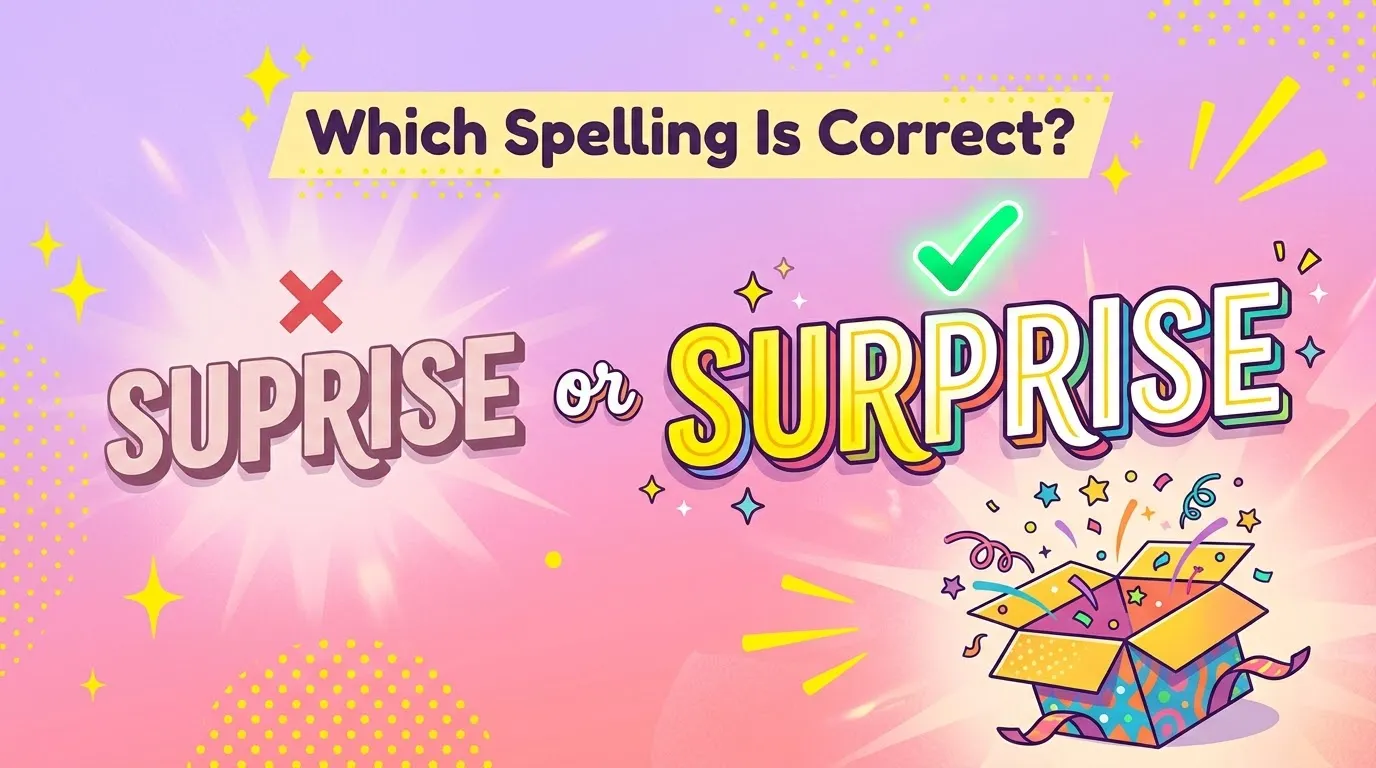
Surprise is the correct spelling. Suprise is a common spelling mistake. The word surprise means an unexpected event, feeling, or action that catches someone off guard.
Have you ever typed a word, looked at it twice, and wondered whether it was spelled correctly? Surprise is one of those words that can make people stop and think. Many writers accidentally leave out the second letter r and write “suprise” instead.
It is an easy mistake to make. When you say the word aloud, the two r letters do not sound very different from one another. This can make the correct spelling harder to remember, especially when you are writing quickly.
The confusion often appears in school assignments, emails, social media posts, and everyday messages. Even people who know the meaning of the word may sometimes spell it incorrectly.
So, is it suprise or surprise? The answer is simple. Surprise is always the correct standard spelling. Let’s look at its meaning, history, pronunciation, and practical examples so you can remember it with confidence.
Suprise or Surprise: The Quick Answer
The correct spelling is surprise, with two r letters.
The spelling “suprise” is incorrect in standard English. It is not an accepted alternative in British or American English.
Here is an easy way to remember:
- Surprise: Correct spelling.
- Suprise: Incorrect spelling.
- Surprised: Correct past tense.
- Surprising: Correct adjective or present participle.
- Surprisingly: Correct adverb.
For example:
- Correct: I have a surprise for you.
- Incorrect: I have a suprise for you.
Remember that the word needs an r after the first u and another r after the p.
Why Is Surprise Spelled With Two Rs?
The word surprise has an interesting history. It came into English through the Old French word surprise, which was related to surprendre, meaning to overtake or catch unexpectedly.
Over time, the word became part of everyday English. Its meaning developed around unexpected events, feelings, and actions.
The two r letters are part of its established spelling. They are not optional, and removing one changes the word into an incorrect form.
This is why writing “suprise” may look acceptable at first glance but is still a spelling error.
One helpful trick is to connect the spelling with its word family. Notice how the same spelling appears in these words:
- Surprise
- Surprised
- Surprising
- Surprisingly
Once you learn the correct spelling of the main word, the other forms become easier to remember.
Surprise Explained: Meaning and Correct Usage
Surprise can work as both a noun and a verb. Its meaning depends on how you use it in a sentence.
1. Surprise as a Noun
As a noun, surprise means something unexpected that causes excitement, happiness, shock, or wonder.
It can describe a planned gift, an unexpected visit, or news that someone did not see coming.
Examples:
- My friends planned a birthday surprise for me.
- The test result came as a surprise.
- We have a special surprise for our parents.
- Her visit was a pleasant surprise.
2. Surprise as a Verb
As a verb, surprise means to make someone feel amazed or shocked because something happens unexpectedly.
Examples:
- I want to surprise my sister with a gift.
- The news surprised everyone in the room.
- His sudden visit surprised his family.
- The final result may surprise you.
3. Surprise as an Adjective in Related Forms
The word also has related forms that describe how something feels or happens.
Examples:
- Surprised: I was surprised by her visit.
- Surprising: It was a surprising result.
- Surprisingly: The team performed surprisingly well.
These forms share the same spelling pattern. Learning them together can help you avoid mistakes.
Suprise vs Surprise: Key Differences
Although both spellings may appear in online searches, only one is correct.
| Term | Meaning | Correct Usage |
| Surprise | An unexpected event or feeling | Correct |
| Suprise | No standard English meaning | Incorrect |
| Surprised | Feeling amazed or shocked | Correct |
| Surprising | Causing unexpected feelings | Correct |
| Surprisingly | In an unexpected way | Correct |
The difference is only one letter, but it matters. Always use surprise in professional, academic, and casual writing.
How to Remember the Correct Spelling of Surprise
If you often forget how to spell surprise, try these simple tricks.
1. Remember the double R
The easiest trick is to remember that surprise contains two r letters.
Break it into smaller parts:
SUR + PRISE = SURPRISE
This makes the spelling easier to recognize.
2. Learn the word family
Practice these four forms together:
- Surprise
- Surprised
- Surprising
- Surprisingly
They all keep the same spelling pattern.
3. Read the word aloud
Say surprise slowly while looking at its spelling. Reading and writing the word together can help you remember its correct form.
4. Write it in a sentence
Try writing one sentence every day.
For example: “I have a surprise waiting for you.”
Using a word in context is often more helpful than memorizing its letters alone.
Common Spelling Mistakes With Surprise
Some mistakes happen because people write words as they hear them. Others happen when they type too quickly.
Here are a few errors to watch for:
| Incorrect Spelling | Correct Spelling |
| Suprise | Surprise |
| Suprised | Surprised |
| Suprising | Surprising |
| Suprisingly | Surprisingly |
| Suprize | Surprise |
A common mistake is replacing the final s sound with a z. Although the word may sound similar when spoken, its standard spelling uses s.
Always check the spelling before using it in an important message or document.
Surprise in Real World Examples
Seeing the word in different situations can help you understand how to use it naturally.
1. In a professional email
“Thank you for organizing the event. The announcement was a pleasant surprise.”
This sounds polite and professional.
2. In a news headline
“Local Students Surprise Their Teacher With a Special Celebration”
Here, surprise is used as a verb.
3. In a social media post
“Life is full of surprises. You never know what tomorrow will bring!”
Here, surprises is the plural noun.
4. In an academic assignment
“The unexpected increase in sales came as a surprise to the management team.”
This example shows how the word can fit into formal writing.
Surprise: Quick Usage Cheat Sheet
Keep this simple guide in mind whenever you are unsure about the word.
| Your Intended Meaning | Word to Use | Example |
| An unexpected event | Surprise | What a lovely surprise! |
| Making someone amazed | Surprise | I will surprise her. |
| Feeling amazed | Surprised | He looked surprised. |
| Causing amazement | Surprising | It was a surprising result. |
| In an unexpected way | Surprisingly | She was surprisingly calm. |
Golden rule: Always write surprise with two r letters. Never use suprise in standard English.
Frequently Asked Questions
Q1. Is it suprise or surprise?
Surprise is the correct spelling. Suprise is a misspelling because it leaves out one r.
Q2. Why do people spell surprise incorrectly?
Many people write words based on how they sound. Since the two r letters are not easy to notice in pronunciation, writers sometimes leave one out.
Q3. Is surprise British or American English?
Surprise is correct in both British and American English. There is no regional spelling difference.
Q4. What is the plural of surprise?
The plural is surprises. For example, “Birthdays often bring wonderful surprises.”
Q5. Is surprised spelled with two Rs?
Yes. Surprised contains the same two r letters as surprise. For example, “I was surprised by the announcement.”
Q6. Is surprise a noun or a verb?
Surprise can be both. As a noun, it describes an unexpected event. As a verb, it means to make someone feel amazed or shocked.
Q7. How can I remember the spelling of surprise?
Remember the two r letters in surprise. You can also practice related words such as surprised, surprising, and surprisingly.
Conclusion
The correct spelling is surprise, not suprise. Although the difference looks small, that missing r makes the second version incorrect.
Remember these key points:
- Surprise is the correct standard spelling.
- Suprise is a common spelling mistake.
- Surprise can work as both a noun and a verb.
- Surprised, surprising, and surprisingly follow the same spelling pattern.
- Both British and American English use surprise.
You do not need a complicated spelling rule to remember this word. Just keep the two r letters in mind whenever you write it.
Now you know exactly which spelling to use. Try writing a few sentences with surprise today, and bookmark this guide so you never second guess its spelling again.
Read More: Too Bad or To Bad: Pick the Right One Fast

My name is Ayesha Sadiqah, the writer behind this website. I write in-depth articles on English spelling, word comparisons, grammar, and vocabulary to help learners make better language choices. Every guide is designed to provide accurate, practical, and easy-to-understand information.






1 thought on “Suprise or Surprise: Which Spelling Is Correct?”