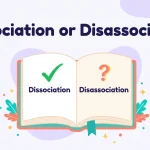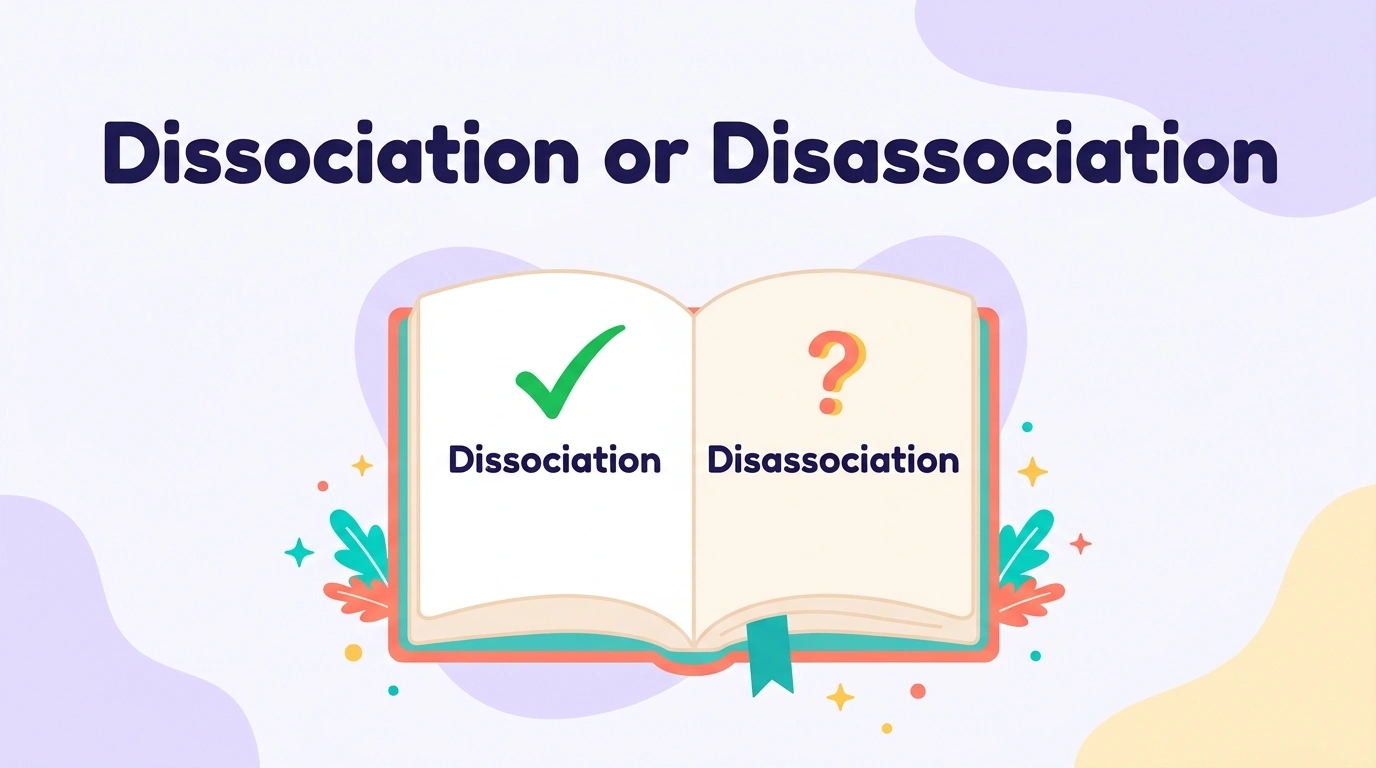
Dissociation means separation, and it is the standard form of the word. Disassociation means the same thing, but it is the less common variant.
I still remember the first time this pair stopped me mid edit. A writer had used both words in one paragraph. Each one looked right. Then both looked wrong.
If that sounds familiar, you are not alone. The two words look almost the same. They sound almost the same. Many readers think one of them must be a typo.
Here is the surprise. Both words have lived in English for about 500 years. Dictionaries list them together. Yet one is clearly the safer choice, and in some fields it is the only choice.
This matters more than it seems. Dissociation is also a real term in psychology and chemistry. A wrong word in those fields can look careless or confusing.
In this guide, you will learn what each word means. You will see where they come from. A cheat sheet, clear examples, and simple rules will follow.
Let’s start with the short version.
Dissociation or Disassociation: Quick Answer
Dissociation is the act of separating, or the state of being separated. Disassociation is a variant with the same meaning. Merriam Webster even defines disassociation as dissociation.
Both can describe pulling away from a person, group, or idea. Dissociation is the one used in psychology, chemistry, and biology.
Examples:
- The company issued a statement of dissociation from the comments.
- Doctors describe dissociation as feeling cut off from your thoughts or surroundings.
Cheat Sheet
- Writing about mental health? Use dissociation.
- Writing about chemistry or science? Use dissociation.
- Writing a formal report? Use dissociation.
- Writing casually and you want to match your reader? Either works, but dissociation is safer.
- Memory trick: The correct form has no extra “as.” Say it as dis plus sociation.
The Origin of Dissociation and Disassociation
Both words grow from Latin. The root is sociare. It means “to join.” It comes from socius, which means “companion.” Add the prefix dis, which means “apart,” and you get a word for coming apart.
Dissociate comes straight from the Latin word dissociare. That makes it the older, cleaner path.
Disassociate took another road. Language writers note that it was modeled on a 16th century French word, désassocier. It added an extra “as” and stayed in English.
Dictionaries give slightly different first dates. Merriam Webster dates dissociation to 1597 and dissociate to 1548. A writer on English usage cites 1603 for disassociate and the early 1600s for other forms. The safe takeaway is that all of these words are about 400 to 500 years old.
So why the confusion? The prefix “dis” already means “apart.” The prefix “as” in disassociate can look like a double step. Some people call it illogical for that reason.
Dissociation and Disassociation Explained
Here is how the two words and their forms line up.
| Term | Meaning | When to Use | Context |
| Dissociation | The act or state of separating | Science, medicine, formal writing | Standard everywhere |
| Disassociation | Same meaning as dissociation | Casual or older style writing | Accepted variant, less common |
| Dissociate | To separate from something | Formal writing and speech | Preferred verb |
| Disassociate | Same meaning as dissociate | When you match a source | Accepted variant, often criticized |
| Dissociative | Relating to dissociation | Psychology and medicine | Clinical term |
The Psychology Meaning
In psychology, dissociation means a break in mental processes that normally work together. These can include thoughts, memory, perception, or sense of identity. Merriam Webster describes it as the separation of parts of the mind from the mainstream of consciousness.
Most people have felt a mild form of this. Zoning out while driving is one example. Daydreaming is another.
Some people have stronger or longer lasting dissociation. The DSM names conditions such as dissociative identity disorder, dissociative amnesia, and depersonalization or derealization disorder. If this sounds like you or someone you know, a mental health professional can help. This article explains the language only. It is not medical advice.
The Chemistry and Biology Meaning
In chemistry, dissociation means a compound breaking into simpler parts. Heat or a liquid can cause it. In biology, it can describe some bacteria splitting into distinct strains.
The Everyday Meaning
In daily life, to dissociate yourself from something means to separate or distance yourself from it. A person might dissociate from a group, an opinion, or a decision.
Which Version Should You Use?
Here is the clear advice.
- For students and teachers: use dissociation. It is the form most textbooks and exams expect.
- For writers and editors: use dissociation. Fowler’s calls disassociate “a common but now widely condemned variant.” Garner’s calls it a “needless variant.”
- For health and science writers: use dissociation and dissociative. These are the clinical terms.
- For global or neutral use: use dissociation. It is shorter by two letters, and Merriam Webster says dissociate is used more often.
- If you are quoting someone: keep their exact spelling.
You will not be wrong to see disassociation in a dictionary. But if you want to avoid doubt, choose the shorter word.
Common Mistakes with Dissociation
1. Writing “disassociation disorder.” Wrong: She has a disassociation disorder. Better: She has a dissociative disorder. Why it happens: People mix the noun with the adjective. The medical adjective is dissociative.
2. Using disassociation in clinical writing. Wrong: The patient reported disassociation after the event. Better: The patient reported dissociation after the event. Why it happens: People hear both words and choose the longer one by habit. Clinical writing uses the shorter form.
3. Saying “dissociate with.” Wrong: He chose to dissociate with the group. Better: He chose to dissociate from the group. Why it happens: Many people say “associate with,” so they copy the pattern. Dissociate pairs with “from.”
4. Using both spellings in one piece. Wrong: The memo mentioned dissociation, then disassociation. Better: Pick one form and keep it. Why it happens: Writers think the words differ in meaning. In dictionaries, they do not.
5. Treating dissociation as only a mental health word. Wrong: The article used dissociation only for trauma. Better: Remember it also has chemistry and biology meanings. Why it happens: Mental health news uses the word more often than other fields.
Dissociation in Real World Examples
A professional email: “I want to make clear that our team seeks dissociation from the earlier proposal.”
A news headline: “Mayor Announces Dissociation From Controversial Fundraiser”
A social media post: “Zoning out in a meeting is a mild kind of dissociation. It is common. Persistent episodes are worth talking to a professional about.”
A formal report: “The dissociation of the compound occurred when the solution reached a high temperature.”
Dissociation: Usage and Trends
This is an informational topic. Readers want to know which word is correct and what it means.
Most people meet the word in three places. Mental health articles come first. School science lessons come second. Statements about distancing from a person or idea come third.
I will not quote search numbers here. They change often, and I do not want to give you a number I cannot check. You can see your own audience in Google Search Console.
One insight stands out. People talk about mental health more openly now. That makes the exact word matter more. Dissociation is a precise term, and readers notice when it is misspelled.
Dissociation vs Disassociation: Comparison Table
| Term or Variant | Meaning | Context | Best Used When |
| Dissociation | Separation, or a break between connected things | Science, medicine, formal writing, daily life | You want the standard form |
| Disassociation | Same meaning as dissociation | Dictionaries list it as a variant | You are quoting or matching a source |
| Dissociative | Describes things related to dissociation | Psychology and medicine | You name a condition or symptom |
Frequently Asked Questions
Q: What does dissociation mean? A: Dissociation means separation. In psychology, it means a break between thoughts, memory, perception, or identity. Chemists use it for a compound breaking into simpler parts.
Q: How do you use dissociation correctly? A: Use it as a noun. For example: “The study measured dissociation.” Use the verb dissociate with “from,” as in “dissociate yourself from the claim.”
Q: What is the difference between dissociation and disassociation? A: Dictionaries treat them as the same word. Dissociation is shorter and more common. Disassociation is a variant that some usage guides criticize.
Q: Is disassociation acceptable in formal writing? A: It appears in dictionaries, but formal writers choose dissociation. Some style guides call disassociate unnecessary. Dissociation is the safer pick.
Q: Which is correct for mental health writing, dissociation or disassociation? A: Use dissociation. The medical terms are built on it, such as dissociative identity disorder and dissociative amnesia.
Q: Where does dissociation come from? A: It comes from Latin. The prefix dis means “apart.” Sociare means “to join.” The word entered English in the 1500s or 1600s, depending on the source.
Q: Can dissociation be used in chemistry? A: Yes. Chemists use dissociation when a compound breaks into simpler parts, such as when it dissolves or is heated.
Conclusion
Here are the key points to remember.
First, dissociation and disassociation mean the same thing. Second, dissociation is shorter and more common. Third, medical and scientific writing use dissociation and dissociative. Fourth, “dissociate from” is the natural phrase.
My recommendation is simple. Use dissociation unless you are quoting someone. It is clear, correct, and accepted everywhere. You will never have to second guess it.
If you write about mental health, take extra care. Readers trust writers who use the right word. A small spelling choice can show them you did your homework.
And if you ever meet disassociation in the wild, do not panic. It is not a typo, and it is not a different idea. It is simply the longer cousin. Keep your own writing clean, and your readers will notice the care.
Now you know exactly which word to choose. Go try it in your next piece of writing. Bookmark this guide, and share it with someone who has been confused about dissociation.
Read More: Nicked or Knicked: The Real Spelling Answer

I’m Zain. Through Wordiums.com, I write clear, accurate word comparison guides that show the difference between similar words, spellings, and phrases, so readers can choose the right word in seconds.