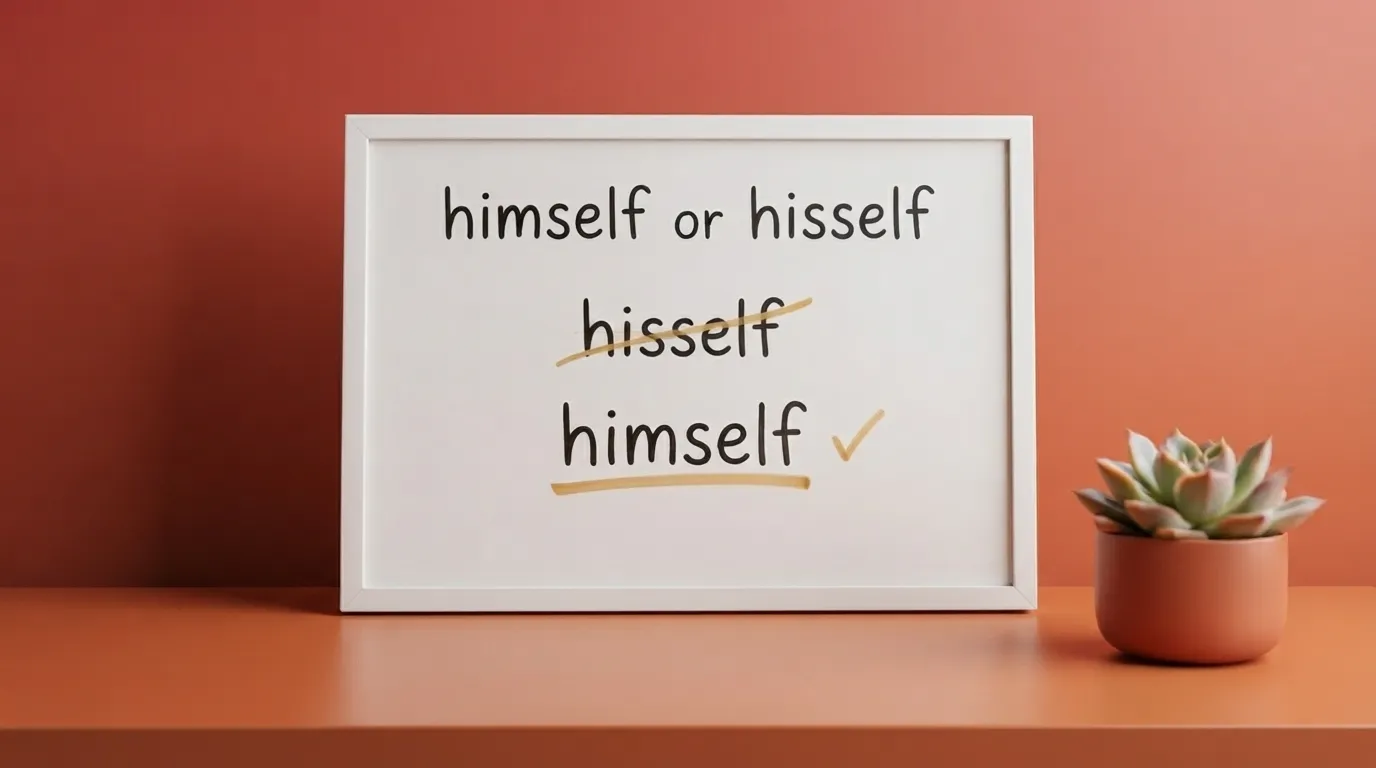
“Himself” is the correct word in standard English. “Hisself” is a dialect word. People say it in casual speech. It is not correct in formal writing.
A Word That Sparks Strong Opinions
I grew up hearing “hisself” a lot. Family members said it all the time. It sounded normal. It felt warm and familiar.
Then I saw it in a school essay. A teacher circled it in red. That moment stuck with me.
A word can sound right in speech. It can still be wrong in writing. This guide explains why. You will learn where “hisself” comes from. You will learn when to use “himself” instead.
Hisself or Himself: Quick Answer
“Himself” is the standard word. Use it in all formal writing.
Example: He taught himself how to play guitar.
“Hisself” shows up in some dialects. You hear it in parts of the American South. You hear it in some UK dialects too.
Example (dialect speech): “He did it hisself.”
Standard English only accepts “himself.”
The Origin of Himself and Hisself
English has a clear pattern for these words. Look at myself, yourself, herself, itself. Each one follows a rule. Take the possessive form. Add “self.”
“Himself” breaks that rule. By the pattern, it should be “hisself.” That would match “herself” exactly.
Old English actually used “hisself” too. Many dialects still use it today. It follows the logical pattern. Standard English just picked “himself” instead. That makes “himself” the accepted exception.
Why Do People Say “Hisself”?
“Hisself” sounds natural because it follows a pattern that exists in several English reflexive pronouns. We say “myself,” “yourself,” and “herself.” Because “his” is the possessive form connected with “he,” some speakers naturally form “hisself” in the same way.
The form has been used in regional varieties of English for a long time. It can still be heard in some American and British dialects today. For people who grow up hearing it, “hisself” may sound completely normal.
That does not make it the standard form, though. Standard English uses “himself” as the reflexive pronoun for “he” and “him.”
For example:
Standard English: He taught himself to cook.
Dialect speech: He taught hisself to cook.
The second sentence can reflect a person’s natural way of speaking. It should not automatically be treated as a random spelling mistake. The important difference is context. Standard writing calls for “himself,” while “hisself” may be appropriate when deliberately representing a particular dialect.
“Hisself” Is Not Always a Simple Typo
When you see “hisself” in writing, it is easy to assume that the writer simply misspelled “himself.” Sometimes that may be true. However, the word can also be an intentional representation of dialect speech.
For example, a novelist might write:
“He fixed the old truck hisself,” she said.
Here, the writer may be using “hisself” to show how the character speaks. Changing it to “himself” could remove part of the character’s regional voice.
The same idea applies to dialogue in films, plays, interviews, and other forms of writing that reproduce spoken language. Writers sometimes preserve nonstandard forms because they help make a character sound realistic.
However, this does not mean you should use “hisself” freely in your own writing. In school assignments, business emails, reports, applications, and other formal contexts, himself is the appropriate choice.
So the difference is not simply “correct word versus meaningless error.” It is better understood as standard English versus a dialect form.
How Is “Himself” Used in a Sentence?
“Himself” has several common uses in standard English. Understanding these uses can make it easier to know when “himself” belongs in a sentence.
As a Reflexive Pronoun
Use “himself” when the person receiving an action is the same person who performs it.
Example: He hurt himself while playing football.
Here, “he” and “himself” refer to the same person.
To Add Emphasis
“Himself” can also emphasize a male person who has already been mentioned.
Example: The manager himself called me.
This means the manager personally made the call, rather than someone else calling on his behalf.
After “By”
Use “himself” after “by” when you mean that someone did something alone or without help.
Example: He completed the entire project by himself.
This tells us that he completed the project without assistance.
After a Noun or Pronoun for Extra Emphasis
“Himself” can appear after a noun or pronoun to add emphasis.
Example: He himself admitted that he was wrong.
In each of these standard uses, himself is the correct form. “Hisself” may appear in dialect speech or intentionally written dialogue, but it is not the standard reflexive pronoun.
Himself vs Hisself: Key Differences and Uses
| Term | Meaning | When to Use | Region/Context |
|---|---|---|---|
| Himself | Standard word | All formal and standard writing | Used everywhere English is spoken |
| Hisself | Dialect word | Casual regional speech only | Common in the southern US and some UK dialects |
Examples:
Himself (standard): He blamed himself for the mistake.
Hisself (dialect): “He blamed hisself for the mistake.”
Himself (standard): She said he needs to believe in himself.
Hisself (wrong in writing): “He needs to believe in hisself.”
Which Version Should You Use?
Use himself for all formal writing. Also use it for business emails. Use it for school papers. There are no exceptions here.
Use hisself only in fiction. It works well in dialogue. It can show a character’s regional voice.
Stick with himself for everyday speech at work or school. It matches what most people expect.
Common Mistakes with Himself and Hisself
Mistake: “He did it all by hisself.”
Fix: “He did it all by himself.”
Why it happens: Dialect speech feels natural. It slips into writing without thought.
Mistake: Thinking “hisself” is just a shortcut.
Fix: See it as its own dialect word. It is not a lazy version of “himself.”
Why it happens: People mix up dialect words with casual shortcuts. They are not the same thing.
Mistake: Using “hisself” in a work email.
Fix: Always use “himself” in professional writing.
Why it happens: Spoken habits can slip into written text without notice.
Mistake: Calling someone’s dialect “wrong” in conversation.
Fix: Dialects follow their own rules. They are valid in their own context. Save “himself” for formal writing only.
Why it happens: People confuse “nonstandard” with “incorrect.” Dialects are simply different, not wrong.
Himself and Hisself in Real World Examples
In a work email:
“He finished the whole project himself. He had no outside help.”
In a news headline:
“Local Hero Rebuilds Community Center Himself After Storm”
In a social media post:
“He taught himself to code from scratch. So inspiring to watch.”
In a novel’s dialogue:
“He done fixed that truck all by hisself,” she said, smiling.
Himself and Hisself: Data, Trends and Usage
People search “hisself or himself” for a few reasons. Some are students. Some are writers. and some just heard the word and got curious.
English learners search this term a lot. Grammar fans do too. It touches both grammar rules and dialect speech.
This is an informational search. People want to learn something. They are not shopping for anything.
It matters today for a good reason. Writers want real dialogue in books and shows. This word choice helps make characters sound true to life.
Himself vs Hisself: Standalone Comparison Table
| Term/Variant | Meaning | Region/Context | Best Used When |
|---|---|---|---|
| Himself | Standard reflexive word | Used everywhere | All formal and everyday writing |
| Hisself | Dialect reflexive word | Southern US and some UK dialects | Writing dialogue in a specific dialect |
Frequently Asked Questions
Q: What does “himself” mean?
A: It means a man did something to or for himself. Example: “He hurt himself.”
Q: Is “hisself” ever correct?
A: Not in standard grammar. It is correct only as a spoken dialect form.
Q: Himself vs hisself, what is the real difference?
A: “Himself” is standard everywhere. “Hisself” is dialect. It does not belong in formal writing.
Q: Can I use “hisself” in formal writing?
A: No. Always use “himself” in formal writing. This rule has no exceptions.
Q: Which one is correct on a job application, “himself” or “hisself”?
A: “Himself” is always correct here.
Q: Where does “hisself” come from?
A: It comes from adding “self” to “his.” This matches how “herself” is built from “her.”
Q: Can writers use “hisself” in fiction?
A: Yes. It works well in dialogue. It helps show a character’s dialect or background.
Final Takeaways
Here is the short version: himself is standard. Hisself is dialect.
Use himself for all formal and professional writing. No exceptions apply.
Seeing “hisself” as a real dialect form, not just an error, helps you understand language better.
Bookmark this guide. Never second guess hisself or himself again. Share it with anyone curious about this grammar quirk.
Read More: Leary or Leery: The Correct Spelling Explained

I’m Zain. Through Wordiums.com, I write clear, accurate word comparison guides that show the difference between similar words, spellings, and phrases, so readers can choose the right word in seconds.