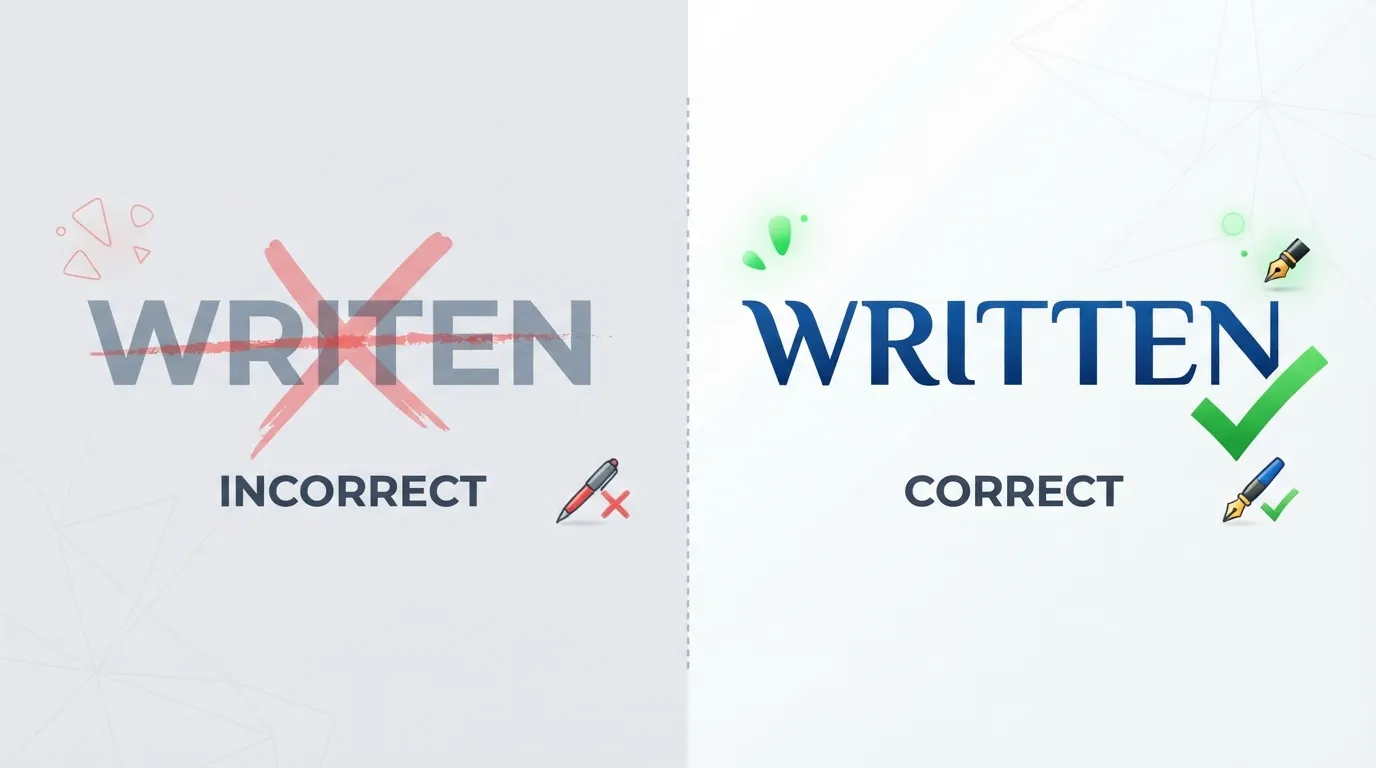
Written is the only correct spelling. Writen is a common misspelling that drops a required letter t and should never appear in formal or casual writing.
I remember typing a college assignment late at night and writing “This essay was writen by hand.” Spell check flagged it instantly. I stared at it for a second, confused, because it looked fine to my tired eyes at the time.
That single missing letter changes everything. Writen is not a real word in standard English, yet people type it constantly, especially when they are rushing, typing on a phone, or working past a deadline with tired eyes.
This guide clears up the confusion for good. You will learn why written is correct, why writen keeps showing up anyway, how the two letter t pattern works, and how to make sure you never make this mistake again, even under pressure.
Spelling mistakes like this one might seem minor, but they carry weight. A misspelled word can quietly undercut an otherwise strong piece of writing, whether it appears in a school essay, a business proposal, or a simple text message to a friend.
Writen or Written: Quick Answer
Written is the correct spelling. It is the past participle of the verb “write,” used in sentences like “The report was written yesterday” or “This letter has been written with great care.”
Writen is simply a misspelling. It has no accepted meaning in English and will not appear in any dictionary, style guide, or reputable publication.
The rule is simple and easy to remember: written always uses a double t. If you only see one t, the spelling is wrong, no matter the context or the platform you are typing on.
The Origin of Written
Written comes from the Old English word writan, meaning to score, draw, or inscribe letters onto a surface. Long before paper was common, this word described the physical act of carving symbols into wood, stone, or wax tablets.
Over centuries, the verb evolved through Middle English into the modern form “write,” with “written” serving as its past participle. This transformation followed the natural sound shifts and spelling patterns that shaped much of modern English.
The double t appears because of a spelling pattern common in English past participles, where a short vowel sound before a final consonant often triggers a doubled letter. You can see similar patterns in words like “hitting,” “sitting,” and “fitting,” where doubling the final consonant before adding an ending is standard practice.
Writen never had a historical basis or an older accepted form. It is purely a modern typing error, not an older or regional spelling variant like some other word pairs in English. There is no dialect, historical text, or dictionary edition where writen appears as a legitimate spelling.
Written Explained: Why the Confusion Happens
| Term | Status | Meaning | Example |
| Written | Correct spelling | Past participle of write | The letter was written last week. |
| Writen | Incorrect spelling | No accepted meaning | Not a valid word |
Most people drop the second t out of habit, not confusion about meaning. English has plenty of words where doubling a consonant feels optional, such as “traveled” versus “travelled,” which varies between American and British spelling. That pattern leaks into words where doubling is actually required in every version of English.
Autocorrect usually catches this error, which is part of why it still slips through in fast typing environments like text messages, comment sections, and social media posts, where autocorrect sometimes lags, gets disabled, or simply gets ignored by the writer in a hurry.
Another factor is visual similarity. The word “writen” still looks close enough to “written” that the eye can skim right past it, especially during a quick proofreading pass where the brain fills in missing letters automatically.
Which Version Should You Use?
In every context, written is the only acceptable choice. This is not a regional spelling difference like color and colour, or like realize and realise. There is no version of English, American, British, Australian, Canadian, or otherwise, where writen is considered correct.
For students, always double check essays, assignments, and research papers for this specific typo, since it appears often in rushed writing done late at night or right before a deadline.
For professionals, proofread emails, reports, and presentations carefully, since writen can undercut credibility even in an otherwise strong and well researched document.
Then For content creators, run a final spell check pass before publishing any article, caption, or headline, since this particular error is easy to miss visually, even for experienced editors.
And For non native English speakers, it can help to remember that written pairs with helping verbs like has, have, was, or were, which gives you a second chance to catch the spelling while reading the full sentence aloud.
Common Mistakes with Written
Mistake 1: Typing “writen” instead of “written” in fast typing situations, particularly on mobile keyboards where autocorrect suggestions sometimes get dismissed by accident. Why it happens: the fingers move faster than proofreading catches, especially when typing under time pressure.
Mistake 2: Confusing “written” with “wrote” in sentence structure, such as saying “I have wrote the report” instead of “I have written the report.” Why it happens: writers forget that “written” pairs with helping verbs like has, have, or was, while “wrote” stands completely on its own without any helper.
Mistake 3: Using “writting” with an extra letter, another incorrect variant that adds a t in the wrong place entirely. Why it happens: writers overcorrect after learning that written needs a double letter somewhere, but place it incorrectly within the word.
Mistake 4: Dropping the second t only in headings or titles, while spelling it correctly everywhere else in the body text. Why it happens: headings often get less careful proofreading attention than full paragraphs, since writers focus more energy on the main content.
Mistake 5: Assuming writen is a valid informal or texting spelling, similar to how some words get shortened casually online. Why it happens: many informal words drop letters casually in texting culture, so people mistakenly assume this same pattern applies here, even though it does not.
Mistake 6: Writing “writen” in a resume, cover letter, or job application, which can create an unintended negative impression on a hiring manager. Why it happens: applicants often rush through final documents without a careful proofreading pass, especially close to a submission deadline.
Written in Real World Examples
In a professional email: “Please find the written summary attached to this message for your review.”
In a news headline: “New Policy Written to Address Housing Shortage in Major Cities”
Then In a social media post: “This is the best written thread I have read all week, honestly.”
Also In a formal document: “All terms must be written and signed before the agreement takes effect.”
And In a school assignment: “The essay was written over three days and revised twice before submission.”
Every correct example uses the double t spelling without exception. None of these contexts, casual or formal, would ever accept writen as a substitute, no matter how quickly the piece was written.
Written Across Different Tenses
Understanding written gets easier once you see it alongside the other forms of the verb write. English verbs often confuse learners because the past tense and the past participle look different, and write is a perfect example of this pattern.
Present tense: I write a letter every week. Past tense: I wrote a letter yesterday. Past participle: I have written a letter already.
Notice that “wrote” never needs a helping verb, while “written” almost always does. This single distinction solves a huge portion of the confusion people have, not just between writen and written, but between written and wrote as well.
Once you memorize this three part pattern, write, wrote, written, the spelling of written becomes far easier to recall, since it locks into place as part of a familiar sequence rather than standing alone as an isolated word to memorize.
Written: Data, Trends and Usage
Search interest for “writen or written” comes mostly from students, non native English speakers, and people typing quickly on mobile devices who want a fast confirmation before hitting send. It falls under informational search intent, where the searcher wants a clear answer, not a long grammar lecture.
This search spikes during school terms, when essay writing increases across classrooms, and among people learning English as a second language, since double letter rules are one of the trickier parts of English spelling to memorize.
Content creators and bloggers search this term too, often while proofreading their own drafts before publishing, since a single misspelled common word can distract readers from otherwise strong content.
Getting this right matters for credibility. A misspelled word like writen can distract readers or make a document look unpolished, even when the underlying content and ideas are genuinely strong and well researched.
Standalone Comparison Table
| Term | Meaning | Region or Context | Best Used When |
| Written | Correct past participle of write | All English speaking regions | Every context, formal and informal |
| Writen | Not a real word | None | Never, always a typing error |
Frequently Asked Questions
Q: What does written mean? A: Written is the past participle of the verb write. It describes something that has been put into words on paper or a screen, such as “The book was written in 1990.”
Q: Is writen ever a correct spelling? A: No, writen is never correct in any form of English. It is always a misspelling of written and does not appear in any dictionary or style guide.
Q: Writen vs written, what is the actual difference? A: There is no real difference in meaning, since writen is not a valid word at all. Written is simply the only correct spelling of the two, without exception.
Q: Is written acceptable in formal writing? A: Yes, written is fully acceptable and required in formal writing. It is the standard past participle form used across academic, business, and legal documents everywhere.
Q: Why do people spell it writen instead of written? A: Most people drop the second t out of habit or fast typing, not because they genuinely think writen is a correct or accepted alternative spelling.
Q: Where does the word written come from? A: Written comes from the Old English verb writan, meaning to inscribe or draw letters, which evolved into the modern verb write over several centuries of language change.
Q: Can writen be used casually online or in texting? A: No, even in casual texting, writen remains an error. Informal writing allows plenty of shortcuts, but this particular spelling is simply incorrect, not just casual.
Q: How can I remember the correct spelling of written? A: Remember that written always has two t letters together, right in the middle of the word. If your version only shows one t, the spelling needs correcting immediately.
Conclusion
Written is the only correct spelling, every time, in every context, across every version of English spoken around the world. Writen is simply a typo, not a valid alternative, a regional variant, or an acceptable informal shortcut.
The fix is simple. Always check for the double t before you hit send or publish anything. If autocorrect flags it, trust the correction rather than dismissing it out of habit.
This kind of small detail matters more than it seems at first glance. A single missing letter can make a strong piece of writing look careless, especially in professional, academic, or job related settings where first impressions matter most.
Now you know exactly how to spell written correctly every single time you sit down to write. Bookmark this guide so you never second guess it again, and share it with someone who could use the reminder too.
Read More: Tuff or Tough: The Real Spelling Explained

Hi, I’m Zara. Words that look almost identical but mean different things have always fascinated me, and that is what pulled me into writing about spelling and usage. Every guide gives you the answer first, then explains it clearly enough that you won’t need to look it up again.