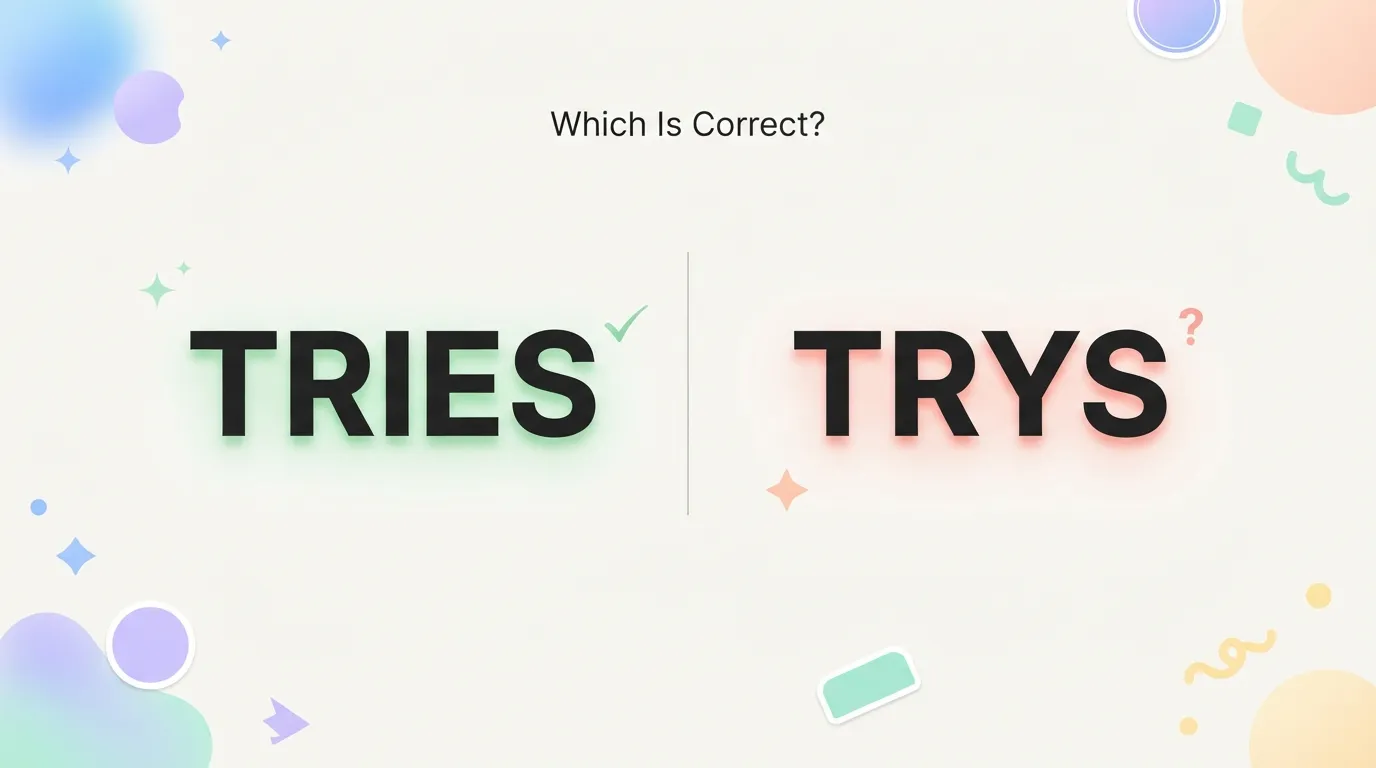
Tries is the only correct spelling. Trys is not a real word in standard English, no matter how natural it looks after typing “try.”
I once watched a coworker type “he trys his best every single day” into a company newsletter draft. Nobody caught it until it was already sent to two hundred employees. She was mortified, since English was her second language and she had followed a rule that works almost everywhere else.
That single letter mistake happens constantly, and it is not really her fault. English spelling rules contradict each other more often than people realize.
If you have ever paused before typing tries or trys, wondering which one looks right, this guide clears it up for good.
You will learn the exact rule behind this spelling, why trys feels so tempting to write, and how to avoid this mistake permanently in your own writing.
Tries or Trys Quick Answer
Tries is the correct present tense form of the verb try when used with he, she, or it. Trys does not exist in any standard dictionary, style guide, or grammar reference.
Example: “She tries her hardest every morning.” Never: “She trys her hardest every morning.”
The confusion almost always comes from one specific spelling rule that most people learn halfway, then misapply.
The Real Reason Trys Feels Right, But Isn’t
Most English speakers learn early on that you add s to make a verb agree with he, she, or it. Play becomes plays. Walk becomes walks. That pattern trains your brain to expect a simple s ending every time.
Try breaks that pattern because it ends in a consonant plus y. When a verb ends in a consonant followed by y, English grammar rules require you to change the y to an i, then add es instead of a plain s.
That single rule explains almost every case people get wrong. Cry becomes cries, not crys. Fly becomes flies, not flys. Apply becomes applies, not applys. Try follows the exact same pattern, becoming tries.
The tempting trys spelling comes from applying the wrong rule, the simple add an s rule, instead of the consonant plus y rule.
Tries or Trys Explained: The Consonant and Y Rule
The rule only applies when a vowel does not appear right before the y. This detail is where a lot of writers get confused, since some similar looking words behave differently.
| Term | Meaning | When to Use | Region or Context |
|---|---|---|---|
| Tries | Correct present tense form of try | Any sentence using he, she, or it with try | Standard English worldwide |
| Trys | Not a valid word | Never | Common misspelling only |
Compare that to words like play, stay, and enjoy. These end in a vowel plus y, so they simply add s with no spelling change at all. Play becomes plays. Stay becomes stays. Enjoy becomes enjoys.
Try does not follow that pattern because the letter right before the y is r, a consonant, not a vowel. That single detail is the entire reason tries exists instead of trys.
Which Version Should You Use?
For everyday writing, always use tries. There is no professional, academic, or casual context where trys is acceptable.
For students learning English, remember the rule works on the letter directly before the y, not the whole word. Check that one letter every time you are unsure.
For non native English speakers, memorize this short list of common exceptions to the simple s rule: tries, cries, flies, applies, denies, replies, and multiplies.
For writers relying on spellcheck, do not assume software will always catch this error, since some fast typing tools and predictive keyboards learn from repeated user mistakes and stop flagging them.
For anyone editing someone else’s writing, treat trys as an automatic correction every time, since there is no context where it becomes acceptable.
Common Mistakes with Tries or Trys
Mistake 1: Writing trys because it looks like a simple add an s pattern. Correction: Remember that consonant plus y words change the y to i before adding es.
Mistake 2: Assuming every y ending word follows the same rule. Correction: Check whether a vowel or a consonant comes right before the y, since that single letter changes everything.
Mistake 3: Trusting autocorrect to catch every instance. Correction: Manually proofread sentences using try, since autocorrect sometimes misses less common misspellings.
Mistake 4: Confusing this rule with plural nouns instead of verb conjugation. Correction: The same consonant plus y rule also applies to plural nouns, such as city becoming cities, so learning it once helps in both situations.
Mistake 5: Applying the exception rule to words that do not need it. Correction: Only apply the y to i change when a consonant sits directly before the y, never after a vowel.
Tries or Trys in Real World Examples
In a professional email: “Our support team always tries to respond within one business day.”
In a news headline: “Local Startup Tries New Approach to Reduce Delivery Delays.”
In a social media post: “She tries something new in the kitchen every single weekend.”
In a formal report: “The department tries several strategies before selecting the most effective option.”
Every example above uses tries correctly, and swapping in trys would immediately look like a typing error to any reader.
Tries or Trys: Data, Trends, and Usage
Search interest for tries or trys comes mostly from students, non native English speakers, and writers double checking spelling before submitting work.
This search sits firmly in the informational category, since almost every searcher wants a fast, clear confirmation rather than a long grammar lesson.
Non native English speakers search this pair more often than native speakers, since the consonant and y spelling rule is rarely taught as clearly as basic pluralization rules.
One trend worth noting is that predictive typing and mobile keyboards have made this mistake more common recently, since fast typing on phones skips the natural pause that once caught small spelling slips.
Standalone Comparison Table
| Term or Variant | Meaning | Region or Context | Best Used When |
|---|---|---|---|
| Tries | Correct present tense of try | Used worldwide in standard English | Any sentence needing he, she, or it form of try |
| Trys | Incorrect spelling | Appears only as a common typing mistake | Never appropriate in any writing |
Frequently Asked Questions
Q: What does tries mean? A: Tries is the present tense form of the verb try, used specifically with he, she, or it. It means attempting to do something.
Q: How do you use tries correctly in a sentence? A: Use tries whenever the subject of your sentence is he, she, it, or a singular noun. Example: “The team tries a new strategy each week.”
Q: Tries vs trys, what is the real difference? A: Tries is the only correct spelling. Trys is not recognized in any dictionary and is always considered a spelling mistake.
Q: Is trys ever acceptable in formal writing? A: No. Trys should never appear in formal, academic, or professional writing under any circumstance.
Q: Which version is correct, tries or trys, for a school essay? A: Tries is correct for every school essay, exam, and academic assignment, without exception.
Q: Where does the tries spelling rule come from? A: It comes from a long standing English spelling pattern that changes a consonant plus y ending to ies before adding an es sound, seen in words like cries, flies, and applies.
Q: Can trys be considered a regional or informal spelling variant? A: No. Unlike words with genuine regional spelling differences, trys is not a recognized variant anywhere. It is simply an incorrect spelling.
Final Thoughts
Tries is the only correct spelling, and trys should never appear in your writing, regardless of context, region, or platform.
Remember the key takeaway. Words ending in a consonant plus y, like try, change that y to an i before adding es. Vowel plus y words, like play, simply add an s with no change at all.
Once you lock in that one small rule, this mistake disappears permanently from your writing.
Bookmark this guide so you never second guess tries or trys again, and share it with anyone who could use a quick, permanent fix.
See More: Realized or Realised: The Complete Spelling Guide

Hey, I’m Ayeza. I started this site because I kept hitting the same wall over and over: typing a word, freezing, and not trusting my own instinct on the spelling. Now I research these mix-ups properly so you don’t have to, and I write every guide the way I wish these explanations had been written for me.