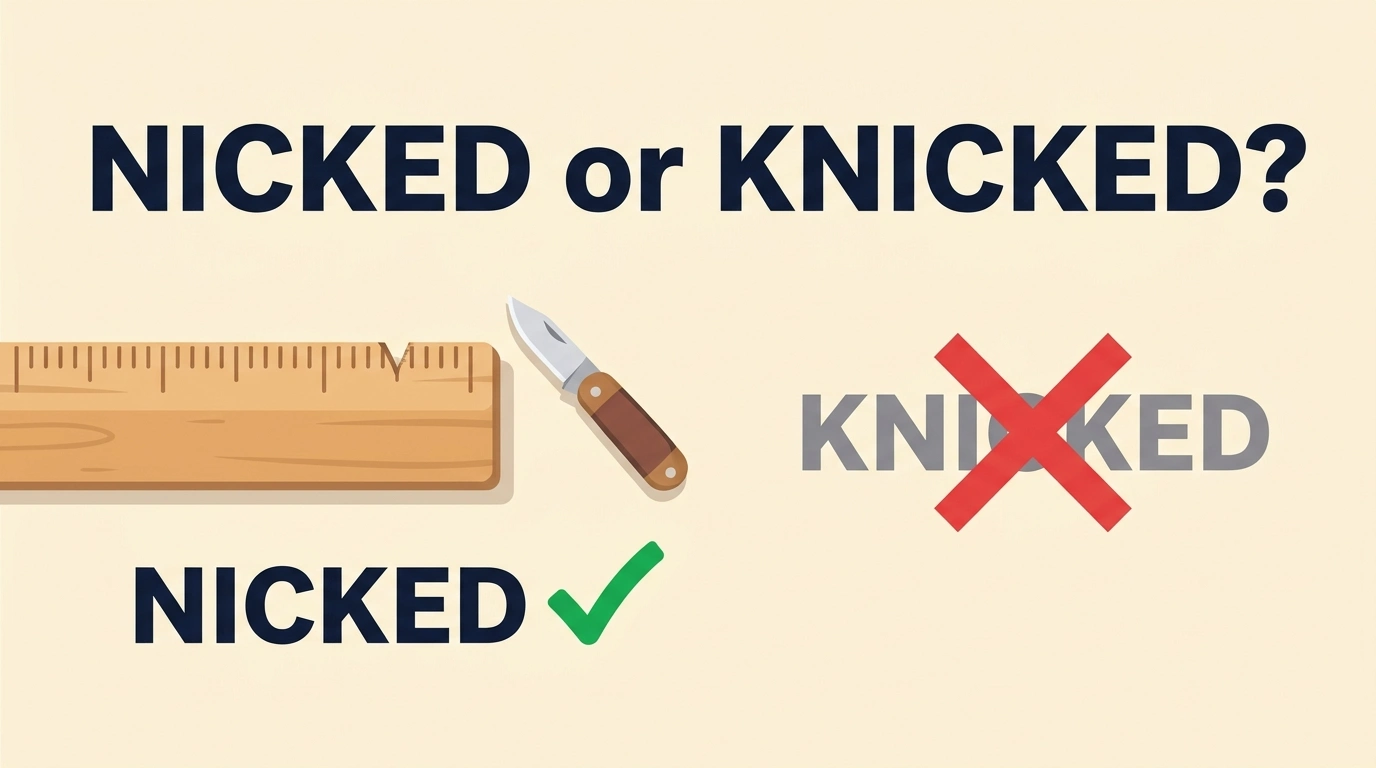
Nicked is the correct spelling. It is the past tense of nick, which means to cut a tiny notch, or in British slang, to steal or arrest. Knicked is not a standard English word.
A few years ago, I edited a crime story for a small local paper. One line said, “Police knicked two men at the station.” I stopped. Was it a typo? Was it local style?
I checked three dictionaries. Only one spelling showed up. The extra k was simply wrong.
Many people search this word for the same reason. It sounds like it should have a silent k. English has plenty of them. Think of knife, knee, knock, and knit. So your brain adds one.
This guide clears it up fast. You will learn what nicked means, where it comes from, and why knicked looks tempting. You will also see common mistakes and get a cheat sheet to save. Let us start with the short version.
Nicked or Knicked: Quick Answer
Nicked is the only standard spelling. It comes from the verb nick. The verb has a few meanings, and all of them start with n.
Here are the main ones:
- To cut a small notch or chip in something.
- To wound someone slightly, as in a shaving cut.
- British slang: to steal.
- British slang: to arrest.
Two quick examples:
- He nicked his chin while shaving.
- Someone nicked my bike from the station.
If you want zero risk, write nicked.
The Origin of Nicked and Why Knicked Looks Right
The word nick is old. It appears in English in the 1400s, meaning a notch or small groove. Etymonline says its origin is unknown. Merriam Webster says it was probably an alteration of the older word nock. Either way, it has always started with n.
The verb came next. By the 1520s people used it for cutting a notch. The slang sense of steal is recorded from 1869. The slang sense of arrest is older, from the 1620s. Etymonline says the link between the two is unclear.
Then there is the phrase in the nick of time. It dates to the 1640s. Some people think it comes from tally sticks, where notches counted time. Treat that as a theory, not a fact.
So why does knicked look right? Three reasons:
- English has many silent k words, such as knife and knee.
- Real words like knickers and knickknack do start with kn.
- The New York Knicks keep the spelling in front of us.
None of those words are related to nick. Each has its own history.
Nicked vs Knicked Explained: Key Differences
One verb, a few look alikes.
| Term | Meaning | When to Use | Region or Context |
| Nicked | Cut a small notch, or hit lightly | Everyday and formal writing | Worldwide |
| Nicked | British slang: stole | Casual speech and informal writing | UK |
| Nicked | British slang: arrested | News and crime writing | UK |
| Knicked | Not a standard spelling | Avoid it | Occasional error |
| Knickers | Underwear in British English | Only when you mean clothing | UK and elsewhere |
| Knicks | Short name for the New York basketball team | Proper noun only | US |
A quick note on sound. Nicked is said the same way every time: nikt. The k sound is already there. A silent k would add nothing.
Nicked (Standard Spelling)
Use it for every meaning of the verb. The forms are nick, nicks, nicked, and nicking.
Knicked (Not Standard)
You may spot it in casual posts and old forum threads. Dictionaries do not list it. Editors will change it.
Which Spelling Should You Use?
Here is the direct advice. Pick the group that sounds like you.
For Students and Writers
Use nicked. Teachers and spell checkers expect it. For the steal sense, add context so the slang is clear.
For Bloggers and Editors
Use nicked. It is the form people search for, and no major dictionary lists the other. In formal text, swap slang senses for plain words like stole or arrested.
For British Slang and Casual Writing
Use nicked for both steal and arrest. It sounds natural in the UK. Readers elsewhere may not know it, so a short hint helps.
For global or neutral writing, nicked works everywhere, as long as you pick the sense your reader knows.
Common Mistakes with Nicked and Knicked
Let us look at the errors people make most. Each one has a reason.
Adding a Silent K
- Wrong: She knicked her finger on the lid.
- Right: She nicked her finger on the lid.
- Why it happens: Silent k words are common, so the brain adds one.
Writing Knick of Time
- Wrong: We arrived in the knick of time.
- Right: We arrived in the nick of time.
- Why it happens: The phrase is old, and writers guess the spelling by ear.
Dropping the Ending
- Wrong: He nick his hand on the saw yesterday.
- Right: He nicked his hand on the saw yesterday.
- Why it happens: Fast typing hides the ed.
Using Slang in Formal Text
- Wrong: The clerk nicked company funds.
- Right: The clerk stole company funds.
- Why it happens: Writers forget that the steal sense is British slang.
Confusing Nicked with Nixed
- Wrong: The board nicked the plan.
- Right: The board nixed the plan.
- Why it happens: The words sound close. Nixed means vetoed.
Nicked or Knicked in Real World Examples
In a Professional Email
“Hi Sam, the delivery van nicked the corner of our gate. Please send someone to check the damage.”
In a News Headline
“Two Men Nicked After Shed Break In”
In a Social Media Post
“Who nicked my last biscuit? I want answers. #kitchencrime”
In a Formal Report
“The inspector nicked the surface with a blade to test the depth of the coating.”
Notice how the spelling stays the same each time. That is the goal.
Nicked or Knicked: Data, Trends, and Usage
People search this pair for a few clear reasons. Some are unsure about spelling in a school paper or post. Others meet the British slang in a TV show, a novel, or a news story.
The search intent is mostly informational. Readers want a fast answer, a meaning, or a safe example. Few searches have a shopping angle.
Why does this matter now? Streaming shows and online chat spread British slang worldwide. More writers meet the word, and more of them need to spell it right.
Nicked vs Knicked Cheat Sheet
Save this for later.
| Term or Variant | Meaning | Region or Context | Best Used When |
| Nicked | Cut a small notch, or hit lightly | Worldwide | You describe a small cut or chip |
| Nicked | Stole (slang) | UK, casual | You write British style dialogue |
| Nicked | Arrested (slang) | UK, news and crime | You write British crime stories |
| Knicked | Not a standard spelling | Error | Never |
Memory trick: A knife makes a nick, but the knife keeps the k. The nick does not get one.
Three second check:
- Start with n, not kn.
- End with ed for the past tense.
- For formal writing, swap slang for stole or arrested.
FAQ
Q: What does nicked mean? A: Nicked means cut with a tiny notch, or wounded slightly. In British slang it also means stolen or arrested.
Q: How do you use nicked correctly? A: Use it as the past tense of nick. Write “he nicked his thumb” for a small cut. Write “someone nicked my phone” for the slang sense.
Q: Nicked vs knicked: what is the difference? A: There is no difference in meaning, because knicked is not a standard word. Nicked is the spelling dictionaries list. Choose it every time.
Q: Is nicked acceptable in formal writing? A: The notch and small cut senses are fine. The steal and arrest senses are British slang. In formal text, use stole or arrested.
Q: Which version is correct, nicked or knicked? A: Nicked is correct. You may see knicked online, but it is a spelling error.
Q: Where does nicked come from? A: It comes from the verb nick, from the noun nick. The noun dates to the 1400s and its origin is unknown.
Q: Can nicked be used in a news headline? A: Yes, in British style headlines. It is short and punchy. Readers outside the UK may need extra context.
Conclusion
Let us wrap up. Here are the key points to remember:
- Nicked is the standard spelling. Use it.
- Knicked is not a standard word. Skip it.
- The phrase is in the nick of time, never knick.
- In formal writing, replace the slang senses with stole or arrested.
My final advice is simple. When in doubt, write nicked with no k up front. Silent k words like knife and knee are real, but they are not this word. You will look careful and confident, and your readers will trust you.
That crime story taught me something. One extra letter can make a sharp writer look unsure. Now you know the spelling and the story behind it.
Now you know exactly how to spell nicked. Go try it in your next post, email, or story. Better yet, share this guide with someone who has been unsure about nicked or knicked. They will thank you.
Read More: Suprise or Surprise: Which Spelling Is Correct?

I’m Zain. Through Wordiums.com, I write clear, accurate word comparison guides that show the difference between similar words, spellings, and phrases, so readers can choose the right word in seconds.


1 thought on “Nicked or Knicked: The Real Spelling Answer”