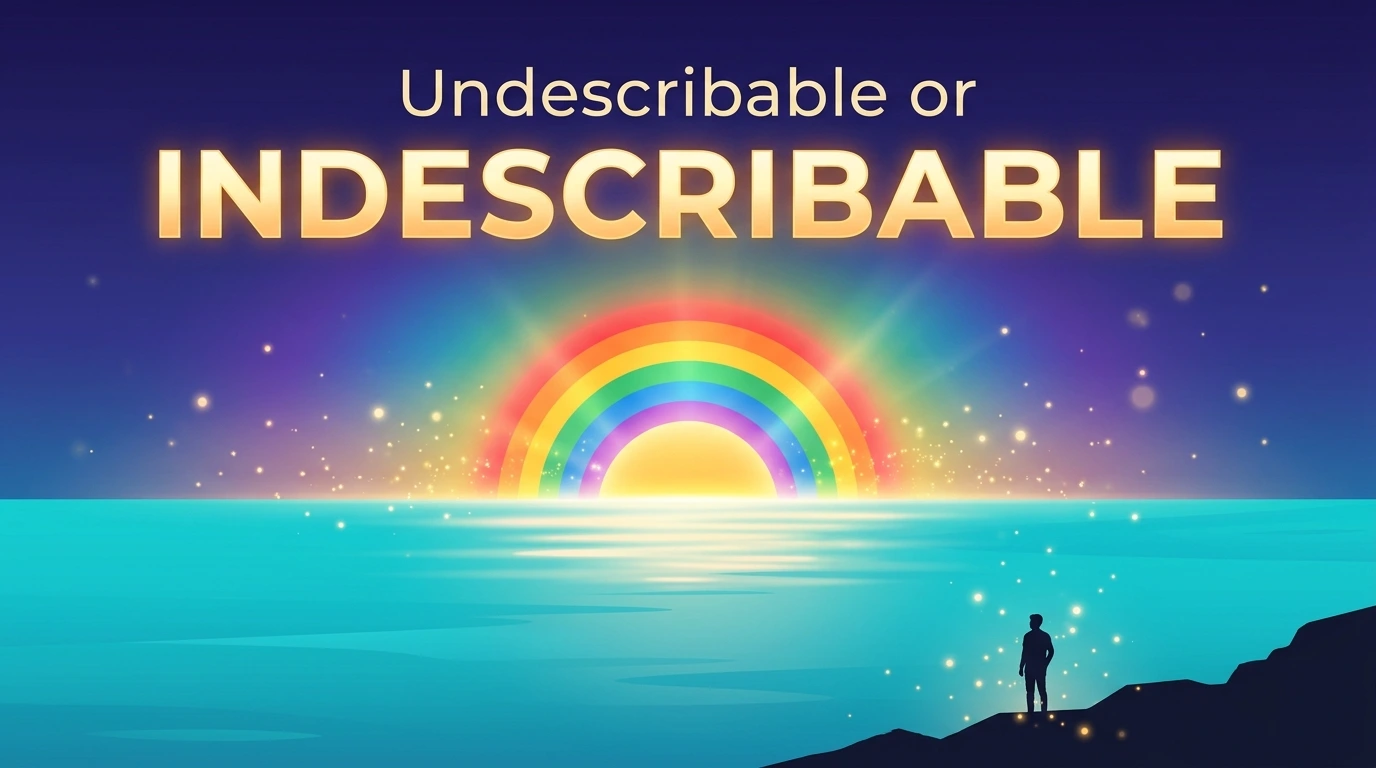
Indescribable means too big, strange, or powerful to put into words. Undescribable means the same, and both are listed in Merriam Webster, but indescribable is the standard choice.
Last year I edited a travel blog for a friend. One line made me stop. It said, “The view from the cliff was undescribable.”
I knew the meaning, yet a tiny doubt crept in. Was that a typo? Or was I about to “fix” a perfectly good word? So I did what any careful editor does and checked three dictionaries.
The answer surprised me. It was not a simple right or wrong.
Maybe you have been there. You are writing a review, an essay, or a social post. A word that means “beyond words” feels right. Then your fingers pause between “un” and “in.” That pause is common, and plenty of careful writers share it.
This guide ends that pause. First, you will see what each word means and where each one comes from. Then you will learn which one to use. Cheat sheets you can copy and keep come along too. Let us start with the short version.
Undescribable or Indescribable Quick Answer
Indescribable is an adjective. It describes something you cannot put into words, such as a feeling, a view, a smell, or a day.
Undescribable has the same meaning. Merriam Webster lists it as an adjective that means “impossible to describe.” It is a real word, but it is the less familiar one.
Here are two simple examples:
- The smell of the old bakery was indescribable.
- After the news, she felt indescribable relief.
For writing that others will read, pick indescribable. It is the standard form and the safer choice.
Where Undescribable and Indescribable Come From
Both words are built from the verb describe. That verb comes from the Latin word describere, which means “to write down” or “to sketch.” It joins de (down) and scribere (to write).
Next, English added the ending able. That made describable, which means “can be described.”
Now we reach the fork in the road. English has two small prefixes that mean “not”:
- in, which came to us through Latin and French
- un, which is the native English prefix
Add in, and you get indescribable. With un, you get undescribable.
Both forms are old. Records show indescribable in use in the 1700s. Merriam Webster also dates undescribable to the 1700s. So one is not a modern slip.
There is even a fun fact. In the early 1800s, people used indescribables as a joking word for trousers. It was colloquial slang in England for a generation or so. The idea was that trousers were too delicate to name.
Why does the confusion exist? We use “un” in many everyday words, such as unbelievable and unspeakable. So “undescribable” feels natural. But we also use “in” in words like incredible and inedible. Both patterns are normal English.
Undescribable or Indescribable Explained: Key Differences
Let us line the two words up. Read this table slowly once.
<table> <thead> <tr><th>Term</th><th>Meaning</th><th>When to Use</th><th>Region or Context</th></tr> </thead> <tbody> <tr><td><strong>Indescribable</strong></td><td>Cannot be described. Beyond words.</td><td>Almost every situation, formal or casual</td><td>General English, and the standard form in dictionaries</td></tr> <tr><td><strong>Undescribable</strong></td><td>Impossible to describe. Same meaning.</td><td>Rare. Fine if you like it, but pick one form and stay with it</td><td>Listed in Merriam Webster; less familiar to readers</td></tr> </tbody> </table>
How to say it
Say indescribable as /ˌɪndɪˈskraɪbəbəl/. The stress falls on the third syllable, “scribe.” Break it into pieces: in, di, SCRIBE, a, ble.
Undescribable follows the same pattern, with “un” at the start. The stress still lands on “scribe.”
Related forms
- Indescribably is the adverb. Example: “The view was indescribably beautiful.”
- Indescribability and indescribableness are noun forms. They are rare.
- Describable is the opposite. It means “can be described.”
Which Word Should You Use?
Let us make this simple. Here is direct advice for different readers.
- For students writing essays: Use indescribable. Teachers and graders expect it.
- For bloggers and content writers: Use indescribable. It reads smoothly and looks right to your readers.
- For English learners: Learn indescribable first. It is the form you will meet most.
- For business and formal writing: Use indescribable, or choose a more precise word such as inexpressible.
- For creative writers: You may use undescribable if you want a slightly unusual feel. Just stay consistent.
- For global or neutral use: Choose indescribable.
A quick rule of thumb: if you are unsure, choose indescribable.
Common Mistakes with Undescribable or Indescribable
Here are five mistakes writers make. Each one has a fix.
Mistake 1: Marking undescribable as a typo
- Wrong: “Undescribable is not a word. Delete it.”
- Right: “Undescribable is a real but rare word. Indescribable is the usual choice.”
- Why it happens: The word looks odd, so editors assume it is an error.
Mistake 2: Mixing both forms in one text
- Wrong: The joy was indescribable, and the view was undescribable.
- Right: The joy was indescribable, and the view was indescribable.
- Why it happens: The writer swaps the forms to avoid repeating a word. It looks like an error to readers.
Mistake 3: Using the adjective as an adverb
- Wrong: The cake tasted indescribable good.
- Right: The cake tasted indescribably good.
- Why it happens: The word before “good” must be an adverb, so it needs the ending “ly.”
Mistake 4: Misspelling describe
- Wrong: indiscribable
- Right: indescribable
- Why it happens: The sound of the word hides the e. Remember that describe has an e after the d.
Mistake 5: Using it as a lazy shortcut
- Weak: The concert was indescribable.
- Better: The concert was indescribable, but the moment the crowd sang along gave me chills.
- Why it happens: The word says that no description exists, then gives none. A small detail helps your reader feel it.
Undescribable or Indescribable in Real World Examples
Seeing a word in use helps it stick. Here are four places you might need it.
A professional email
Subject: Thank you for the event
Hi Dana,
The energy in the room last night was indescribable. Thank you for making it happen. The team is still talking about it.
A news headline
Rescued Hikers Share Indescribable Relief After Night on the Mountain
A social media post
Watched the sun rise over the desert today. The colors were indescribable. No photo can show it.
A formal report
Participants reported emotional responses that were difficult to measure. Many called their experience indescribable, so the researchers added open interview questions.
See how the word works in every setting? It fits casual talk and formal writing alike.
Indescribable in Everyday Phrases
The word pairs with many nouns. Dictionaries give examples such as an indescribable sensation, indescribable joy, and the indescribable immensity of a mountain. In daily writing you will also meet indescribable pain, indescribable beauty, and indescribable relief.
Notice one thing. The word is neutral. It can praise a sunset or describe a painful night. The noun that follows tells the reader which one you mean.
When a More Exact Word Works Better
Indescribable says “I cannot describe it.” Sometimes you can do better. Ask yourself what kind of feeling it is.
- For something too beautiful for words: try breathtaking, stunning, or sublime.
- For something too painful to name: try unbearable or agonizing.
- For something too big to picture: try vast or immense.
- For something too strange to explain: try bizarre or baffling.
A precise word gives your reader a clearer picture. Save indescribable for the rare moments when no other word will do.
Cheat Sheets for Undescribable or Indescribable
Copy these. Print them. Keep them near your desk.
Cheat Sheet 1: The Quick Choice
- Writing for readers or a grade? Use indescribable.
- Not sure? Use indescribable.
- Already used one form? Keep the same form through the whole text.
- Need an adverb? Use indescribably.
Cheat Sheet 2: Memory Tricks
- In plus describable equals indescribable. Think “not describable.”
- Words in the same family use in too: incredible, inedible, and indescribable.
- Remember the sentence: “It is indescribable, so I cannot put it in words.”
- Spelling help: describe has an e after the d.
Cheat Sheet 3: The Swap Test
Swap the word with “beyond words.” If the sentence still makes sense, the word is correct.
- “The pain was beyond words.” So the right word is indescribable.
- “The pain was indescribable.” The sentence stays natural. So the word fits.
Cheat Sheet 4: The Word Family Map
- Describe (verb): to say what something is like.
- Describable (adjective): can be described.
- Indescribable (adjective): cannot be described.
- Indescribably (adverb): in a way that cannot be described.
Cheat Sheet 5: Stronger and Softer Options
If you want other words with the same idea, try these.
- Inexpressible: cannot be put into words, often used for feelings.
- Ineffable: too great to be spoken, often used in a serious or spiritual way.
- Unspeakable: often used for things too terrible to say.
- Unutterable: very formal, used for deep feelings.
- Beyond words: a plain phrase that works in casual writing.
Undescribable or Indescribable: Who Searches and Why
This part is about trends. Here is the honest part: I do not have reliable search numbers for this pair, and they change often. For exact figures, check a free tool such as Google Trends for your country.
Here is what we can say safely:
- Search intent: Informational. People want to know which spelling is correct.
- Who asks: Students, bloggers, English learners, and editors.
- When they ask: Often in the middle of writing, when a word looks slightly odd.
- Why it matters now: More people publish online every day. One doubtful word can make a good post look careless. A quick check builds trust.
Undescribable or Indescribable Comparison Table
Here is one more table. It adds the cousins, so you can see the whole family.
<table> <thead> <tr><th>Term or Variant</th><th>Meaning</th><th>Region or Context</th><th>Best Used When</th></tr> </thead> <tbody> <tr><td><strong>Indescribable</strong></td><td>Cannot be described</td><td>General English</td><td>You want the standard, safe form</td></tr> <tr><td><strong>Undescribable</strong></td><td>Impossible to describe</td><td>Listed in Merriam Webster; less familiar</td><td>You want the rarer form and stay consistent</td></tr> <tr><td><strong>Indescribably</strong></td><td>In a way that cannot be described</td><td>General English</td><td>You need an adverb, as in “indescribably beautiful”</td></tr> <tr><td><strong>Describable</strong></td><td>Able to be described</td><td>General English</td><td>You need the opposite idea</td></tr> <tr><td><strong>Ineffable</strong></td><td>Too great to be put into words</td><td>Formal or spiritual writing</td><td>You want a more serious, elevated tone</td></tr> <tr><td><strong>Inexpressible</strong></td><td>Cannot be expressed</td><td>General and formal English</td><td>You talk about feelings that words cannot carry</td></tr> </tbody> </table>
Frequently Asked Questions
Q: What does indescribable mean?
A: Indescribable means impossible to describe in words. It can be used for good or bad things, such as indescribable joy or indescribable pain.
Q: How do you use indescribable correctly?
A: Use it as an adjective before a noun or after a verb. Example: “The feeling was indescribable.” For an adverb, use indescribably.
Q: Undescribable vs indescribable: what is the difference?
A: There is no difference in meaning. Both mean impossible to describe. Indescribable is the standard form, and undescribable is rarer.
Q: Is undescribable a real word?
A: Yes. Merriam Webster lists it as an adjective that means impossible to describe. Still, most writers choose indescribable.
Q: Which is correct: undescribable or indescribable?
A: Both are listed in dictionaries. For safe and clear writing, use indescribable.
Q: Where does indescribable come from?
A: It joins the prefix in, meaning “not,” with describable. Describe comes from the Latin word describere, which means “to write down.” It was in use by the 1700s.
Q: Is indescribable acceptable in formal writing?
A: Yes. It fits both casual and formal writing. If you want a more precise tone, try inexpressible or ineffable.
Conclusion
Let us pull it together.
Indescribable and undescribable mean the same thing. Both are listed in a major dictionary. But indescribable is the standard form, and it is the one readers expect.
Remember three takeaways. First, choose indescribable when you are unsure. Second, never mix both forms in one text. Third, use indescribably when you need an adverb.
Words that point to the limits of language are powerful. Use them with one small detail, and your reader will feel the moment too.
Now you know exactly how to use undescribable or indescribable. Go try it in your next post or essay. And bookmark this guide so you never second guess the pair again.
Read More: Racoon or Raccoon: The Real Spelling Answer Made Easy

Hey, I’m Ayeza. I started wordiums.com because I kept freezing over words that look almost the same, unsure which one was right. Now I explain every word comparison in plain language, so you can pick the right word with confidence and move on.








1 thought on “Undescribable or Indescribable: The Real Answer”