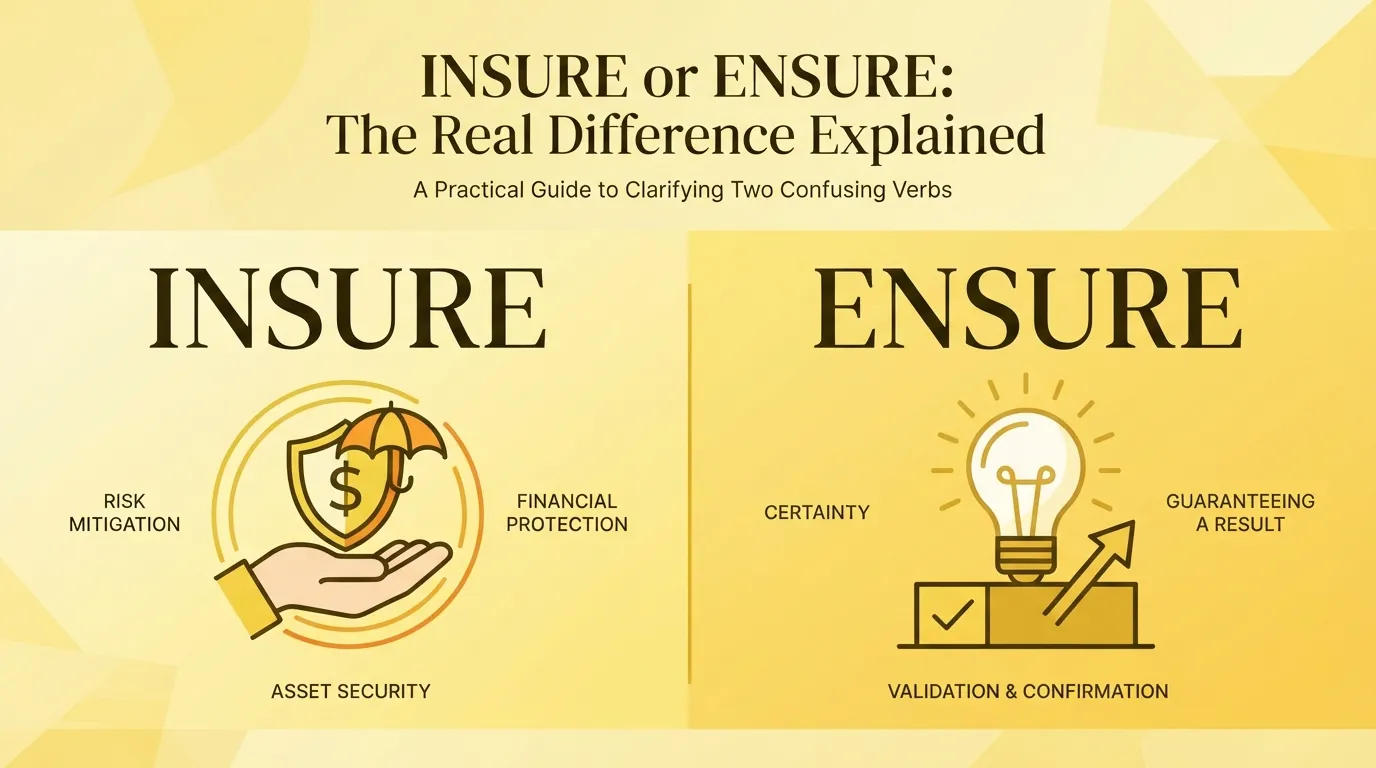
Insure means to protect something with money if it gets lost or damaged. Ensure means to make sure something will happen. In short, they sound alike, but they do not mean the same thing.
I once wrote an email to a client about a late shipment. I typed, “We will insure your package arrives on time.” Suddenly, I stopped. Something felt wrong. So I stared at that line for a full minute. Then it hit me. I actually needed ensure, not insure.
That small slip is one of the most common mistakes in English. After all, both words come from the same old root. In fact, both are spelled almost the same. Plus, both sound identical when you say them out loud. So it makes sense that so many people search for the right one every day.
This guide will end that confusion for good. First, you will learn what each word means. Next, you will learn when to use each one. Then, you will learn how to avoid the mix up that trips up even skilled writers. In the end, you won’t need to pause and guess again.
So let’s dig in.
Insure or Ensure: Quick Answer
Ensure means you make an outcome certain. For example, you ensure a project finishes on time. Likewise, you ensure your kids brush their teeth before bed.
On the other hand, insure means you buy or give money protection against risk. For instance, you insure your car. You also insure your home. And you insure your health.
Here is a simple test. If money and a policy are part of the sentence, use insure. But if you are just making something certain, use ensure instead.
Where the Insure or Ensure Mix Up Started
To begin with, both words come from the old French word “enseurer.” That word meant to make safe or sure. Over time, however, English split this into two spellings.
At first, British English used both spellings for similar ideas. Even today, some older British texts still use insure where modern writers would use ensure. As a result, that old overlap is part of why people still mix them up today.
Later, American English drew a clear line. Ensure became the word for a promise or a guarantee. Meanwhile, insure stayed tied to money, risk, and coverage. Because of this split, life became easier for writers once they learned the rule.
Insure or Ensure: Key Differences
Overall, here is how each word works in real sentences.
Insure Meaning: protect something with money against loss. When to use: talking about policies, coverage, or risk. Region or context: used worldwide in finance and legal writing.
Ensure Meaning: make something certain. When to use: talking about outcomes, promises, or guarantees. Region or context: used worldwide in general writing.
Assure Meaning: tell someone something is true. When to use: talking to a person to calm their worry. Region or context: used worldwide in conversation and writing.
Additionally, assure often gets pulled into this mix up too. Still, it belongs in its own lane. In short, you assure a person, you ensure an outcome, and you insure property or a life against risk.
For example, look at these quick sentences:
- “Please ensure the report is done by Friday.” This is about a certain outcome.
- “We insured the warehouse against fire damage.” This is about money and risk.
- “I assure you the numbers are correct.” This is about calming a person’s doubt.
Which Word Should You Use?
- For business writers and marketers: use ensure when you talk about outcomes, deadlines, or quality. However, use insure only when you talk about real insurance products or coverage.
- For insurance and finance workers: insure will show up often in your daily writing since it deals with policies and claims. Even so, ensure still fits when you talk about rules or service standards.
- For students and everyday writers: pick ensure almost every time. In fact, you will rarely need insure unless you write about buying protection for something.
- For global or neutral writing: follow the standard American English rule. Simply put, use ensure for certainty and insure for money protection. This way, your writing stays clear for any reader.
Common Mistakes with Insure or Ensure
For instance, “We will insure the meeting starts on time” is wrong. Instead, write “We will ensure the meeting starts on time.” This happens because insure sounds formal, so writers grab it even when no money is involved.
Similarly, “I ensured my car last month” is wrong. Instead, write “I insured my car last month.” This happens because ensure gets used so often that it becomes a habit, even in a sentence about a real policy.
Also, “Let me insure you this plan works” is wrong. Instead, write “Let me assure you this plan works.” This happens because all three words sound close, so assure gets swapped by accident.
Next, “The company failed to ensure their assets properly” is wrong. Instead, write “The company failed to insure their assets properly.” This happens because the sentence involves risk and coverage, so ensure feels close but is wrong here.
Finally, “Please insure that the doors are locked” is wrong. Instead, write “Please ensure that the doors are locked.” This happens because insure shows up more in formal papers, so writers assume it always sounds more proper.
Insure or Ensure in Real World Examples
In a professional email, you might write, “To ensure a smooth handoff, please share the updated files by Tuesday.”
In a news headline, you might see, “New Law Will Ensure Faster Response Times for Emergency Services.”
On social media, a brand might post, “Nothing beats knowing your family is safe. Insure your home today and rest easy.”
In a formal document, you might read, “The vendor shall insure all equipment against theft or damage during transport. The vendor shall also ensure that safety rules are followed at every site.”
In every case, each example uses the right word based on whether the sentence needs a guarantee or money protection.
Insure or Ensure: Data, Trends and Usage
Overall, many people search for “insure or ensure.” Students search it. Business writers search it too. So do non native English speakers. Above all, they want a clear rule, not a long grammar lecture.
Notably, searches rise at tax time. They also rise during health plan enrollment. During those times, the word insure gets used more in daily talk. So writers double check their word choice before they send emails or forms.
This matters more today than ever before. After all, we talk through email, posts, and quick chats constantly. Therefore, one wrong word can hurt your image at work. Ultimately, getting this right protects your name, just like insurance protects your stuff.
The Ultimate Insure or Ensure Cheat Sheet
Here is the fastest reference you will find anywhere. Save it, screenshot it, or bookmark this page.
Quick Decision Test
| Ask Yourself | If Yes, Use |
|---|---|
| Am I guaranteeing something will happen? | Ensure |
| Am I talking about an insurance policy or coverage? | Insure |
| Can I replace the word with “guarantee”? | Ensure |
| Can I replace the word with “get insurance for”? | Insure |
| Am I comforting or promising someone directly? | Neither, use assure |
Insure or Ensure: Comparison Table
In summary, here is a side by side look at all three words.
| Term or Variant | Meaning | Region or Context | Best Used When |
|---|---|---|---|
| Insure | Money protection against loss | Insurance and legal writing | Talking about policies, coverage, or claims |
| Ensure | Make something certain | General and professional writing | Talking about guarantees or outcomes |
| Assure | Calm a person’s doubt | Conversation and professional writing | Reassuring someone directly |
Frequently Asked Questions
Q: What does insure mean?
A: In simple terms, insure means to protect something with money against loss or damage, usually through an insurance policy. For example, you insure a car, a house, or a business.
Q: How do you use ensure correctly?
A: Basically, use ensure when you want to guarantee that something will happen. For example, “Ensure the door is locked before you leave.”
Q: Insure vs ensure, what is the difference?
A: In short, insure deals with money protection through a policy, while ensure means making something certain. Therefore, they do not swap with each other in formal writing.
Q: Is insure fine to use in formal writing?
A: Yes, insure works well in formal writing. However, it only fits when you talk about insurance, coverage, or protection against risk.
Q: Which word is correct in British English, insure or ensure?
A: Today, modern British English follows the same rule as American English. That said, older British texts sometimes used insure in a broader way.
Q: Where does the word ensure come from?
A: Originally, ensure comes from the old French word “enseurer,” which meant to make safe or sure. That same root also gave us the word insure.
Q: Can insure ever mean guarantee?
A: In older or casual writing, some people use insure loosely to mean guarantee. Nowadays, though, modern style guides suggest ensure for that meaning instead.
Read More: Traveling Or Travelling: The Simple Rule You Need
Final Thoughts
Overall, insure and ensure look almost the same, but they do very different jobs. Insure lives in the world of money and policies. Ensure lives in the world of promises and outcomes. Meanwhile, assure is their close cousin, and you use it to calm a person’s doubt.
So try this simple test. Money and coverage point to insure. Certainty and outcomes point to ensure. Once you keep that rule close, you won’t second guess yourself again.
Therefore, bookmark this guide so you can check it any time the mix up strikes. Also, if you know someone who confuses insure and ensure, send this their way. After all, it might save them from an awkward email mistake, just like mine.
See More: Chose or Choose: The Simple Trick to Never Mix Them Up Again

My name is Ayesha Sadiqah, the writer behind this website. I write in-depth articles on English spelling, word comparisons, grammar, and vocabulary to help learners make better language choices. Every guide is carefully researched and designed to provide accurate, practical, and easy-to-understand information.