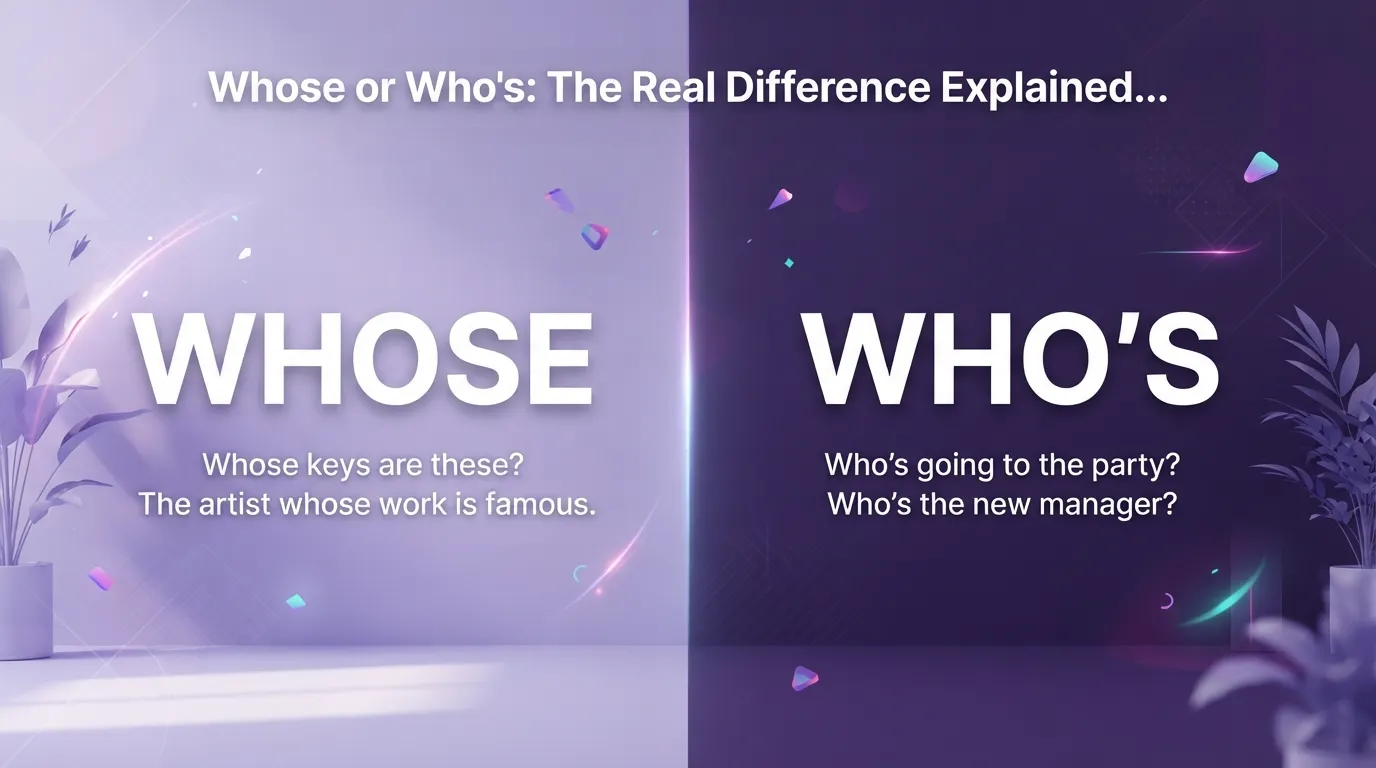
Whose shows possession, and who’s is a contraction of who is or who has. They sound identical but mean completely different things.
I once edited a client’s website copy where the homepage headline read, “Who’s idea was this?” It looked confident and clean, sitting right at the top of the page in large bold letters, and it stayed live for almost two weeks before anyone noticed.
That one apostrophe changed the entire meaning of the sentence, and nobody caught it because the words sound exactly the same out loud.
This mix up happens to careful writers all the time, not just beginners. Unlike gray and grey, this isn’t a regional spelling choice. Whose and who’s serve two completely different jobs in a sentence, and mixing them up changes what you’re actually saying. This guide breaks down exactly how to tell them apart, permanently.
Whose or Who’s: Quick Answer
Whose is a possessive pronoun. It shows that something belongs to someone, similar to his, her, or their.
Who’s is a contraction. It combines who and is, or who and has, into one shorter word.
Correct: “Whose phone is this?” (asking who owns the phone) Correct: “Who’s coming to the party?” (asking who is coming)
The Origin of Whose or Who’s
Whose comes from Old English “hwæs,” the possessive form of “who,” and it has worked as a possessive word for well over a thousand years, long before apostrophes existed in English at all.
Who’s is much younger by comparison. Contractions using apostrophes became common in English writing around the sixteenth and seventeenth centuries, as writers looked for shorter, more natural sounding ways to combine common word pairs like who is, it is, and do not.
Here’s where the real confusion starts. In almost every other case, an apostrophe plus s signals possession, like in “the dog’s leash” or “Sarah’s car.” Whose breaks that expectation completely, because it shows possession without any apostrophe at all, while who’s, which looks like it should show possession, is actually just a shortened version of who is or who has.
That contradiction between how apostrophes normally work and how they work here is exactly why this pair trips up so many writers, even ones who rarely make other grammar mistakes.
Whose or Who’s Explained: Key Differences
The difference here isn’t about formality or region. It’s about grammatical function.
| Term | Meaning | When to Use | Region/Context |
| Whose | Possessive pronoun, showing ownership | Asking or stating who owns something | Standard English worldwide |
| Who’s | Contraction of who is or who has | Asking about identity or a current action | Standard English worldwide |
Both words are grammatically correct on their own. The mistake only happens when one gets swapped for the other inside a sentence where it doesn’t belong.
Which Version Should You Use?
This isn’t an audience based choice like American versus British spelling. The correct word depends entirely on what the sentence is actually saying.
Use whose when you’re identifying an owner. If you can replace the word with his, her, its, or their and the sentence still makes sense, whose is correct.
Use who’s when you’re asking about identity or describing an ongoing action. If you can expand it into who is or who has and the sentence still makes sense, who’s is correct.
For global and neutral use, this simple substitution test works in every context, every audience, and every type of writing, from casual texts to formal reports.
Common Mistakes with Whose or Who’s
These five mix ups show up constantly, even in professional writing.
Mistake 1: Using who’s to show possession. Wrong: “I don’t know who’s bag this is.” Correct: “I don’t know whose bag this is.” Why it happens: Writers assume the apostrophe pattern from words like Sarah’s or the dog’s applies here too, when it actually doesn’t.
Mistake 2: Using whose instead of who’s for a contraction. Wrong: “Whose coming to dinner tonight?” Correct: “Who’s coming to dinner tonight?” Why it happens: Whose looks more familiar and formal, so writers default to it even when they mean who is.
Mistake 3: Skipping the substitution test entirely. Wrong: Guessing based on how the sentence sounds rather than checking the actual meaning. Correct: Try swapping in who is or who has, and if it fits, who’s is correct every time. Why it happens: Writers rely on instinct instead of a quick, reliable test that takes only a few seconds.
Mistake 4: Assuming who’s always relates to a question. Wrong belief: Who’s only appears in questions. Correct belief: Who’s also works in statements, like “who’s been eating my lunch.” Why it happens: Writers picture who’s mainly in questions like “who’s calling,” and forget its use inside regular statements too.
Mistake 5: Overcorrecting and avoiding both words. Wrong: Rewriting an entire sentence awkwardly just to dodge the choice between whose and who’s. Correct: Learn the substitution test once, and use both words confidently and naturally going forward. Why it happens: Past embarrassment over the mistake makes some writers avoid the words entirely instead of learning the simple rule behind them.
Whose or Who’s in Real World Examples
Professional email: “Whose approval do we need before this contract moves forward?”
News headline: “Who’s Leading the Race for City Council This Year?”
Social media post: “Whose dog is this adorable little guy in the photo everyone’s sharing?”
Formal report: “The committee could not determine whose department was responsible for the delay.”
Each example uses the correct word based on whether it’s showing ownership or standing in for who is.
Whose or Who’s: Data, Trends & Usage
Search interest in this topic stays consistently strong, since the mistake shows up everywhere, from casual texts to professional emails to published articles. People searching this term are almost always checking their own writing before sending or publishing it.
This is an informational search with an immediate, practical purpose. Readers aren’t looking for grammar theory, they’re looking for a fast, confident answer they can apply right away, which is exactly why a clear substitution test matters more here than a long explanation of pronoun categories.
The Simple Memory Trick Nobody Else Explains
Most guides just tell you to memorize the rule and move on. Here’s a trick that actually sticks.
Picture the apostrophe in who’s as a tiny missing letter, standing in for the space where a letter used to be. Who is becomes who’s, with the apostrophe marking exactly where the i in is disappeared.
Now picture whose as a word that already has everything it needs, with nothing missing and nothing to squeeze into a shorter form. It’s a complete possessive word on its own, the same way his and hers are complete without any apostrophe.
So whenever you see an apostrophe in who’s, think of it as a placeholder for a missing letter, never as a sign of ownership. That single mental shift clears up the entire confusion in a way that simply memorizing “whose shows possession” often doesn’t.
Quick Self Check: Test Yourself in Ten Seconds
Before you publish or send anything with this word, run it through this tiny checklist.
Can you replace the word with who is or who has, and does the sentence still make sense? If yes, who’s is correct.
Can you replace the word with his, her, its, or their, and does the sentence still make sense? If yes, whose is correct.
Read the sentence out loud one more time with your chosen replacement in place. If it sounds natural and complete, you’ve picked the right word, and you’re ready to hit send with confidence.
This ten second substitution test works faster than trying to recall a grammar rule mid sentence, and it catches the mistake almost every single time.
Standalone Comparison Table
| Term/Variant | Meaning | Region/Context | Best Used When |
| Whose | Possessive pronoun showing ownership | Standard English worldwide | Identifying who owns something |
| Who’s | Contraction of who is or who has | Standard English worldwide | Asking about identity or describing an action |
| Its | Possessive pronoun for things or animals | Standard English worldwide | Showing ownership without an apostrophe |
| It’s | Contraction of it is or it has | Standard English worldwide | Standing in for it is or it has in a sentence |
Related Words Worth Knowing
A few other pronoun pairs follow this exact same pattern, so recognizing it here helps far beyond just whose and who’s.
Its and it’s work identically. Its shows possession without any apostrophe, as in “the cat licked its paw,” while it’s is short for it is or it has, as in “it’s raining outside.”
Your and you’re follow the same logic too. Your shows possession, as in “your car,” while you’re is short for you are, as in “you’re welcome.”
Their, they’re, and there also share this pattern, even though there isn’t a possessive form at all. Their shows possession, they’re is short for they are, and there refers to a location, giving you three separate words instead of just two.
Once this pattern clicks across whose, its, and your, the whole family of possessive versus contraction pairs becomes far easier to manage without second guessing every sentence.
Frequently Asked Questions
Q: What does whose or who’s mean?
A: Whose shows possession or ownership, while who’s is a contraction of who is or who has. They sound identical but serve completely different grammatical roles.
Q: How do you use whose correctly?
A: Use whose whenever you’re identifying who owns something, such as “whose keys are these” or “the author whose book won the award.”
Q: Whose vs who’s, what’s the actual difference?
A: Whose is possessive, similar to his or her, while who’s is short for who is or who has. Try substituting who is into the sentence, and if it still makes sense, who’s is correct.
Q: Is who’s acceptable in formal writing?
A: Yes, when it’s genuinely standing in for who is or who has. Some formal style guides prefer spelling out who is fully, but who’s itself is grammatically correct.
Q: Which version is correct, whose or who’s?
A: Both are correct, but only in their proper context. Whose shows ownership, and who’s replaces who is or who has, so the right choice depends entirely on the sentence.
Q: Where does the confusion between whose and who’s come from?
A: It comes from the normal pattern of apostrophe plus s showing possession in most English words, which doesn’t apply to whose, creating an exception that trips up many writers.
Q: Can who’s ever show possession?
A: No. Who’s only ever means who is or who has. Possession always requires whose, with no apostrophe involved at all.
Final Thoughts
Whose shows ownership, and who’s stands in for who is or who has, and mixing them up changes the entire meaning of a sentence, even though they sound exactly alike. Remember the substitution test: try swapping in who is or who has, and if it fits, who’s is correct, otherwise whose is what you need.
Now you know exactly how to use whose and who’s correctly, so go try it in your next piece of writing. Bookmark this guide so you never second guess it again.
See More: Layed or Laid: The Real Difference Explained

Hey, I’m Ayeza. I started wordiums.com because I kept freezing over words that look almost the same, unsure which one was right. Now I explain every word comparison in plain language, so you can pick the right word with confidence and move on.