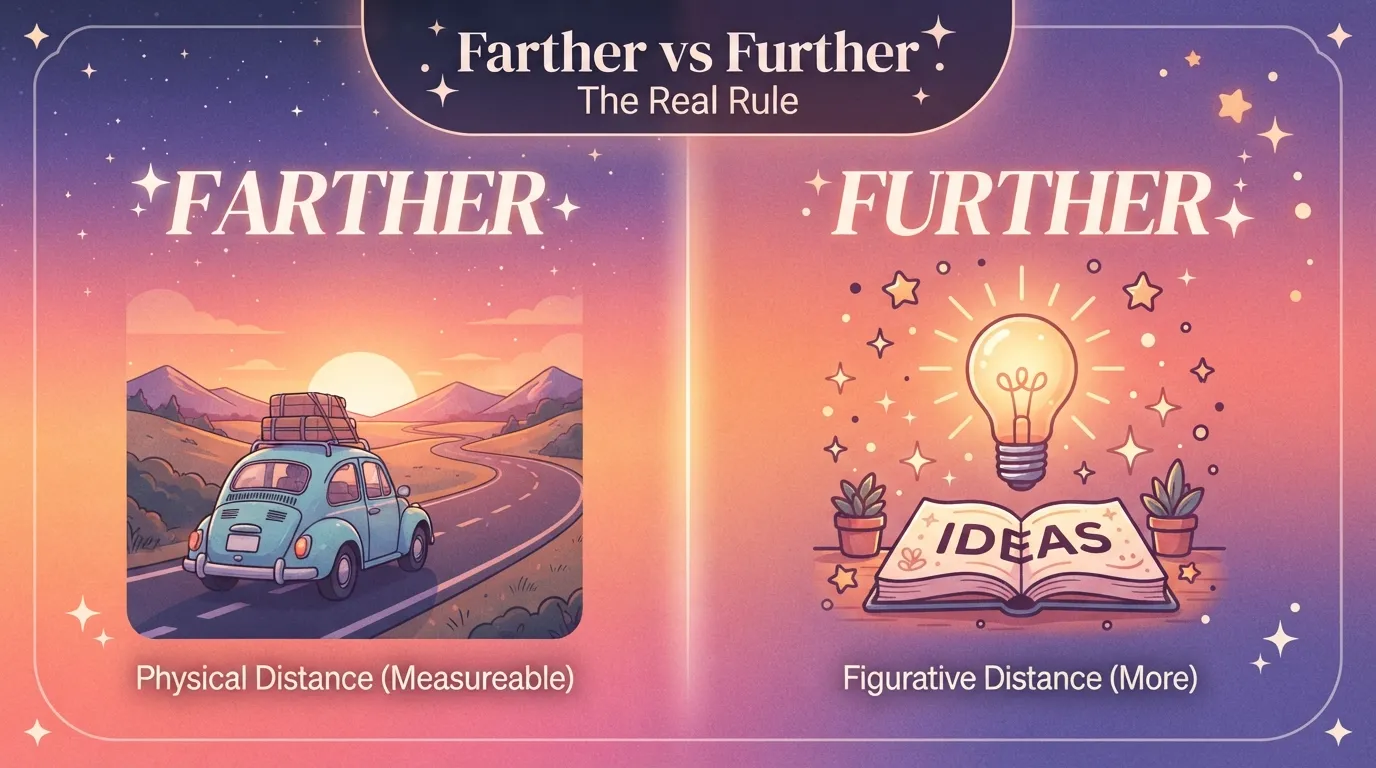
Farther or further both mean additional distance or extent. Farther is for physical distance you can measure. Further is for figurative distance, like ideas, time, or degree. Many writers use them interchangeably today, but the distinction still matters in careful writing.
I once sent a work email that said “let’s discuss this farther in our next meeting.” My editor circled it in red and wrote one word: “further.” I stared at that correction for a solid minute, genuinely unsure why it mattered. Weren’t these just two spellings of the same idea?
That mix up is one of the most common in English, and it makes sense why. Farther and further sound almost identical, mean something close enough to confuse anyone, and even show up interchangeably in casual speech all the time. Yet in careful writing, style guides, and grammar tests, the difference still counts.
This guide clears up the confusion completely. You will learn the traditional rule, see exactly when each word fits, walk through real examples, and pick up a simple trick to remember the difference for good. By the end, you will never freeze over this word pair again, whether you are writing an email, an essay, or a text to a friend.
Farther or Further, Quick Answer
Here is the traditional rule in one breath: use farther for physical, measurable distance, and use further for figurative distance, meaning extent, degree, or additional effort.
Quick examples:
- “The gas station is two miles farther down this road.” (physical distance)
- “We need to discuss this issue further before deciding.” (figurative extension)
- “She ran farther than anyone else in the race.” (measurable, physical)
- “Let’s look further into the report before we sign off.” (abstract, not measurable)
Many everyday speakers blur this line without anyone noticing. But knowing the traditional distinction gives your writing an extra layer of precision, especially in formal or academic settings.
The Origin of Farther and Further
Both words trace back to the same root: the Old English word “further,” related to “forth,” meaning to move forward. For centuries, English speakers used further and its older spelling variations for both physical and figurative movement, without any strict separation.
Farther actually developed later, as a variant spelling that gradually attached itself specifically to physical distance. Grammarians in the eighteenth and nineteenth centuries began pushing for a cleaner split: farther for things you could physically measure, further for things you could not.
This distinction became a fixture of traditional grammar textbooks, especially in American English. British English, interestingly, never fully committed to the split, and many British writers use further for both physical and figurative distance without much concern.
That regional difference is part of why the confusion persists today. If you grew up reading British sources, watching British television, or learning English outside the United States, you may have never encountered the farther versus further distinction as a rule at all. It simply was not enforced the same way.
Dictionaries reflect this uncertainty too. Most major dictionaries list both words as acceptable for physical distance, while reserving further exclusively for figurative use and verb forms. That small asymmetry, further covering more ground than farther, is really the heart of the entire debate, and it explains why so many editors treat further as the safer default when a writer is unsure.
Farther Versus Further Explained
Understanding when to use each word gets easier once you separate the two core ideas: something you can measure with a ruler, a map, or a number, versus something you cannot.
| Term | Meaning | When to Use | Region or Context |
| Farther | Additional physical distance | Distance you can measure, like miles or feet | Traditional American English, formal writing |
| Further | Additional degree, extent, or abstract distance | Ideas, time, effort, or anything non physical | Both American and British English, everyday speech |
| Further (as a verb) | To advance or promote something | “To further your career” or “further a cause” | Universal, no physical distance meaning available for farther |
That last row matters a lot. Only further works as a verb. You can say “this decision will further your goals,” but you can never say “farther your goals.” Farther only exists as an adjective or adverb describing physical distance, never as an action word.
Which Version Should You Use?
Your answer depends on what you are actually describing.
For physical, measurable distance: Use farther. If you can picture a ruler, a map, or a mile marker attached to what you are describing, farther fits. “The store is farther than I remembered” works because distance is physically measurable.
For abstract or figurative distance: Use further. Discussions, ideas, plans, and levels of detail are not measured in miles, so further is the natural choice. “We should think further about this plan” fits because thinking has no physical distance.
When you genuinely cannot tell: Default to further. It has always covered both meanings historically, and most style guides agree that further is the safer, more broadly accepted choice when you are unsure. Many professional editors will not flag further even when farther would technically be more precise, but the reverse is not always true.
For verbs: Always use further. There is no other option here, since farther cannot function as a verb in modern English.
Memory Trick: Farther has the word “far” sitting right inside it. If you can measure how far something is, use farther. Further does not contain “far,” so save it for everything else, like ideas, plans, and effort.
Common Mistakes with Farther and Further
Even confident writers slip up here. Below are the most frequent errors, shown side by side with the correct version.
- Mistake: “Let’s discuss this farther tomorrow.” Correct: “Let’s discuss this further tomorrow.” A discussion has no physical distance, so further fits.
- Mistake: “This job will farther my career.” Correct: “This job will further my career.” Farther cannot be used as a verb under any circumstance.
- Mistake: “The hiking trail is further than I expected.” Correct: “The hiking trail is farther than I expected.” Trail distance is physically measurable, so farther is more precise here.
- Mistake: Assuming British and American English apply the same rule. Correct: American style guides tend to enforce the farther and further split strictly. British English is far more relaxed, and further is often used for both meanings without correction.
- Mistake: Believing one spelling is simply wrong. Correct: Neither word is incorrect. The distinction is a style preference reinforced by traditional grammar guides, not a hard grammatical law, though following it does add polish to formal writing.
Farther and Further in Everyday Examples
Email: “Thanks for the update. Let’s discuss the budget further once the full report arrives.”
News Headline: “City Council Pushes Plan Further Despite Community Pushback”
Social Media Post: “Drove farther than planned today just to catch the sunset. Worth it.”
Formal Report: “Further analysis is required before the committee can finalize its recommendation.”
Everyday Conversation: “How much farther until we get there?”
Notice how naturally each version fits its context. Physical trips and distances pull toward farther, while plans, analysis, and discussions pull toward further almost automatically once you start paying attention.
Farther or Further, Data, Trends, and Usage
Interest in this exact question spikes whenever people write formal documents, prepare for grammar tests, or edit academic papers, since informal daily speech rarely forces anyone to stop and think about it.
American English search activity for this comparison tends to be higher than in other English speaking regions, largely because American style guides like AP and Chicago actively teach and enforce the split. British, Australian, and Canadian audiences search this less often, since further already comfortably covers both meanings in those varieties of English.
This distinction matters most in professional, academic, and editorial contexts. Students preparing essays, professionals drafting formal reports, and writers following a specific style guide are the audiences most likely to need a confident, correct answer rather than a guess.
Editors and proofreaders also report that further shows up far more often in everyday published writing than farther, likely because it safely covers both meanings without much risk. Farther appears more narrowly, usually in travel writing, sports reporting, and anything describing literal movement across a measurable space.
Quick Self Check
Try picking the correct word before reading the answer underneath each line.
- “I cannot walk any (farther or further) without a break.”
- “We need to look (farther or further) into this matter before deciding.”
- “This scholarship will (farther or further) her education.”
- “The nearest hospital is five miles (farther or further) than the clinic.”
Answers: 1. farther, 2. further, 3. further, 4. farther
If you got three or four correct, you already have a solid grip on this rule. If you missed a couple, revisit the memory trick above before your next writing task.
Comparison Table
| Term | Meaning | Region or Context | Best Used When |
| Farther | Physical, measurable distance | American formal writing | Describing miles, feet, or measurable travel |
| Further | Figurative distance, extent, degree | Universal, both American and British English | Discussing ideas, plans, or abstract progress |
| Further (verb) | To advance or promote | Universal | Any sentence needing an action word |
| Farthest | Superlative of farther | American formal writing | The greatest physical distance among options |
| Furthest | Superlative of further | Universal, common in British English | The greatest figurative distance or, informally, physical distance too |
Frequently Asked Questions
Q: Is farther or further correct in formal writing? A: Both are correct, but formal American writing typically expects farther for physical distance and further for everything abstract. British formal writing accepts further for both.
Q: How do you use further correctly in a sentence? A: Use it for anything non physical, such as ideas, discussions, or effort, as in “We should investigate this further before responding.”
Q: Farther vs further, what is the real difference? A: Farther describes measurable physical distance. Further describes abstract extent, degree, or serves as a verb meaning to advance something.
Q: Is farther ever acceptable as a verb? A: No. Farther only works as an adjective or adverb. Further is the only correct choice whenever you need a verb form.
Q: Which version is correct, farther or further, for British readers? A: British readers generally accept further for both physical and figurative distance, so leaning on further is safe for that audience.
Q: Where do farther and further come from? A: Both descend from the same Old English root related to “forth.” Farther split off later as a distinct spelling tied specifically to physical distance.
Q: Can further be used when describing physical distance too? A: Yes, especially in British English or casual speech. It is considered acceptable, though American style guides prefer farther for precision in that context.
Conclusion
Farther or further, the choice comes down to one simple question: can you measure it? If the answer is yes, physical miles, feet, or steps, farther is your word. If the answer is no, ideas, plans, effort, or degree, further fits better, and it is also your only option whenever you need a verb.
You now understand where this split came from, why British and American English treat it differently, and how to avoid the most common mistakes people make with these two words. Whether you are drafting a formal report, finishing a school essay, or just texting a friend about how much farther the trip will take, you can choose the right word with real confidence.
Keep the memory trick in mind: farther has “far” built right in, so let that be your signal for physical distance every time. Bookmark this guide, run through the quick self check whenever you are unsure, and share it with anyone who has ever paused mid sentence wondering which one to use.
See More: Bingeing or Binging: The Complete Spelling Guide

My name is Ayesha Sadiqah, the writer behind this website. I write in-depth articles on English spelling, word comparisons, grammar, and vocabulary to help learners make better language choices. Every guide is carefully researched and designed to provide accurate, practical, and easy-to-understand information.