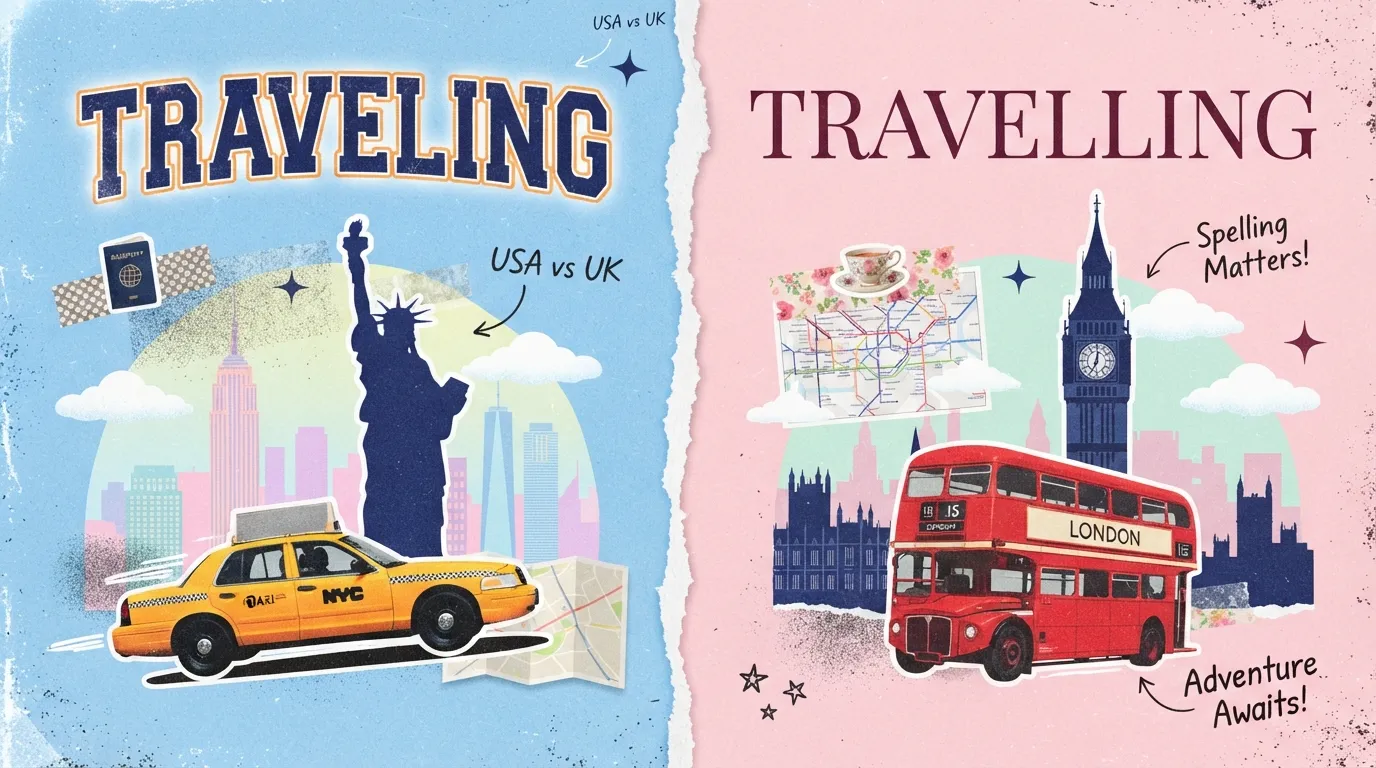
Traveling is the American English spelling, and travelling is the British English spelling. Both mean the exact same thing, moving from one place to another, and the only real difference is which country’s spelling rules you follow.
James spent an hour rewriting his travel blog post, switching between traveling and travelling, convinced one of them had to be wrong. He wasn’t wrong to worry. Spell check flagged one version, then his editor flagged the other, and suddenly a simple word felt like a trap.
This mix up trips up bloggers, students, and business writers every single day. The word looks almost identical in both forms, just one letter apart, yet plenty of writers assume only one version can be correct English.
Here’s the truth. Neither spelling is wrong. You’re not choosing between correct and incorrect, you’re choosing between two respected English traditions.
This guide breaks the whole thing down in plain language. You’ll learn exactly why both spellings exist, which one fits your audience, and how to stay consistent so your writing always looks polished and intentional.
By the end, you’ll never pause over traveling or travelling again.
And you’re definitely not alone in feeling stuck here. Teachers see both spellings in student essays. Editors see both in submitted articles. Even large travel brands sometimes mix them up across different pages of the same website.
The confusion makes sense once you realize spell check tools quietly assume one country’s rules by default. If your software is set to British English, it will underline traveling in red. If it’s set to American English, it does the opposite. Neither warning means you made a mistake, it just means your settings and your chosen spelling don’t currently match.
Traveling Or Travelling, Quick Answer
Traveling, with one L, is the standard spelling in American English. You’ll see it in United States newspapers, textbooks, and most software spell checkers set to English United States.
Travelling, with two L’s, is the standard spelling in British English. You’ll see it across the United Kingdom, Australia, India, and most Commonwealth countries.
A quick example makes it click fast. An American airline might write, “We hope you enjoy traveling with us.” A British airline would write, “We hope you enjoy travelling with us.” Same meaning, same tone, just a different regional rulebook.
The Origin Of Traveling And Travelling
This spelling split traces back to a much bigger pattern in English, not just this one word. American lexicographer Noah Webster simplified many British spellings in the early 1800s, aiming to make American English more efficient and distinct from British English.
Webster’s rule usually dropped the extra consonant before adding a suffix like ing or ed, unless the stress fell on that final syllable. Since travel is stressed on the first syllable, Webster’s system kept it to one L, giving us traveling.
British English never adopted that simplification, and it kept doubling the final consonant before adding ing, giving us travelling. The exact same split shows up in cousin words like canceled versus cancelled, and modeling versus modelling.
Once you learn this pattern, you’ll start noticing it everywhere, and it stops feeling random.
It also explains why so many textbooks call this a spelling variant rather than an error. Dictionaries on both sides of the Atlantic list both traveling and travelling as valid entries, they simply label each one with its region. That single detail settles the debate for good, straight from the source most people trust the most.
Traveling Or Travelling Explained, Key Differences
Both words function identically in a sentence. They’re the same part of speech, carry the same meaning, and follow the same grammar rules around them. The only variable is regional spelling convention.
| Term | Meaning | When To Use | Region/Context |
| Traveling | Moving from place to place | American audience or US based publication | United States, and often Canada |
| Travelling | Moving from place to place | British audience or UK based publication | United Kingdom, Australia, India, most Commonwealth nations |
This same doubling pattern applies to related words too. Traveler becomes traveller in British English. Traveled becomes travelled. Once you pick a spelling system, apply it consistently across every related word in your document, not just the main one.
Which Version Should You Use?
For American readers, businesses, or platforms, use traveling with a single L. This includes most US based blogs, resumes, and corporate communication.
For British, Australian, or Indian readers, use travelling with double L’s. This matches what feels natural and correctly spelled to that audience, and it signals attention to detail.
For global or neutral audiences, pick one spelling and stay consistent throughout the entire piece. Search engines and readers both notice when a single article mixes traveling and travelling randomly, and it can look careless rather than intentional.
If you’re writing for a specific client or publication, always check their style guide first. Many international brands specify one spelling standard for every writer on their team.
Common Mistakes With Traveling Or Travelling
Mistake 1: Mixing both spellings in the same article. Correction: Choose one spelling system and use it throughout the entire piece. This happens most often when multiple writers or editors touch the same document without agreeing on a style first.
Mistake 2: Assuming one spelling is simply wrong. Correction: Both traveling and travelling are fully correct, just in different English varieties. Writers often panic when spell check flags one version, forgetting that spell checkers are usually set to only one regional dictionary.
Mistake 3: Forgetting to match related words. Correction: If you write travelling, also write traveller and travelled, not traveler and traveled. People often fix the main word but forget the doubling rule applies to every form of that word.
Mistake 4: Ignoring audience location. Correction: Match your spelling to where most of your readers live, not your own personal habit. A US company marketing to UK customers should use travelling, even if the writer personally prefers the American spelling.
Mistake 5: Assuming Canadian English always matches American spelling. Correction: Canadian English often blends both systems, and travelling with two L’s is actually common in Canada. This surprises many writers who assume North America always follows the exact American standard.
Traveling Or Travelling In Real World Examples
Professional email: “I’ll be traveling for work next week, so please expect a delayed response to your message.”
News headline: “Cost Of Travelling Abroad Rises Sharply This Summer, New Report Finds”
Social media post: “Currently travelling through Southeast Asia and loving every single minute of this trip.”
Formal document: “Employees traveling for business purposes must submit receipts within fourteen days of return.”
Notice how the sentence structure, tone, and meaning stay identical, no matter which spelling appears.
Traveling Or Travelling, Data, Trends, And Usage
Search data consistently shows traveling spiked in American search regions, while travelling dominates searches from the United Kingdom, Australia, and India. This split mirrors the exact population and internet usage patterns of each spelling system.
This keyword falls firmly into the informational search category. People aren’t shopping, they’re double checking spelling before sending an email, publishing a blog post, or finishing a school assignment.
One insight matters here more than ever. As remote work and global content teams grow, more writers now publish for mixed international audiences. Understanding both spellings, and knowing exactly when to switch, has become a genuinely useful professional skill, not just trivia.
Comparison Table
| Term/Variant | Meaning | Region/Context | Best Used When |
| Traveling | Moving between places | United States, general North America | Writing for American audiences or US style guides |
| Travelling | Moving between places | United Kingdom, Australia, India, Canada often | Writing for British or Commonwealth audiences |
| Traveler / Traveller | A person who travels | Follows the same regional split as above | Match whichever main spelling you already chose |
Other Words That Follow The Same Pattern
Traveling and travelling aren’t alone. Once you understand this rule, entire families of words suddenly make sense.
- Cancel becomes canceled in American English, and cancelled in British English.
- Model becomes modeled and modeling in American English, and modelled and modelling in British English.
- Label becomes labeled in American English, and labelled in British English.
- Signal becomes signaled in American English, and signalled in British English.
- Fuel becomes fueled in American English, and fuelled in British English.
Every single one of these words follows the exact same rule as travel. The stress lands on the first syllable, American English keeps one consonant, and British English doubles it. Learning traveling or travelling essentially hands you a shortcut for dozens of other spelling decisions too.
This pattern matters especially for writers, students, and content teams working across international markets. Once the rule clicks for one word, it applies cleanly to every word in that same family, saving you from looking each one up individually.
Traveling Or Travelling For SEO And Content Writers
If you run a blog, an online store, or any content driven website, this choice actually affects your search rankings too. Search engines treat traveling and travelling as related but distinct terms, since real users search for both versions depending on their location.
Smart content writers often include both spellings naturally within a longer article, especially in headers, alt text, or FAQ sections, without forcing awkward repetition. This helps a single page capture search traffic from both American and British audiences.
For product listings or global landing pages, check your analytics first. If most of your traffic comes from the United States, lead with traveling. If your traffic skews British, Australian, or Indian, lead with travelling instead.
Frequently Asked Questions
Q: What does traveling or travelling actually mean?
A: Both words mean exactly the same thing, moving from one place to another. The only difference is spelling, based on American versus British English conventions.
Q: How do you use traveling correctly in a sentence?
A: Use traveling with one L whenever you’re writing for an American audience or following US style guides, as in “She loves traveling alone.”
Q: Traveling vs travelling, what’s the real difference?
A: The real difference is entirely regional. Traveling is American English, travelling is British English, and neither one is grammatically incorrect.
Q: Is travelling acceptable in formal writing?
A: Yes, travelling is completely acceptable and standard in formal British, Australian, and Indian English writing, including academic papers and business reports.
Q: Which version is correct, traveling or travelling?
A: Both are correct, depending on your audience. American style guides prefer traveling, while British style guides prefer travelling.
Q: Where does the traveling and travelling spelling split come from?
A: It comes from Noah Webster’s early efforts to simplify American English spelling in the 1800s, which dropped extra consonants that British English kept.
Q: Can travelling be used in American publications?
A: Technically yes, readers will still understand it, but most American editors will flag it as a spelling error, since traveling is the expected standard there.
Conclusion
Traveling or travelling isn’t a grammar mistake waiting to happen, it’s simply a choice between two valid English traditions. American English keeps one L, British English doubles it, and both are fully correct in their own context.
The real skill isn’t memorizing a single right answer, it’s knowing your audience and staying consistent once you pick a side. Match your spelling to related words too, like traveler or traveller, so your writing feels intentional from start to finish.
Now you know exactly how to use traveling or travelling with total confidence, so go apply it in your next blog post, email, or resume. Bookmark this guide so you never second guess yourself again, and share it with a fellow writer who’s been stuck on this exact question.
Read More: Worst or Worse: The Real Way To Use Each One

I’m Zain. I got interested in commonly confused words while helping non-native English speakers prep for writing exams, where a single misused word could cost real marks. That experience shaped how I write now: I try to explain not just which spelling is correct, but why the confusion exists in the first place, since understanding the reason is what actually makes it stick.