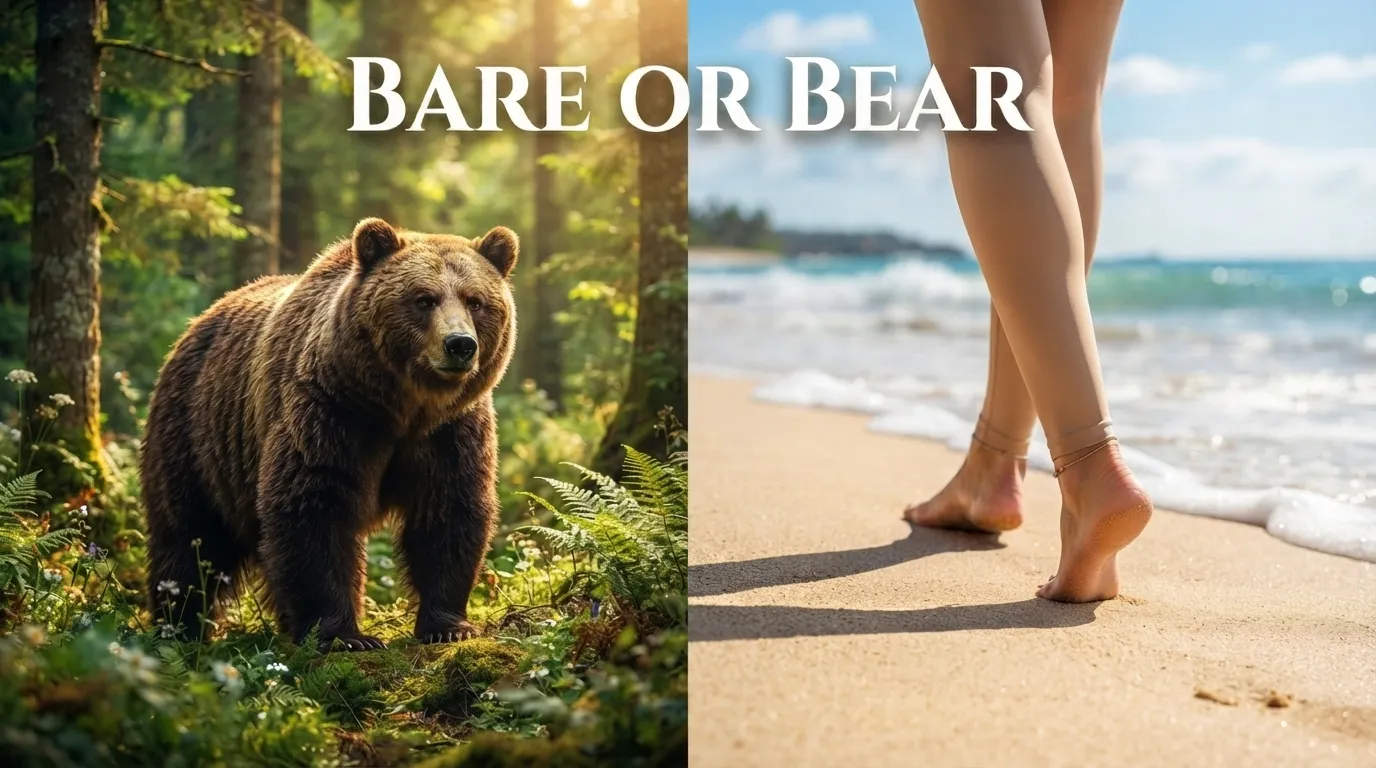
Bare means naked, plain, or uncovered, while bear means either the large wild animal or the verb meaning to carry, hold, or endure something.
I once watched a manager type “please bare with me” in an email to her entire team during a system outage. Someone replied all with a laughing emoji, and the thread turned into a small office legend. She meant “bear with me,” asking for patience, not asking anyone to undress.
That single letter swap is one of the most common mixups in English, and it shows up constantly in emails, texts, and even published articles.
If you have ever paused before typing bare or bear, unsure which one belongs in your sentence, you are far from alone.
This guide breaks down exactly what separates these two words, why the confusion happens so often, and how to lock in the correct spelling permanently, so you never send an awkward message like that manager did.
Bare or Bear Cheat Sheet
Use this the next time you freeze mid sentence.
| If your sentence means… | Use This Word |
|---|---|
| Naked, plain, or uncovered | Bare |
| The wild animal | Bear |
| To carry, hold, or endure | Bear |
| Asking someone for patience | Bear, as in “bear with me” |
| Bare minimum, bare essentials | Bare |
| To reveal something openly | Bare, as in “bare your soul” |
| To give birth, in older or formal usage | Bear, as in “she bore a child” |
Bare or Bear Quick Answer
Bare is almost always an adjective or a verb describing something uncovered, plain, or stripped down. Bear is almost always either a noun naming the animal, or a verb meaning to carry, support, or tolerate something.
Example with bare: “The room felt cold with its bare walls and no furniture.” Example with bear: “I can barely bear the noise from the construction site next door.”
Notice something sneaky there. The word barely, meaning hardly, is built from bare, not bear, which adds another layer to the confusion.
The Origin and Background of Bare or Bear
Bear comes from Old English beran, meaning to carry. That same root gives us words like birth, born, and burden, all connected to the idea of carrying something.
Bare comes from a completely different Old English word, bær, meaning naked or uncovered. It has zero connection to the animal or the verb meaning to carry.
The animal sense of bear actually comes from an entirely separate ancient root, possibly linked to the color brown, since early speakers may have avoided saying the animal’s “true” name out of superstition and used a descriptive nickname instead.
So bare and bear are not variations of the same word at all. They are two unrelated words that happen to sound identical, which linguists call homophones, and that accident of pronunciation is the entire reason this mixup exists.
Bare or Bear Explained: Key Differences
The difference comes down to meaning, not tense or grammar rules. These are simply two separate words that sound the same.
| Term | Meaning | When to Use | Region or Context |
|---|---|---|---|
| Bare | Naked, plain, uncovered, or to reveal | Describing something stripped down or exposed | Universal across English |
| Bear | Animal, or to carry, hold, endure | Naming the animal, or describing carrying or tolerating something | Universal across English |
One more twist worth knowing. Bear also has a past tense, bore, and a past participle, borne, neither of which apply to bare in any form.
Which Version Should You Use?
For phrases about patience, always use bear, as in “please bear with me while I finish this.”
For phrases about nakedness or plainness, always use bare, as in “the bare truth” or “bare feet.”
Then, For talking about the animal, always use bear, whether you mean a grizzly, a polar bear, or a teddy bear.
Also,For phrases about carrying weight or responsibility, use bear, as in “bear the burden” or “bear the cost.”
For global or neutral writing, remember the simple rule. If you can replace the word with “naked” or “plain” and the sentence still makes sense, use bare. If not, use bear.
Common Mistakes with Bare or Bear
Mistake 1: Writing “please bare with me” instead of “please bear with me.” Correction: Bear with me means please be patient, and it always uses bear, never bare.
Mistake 2: Writing “bare in mind” instead of “bear in mind.” Correction: Bear in mind means to remember or consider something, and it requires bear, not bare.
Mistake 3: Assuming bare can describe an animal casually, like “a bare in the woods.” Correction: The animal is always spelled bear, with no exceptions.
Mistake 4: Confusing “bare minimum” with “bear minimum.” Correction: Bare minimum means the smallest acceptable amount, and it always uses bare, since it relates to something stripped down.
Mistake 5: Writing “I can’t bare it anymore” instead of “I can’t bear it anymore.” Correction: When you mean to endure or tolerate something, the correct word is always bear.
Mistake 6: Mixing up bore and bared as past tense forms. Correction: Bear becomes bore in the past tense, while bare simply becomes bared, and the two never overlap.
Bare or Bear in Real World Examples
In a professional email: “Please bear with us while our systems update overnight.”
In a news headline: “Grizzly Bear Sighted Near Popular Hiking Trail This Weekend.”
Then, In a social media post: “Walking on the beach with bare feet is my favorite part of summer.”
Also In a formal document: “Employees must bear responsibility for reporting safety hazards immediately.”
Each example shows how context locks in meaning fast, though the spelling itself still trips up even experienced writers under time pressure.
Bare or Bear: Data, Trends, and Usage
Search interest for bare or bear spikes constantly among writers, students, and professionals double checking spelling before hitting send on an email or social post.
This confusion sits squarely in the informational category, since almost everyone searching just wants a fast, reliable answer, not a long grammar lecture.
“Bear with me” is by far the most searched phrase in this pair, since it appears constantly in professional communication and gets misspelled as “bare with me” at an unusually high rate.
One trend worth noting right now is that autocorrect tools rarely catch this mistake, since bare and bear are both real, correctly spelled words, which means spellcheck sees no error at all even when the meaning is completely wrong.
Standalone Comparison Table
| Term or Variant | Meaning | Region or Context | Best Used When |
|---|---|---|---|
| Bare | Naked, plain, uncovered, or to reveal | Used universally in English | Describing something stripped down or exposed |
| Bear | Animal, or to carry, hold, endure | Used universally in English | Naming the animal or describing carrying and tolerating |
Frequently Asked Questions
Q: What does bare mean? A: Bare means naked, plain, or uncovered. It can also work as a verb meaning to reveal something openly, as in “bare your soul.”
Q: How do you use bear correctly in a sentence? A: Use bear when naming the animal, or when describing carrying, holding, or enduring something. Example: “She had to bear the weight of the heavy backpack.”
Q: Bare vs bear, what is the real difference? A: Bare describes something uncovered or plain, while bear refers to the animal or means to carry and endure something. They are unrelated words that simply sound alike.
Q: Is “bear with me” or “bare with me” correct? A: “Bear with me” is correct. It means please be patient, using the verb bear, meaning to tolerate or endure.
Q: Which version is correct, bare minimum or bear minimum? A: Bare minimum is correct, since it describes the smallest, most stripped down amount possible.
Q: Where does the word bear come from? A: Bear comes from Old English beran, meaning to carry, which also gave English words like birth, born, and burden.
Q: Can bare be used to describe an animal? A: No. The animal is always spelled bear. Bare never refers to any creature and only describes nakedness or plainness.
Final Thoughts
Bare and bear sound identical but carry completely different meanings, and mixing them up is one of the easiest slip ups in English writing.
Remember the key points. Bare means naked, plain, or uncovered. Bear means the animal, or the verb meaning to carry, hold, or endure. When in doubt, try swapping in the word naked. If it still makes sense, you need bare.
Bookmark this guide so you never second guess bare or bear again, and share it with someone who still types “bare with me” by accident.
See More: Tries or Trys: The Correct Spelling Explained

Hi, I’m Zara. Words that look almost identical but mean completely different things have always fascinated me, that’s what pulled me toward writing about spelling and usage. I focus on digging into where these mix-ups actually come from, whether it’s a British-American split or just a rule English never bothered to make consistent. My goal with every guide is simple: give you the answer fast, then explain it well enough that you never have to look it up again.