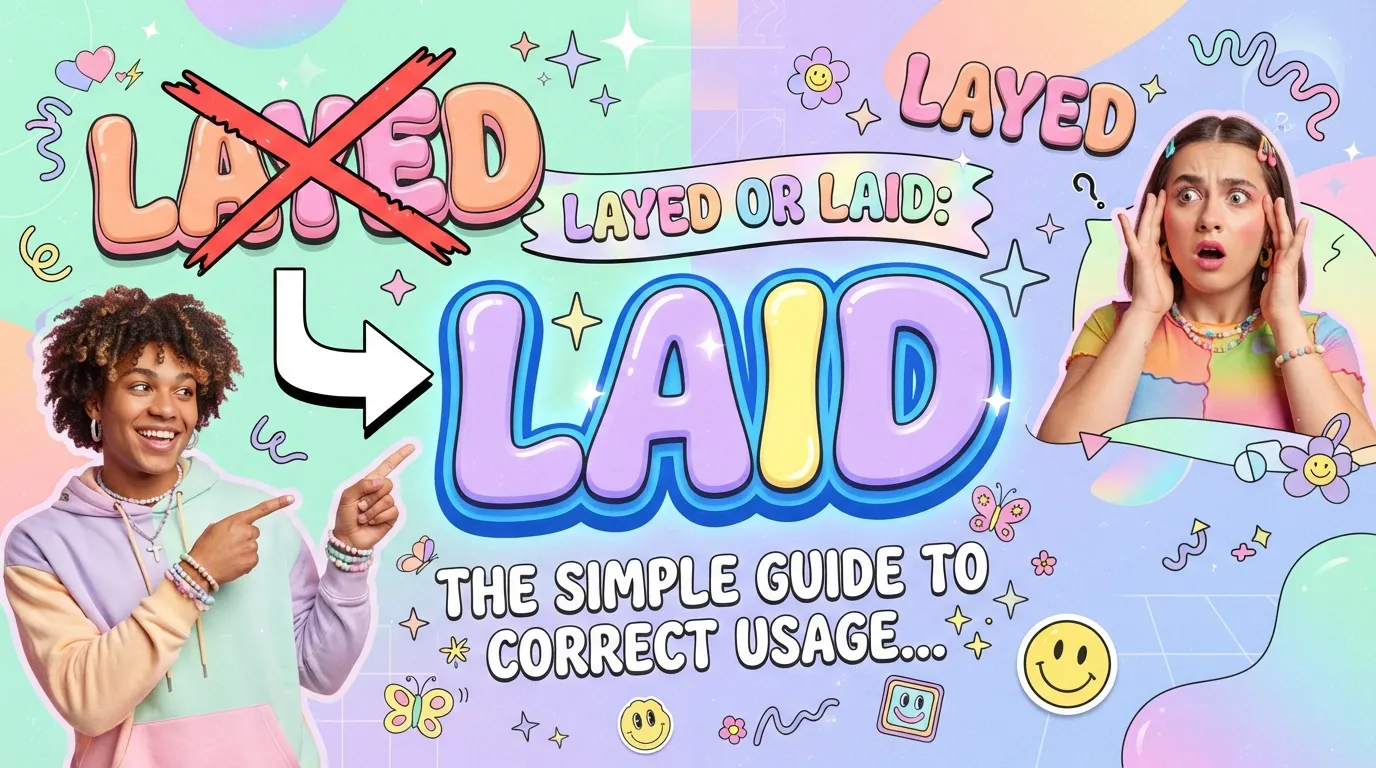
Laid is the correct spelling. Layed is a common misspelling and is not accepted in standard English writing.
I once reviewed a job application for a friend who wrote, “I layed out the entire project plan for my team.” She’d worked incredibly hard on that resume, but that one word made a hiring manager pause before reading the rest.
This mistake happens constantly. You’re typing quickly, you’re not sure which form sounds right, and “layed” slips out because it seems to follow the normal pattern of adding “ed” to a verb.
Here’s the clear answer. Unlike gray and grey, this isn’t a regional spelling split. Only one of these words is actually correct. This guide explains exactly why laid is right, why layed keeps showing up anyway, and how to stop making this mistake for good.
Layed or Laid: Quick Answer
Laid is the past tense and past participle of the verb “lay,” which means to place something down.
Layed is not a real word in standard English. It’s a spelling error that comes from confusing “lay” with “play” or “stay,” where adding “ed” is correct.
- Correct: “She laid the book on the table.”
- Incorrect: “She layed the book on the table.”
The Origin of Layed or Laid
The verb “lay” comes from Old English “lecgan,” meaning to place or set something down. Its irregular past tense, “laid,” has stayed consistent for centuries, even as English simplified many other irregular verbs into regular “ed” forms.
Most English verbs follow a predictable pattern. Add “ed” and you get the past tense. Walk becomes walked. Play becomes played. Stay becomes stayed.
“Lay” breaks that pattern completely, which is exactly why so many writers default to “layed.” Your brain sees a verb ending in a similar sound to play or stay, and it applies the same rule automatically. English just doesn’t work that way here.
Adding to the confusion, “lay” is also the past tense of a completely different verb, “lie,” meaning to recline. That overlap between two unrelated verbs is where most of the real trouble starts.
Layed or Laid Explained: Key Differences
The difference here isn’t regional. It’s simply correct versus incorrect.
| Term | Meaning | When to Use | Region/Context |
| Laid | Past tense of “lay,” meaning placed something down | Any formal or informal writing | Standard English worldwide |
| Layed | Not a standard word, common misspelling of laid | Never in correct writing | Nonstandard, avoid entirely |
Some readers assume layed might be a British or regional variant, similar to gray and grey. It isn’t. Every major dictionary and style guide, on both sides of the Atlantic, treats “laid” as the only correct spelling.
Which Version Should You Use?
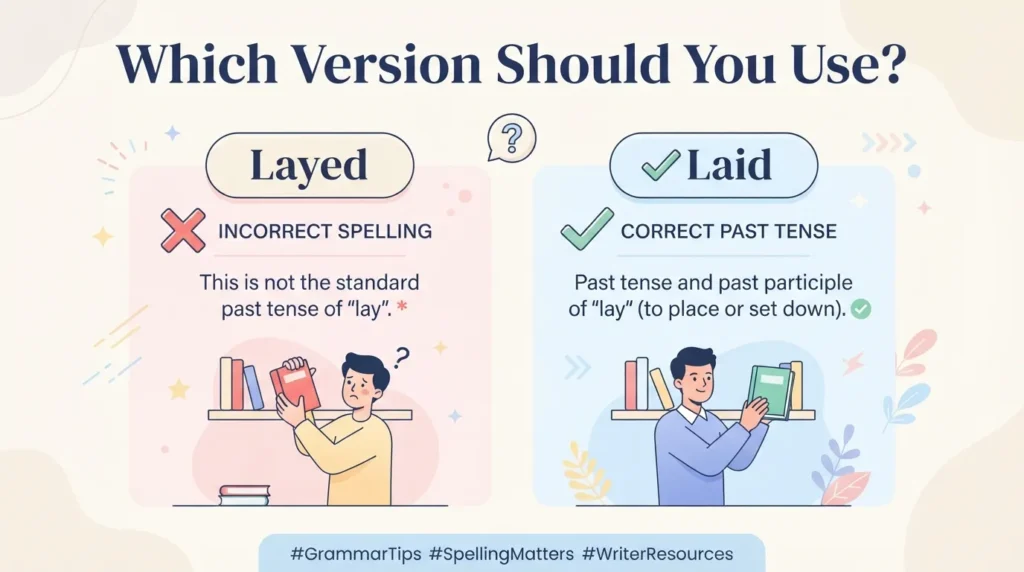
This one has a single confident answer, no audience-based exceptions required.
For every audience, in every context, use laid. Formal essays, casual texts, business emails, and creative writing all follow the same rule here.
If you’re tempted to use layed because it looks familiar from a name, brand, or specific phrase, double check that context carefully first. Outside of proper nouns, layed simply isn’t standard English anywhere.
Common Mistakes with Layed or Laid
These five mix-ups come up again and again, even among confident writers.
Mistake 1: Writing layed instead of laid. Wrong: “He layed the tools down and took a break.” Correct: “He laid the tools down and took a break.” Why it happens: Writers apply the regular “ed” pattern from verbs like played and stayed.
Mistake 2: Confusing lay and lie in the present tense. Wrong: “I’m going to lay down for a nap.” Correct: “I’m going to lie down for a nap.” Why it happens: “Lay” requires an object, like laying something down, while “lie” describes reclining yourself, and the two verbs get blended constantly in casual speech.
Mistake 3: Using lay instead of laid for past tense. Wrong: “Yesterday, she lay the blanket on the bed.” Correct: “Yesterday, she laid the blanket on the bed.” Why it happens: “Lay” is correct as the present tense form, but it’s also the past tense of “lie,” which creates constant crossover confusion.
Mistake 4: Assuming laid only applies to physical objects. Wrong belief: Laid can only describe placing a physical item somewhere. Correct belief: Laid also applies to abstract ideas, like laying out a plan or laying down rules. Why it happens: Writers associate the verb narrowly with physical placement and forget its broader figurative uses.
Mistake 5: Overcorrecting and avoiding laid entirely. Wrong: Rewriting every sentence to avoid the word because of past confusion, resulting in awkward phrasing. Correct: Trust “laid” once you understand the rule, and use it naturally and confidently. Why it happens: Past embarrassment over the mistake makes some writers avoid the word altogether instead of simply learning the correct form.
Layed or Laid in Real World Examples
Professional email: “I laid out the quarterly targets in the attached spreadsheet for your review.”
News headline: “City Council Laid Groundwork for New Transit Plan This Week”
Social media post: “Finally laid down some new house rules with the kids, and it already feels calmer around here.”
Formal report: “The committee laid several key recommendations before the board for final approval.”
Each example uses laid naturally, whether describing a physical action or a figurative one like setting expectations.
Layed or Laid: Data, Trends & Usage
Search interest in this topic stays consistently high, since the mistake is so common across everyday writing, resumes, and business communication. People searching this term are almost always trying to confirm spelling before publishing or sending something important.
This is an informational search with a strong practical purpose. Writers aren’t debating grammar theory. They’re checking a word right before hitting send on an email or submitting a document, which makes clarity and confidence the most valuable things a guide like this can offer.
Standalone Comparison Table
| Term/Variant | Meaning | Region/Context | Best Used When |
| Laid | Past tense and past participle of “lay” | Standard English, worldwide | Describing something placed down, in past tense |
| Layed | Not a standard English word | Nonstandard, avoid entirely | Never appropriate in correct writing |
| Lay | Present tense of “lay,” or past tense of “lie” | Standard English, worldwide | Placing something now, or describing reclining in the past |
| Lie | Present tense meaning to recline | Standard English, worldwide | Describing a person or animal reclining |
Related Words Worth Knowing
A few related verb forms trip people up in similar ways, so understanding this pattern helps beyond just laid and layed.
Paid follows the exact same irregular pattern as laid. The verb “pay” doesn’t become “payed” in standard use, it becomes paid, just like lay becomes laid instead of the expected layed.
Said works the same way too. “Say” doesn’t become “sayed,” it becomes said, following that same irregular shift instead of the regular “ed” ending.
Noticing this shared pattern across paid, said, and laid makes the irregular form easier to remember. These verbs simply don’t follow the standard “ed” rule, and recognizing that pattern helps prevent the mistake from happening again.
Frequently Asked Questions
Q: What does layed or laid mean?
A: Laid means placed something down, and it’s the correct past tense of “lay.” Layed isn’t a real word and should never be used.
Q: How do you use laid correctly?
A: Use laid whenever you’re describing the past tense of placing something down, such as “she laid the papers on the desk.”
Q: Laid vs lay, what’s the actual difference?
A: Lay is the present tense verb requiring an object, while laid is its past tense form. “I lay the blanket down now” becomes “I laid the blanket down yesterday.”
Q: Is layed acceptable in formal writing?
A: No. Layed is considered a spelling error in every formal or informal context, and it should always be corrected to laid.
Q: Which version is correct, layed or laid?
A: Laid is correct. Layed is a common misspelling that doesn’t appear in standard dictionaries as a valid form.
Q: Where does the confusion between layed and laid come from?
A: It comes from the regular “ed” pattern used in verbs like played and stayed, which writers mistakenly apply to the irregular verb “lay.”
Q: Can layed ever be used correctly?
A: No, not in standard English. The only correct past tense form of “lay” is laid, in every context and audience.
Final Thoughts
Laid is the only correct spelling here, and layed simply isn’t a standard word, no matter the context. Remember that lay needs an object, while lie describes reclining, and laid is always the past tense you’re looking for when something got placed down.
Now you know exactly how to use laid correctly, so go try it in your next piece of writing. Bookmark this guide so you never second guess it again.
See More: Grey or Gray? The Real Difference Explained

Hi, I’m Zara. Words that look almost identical but mean completely different things have always fascinated me, that’s what pulled me toward writing about spelling and usage. I focus on digging into where these mix-ups actually come from, whether it’s a British-American split or just a rule English never bothered to make consistent. My goal with every guide is simple: give you the answer fast, then explain it well enough that you never have to look it up again.