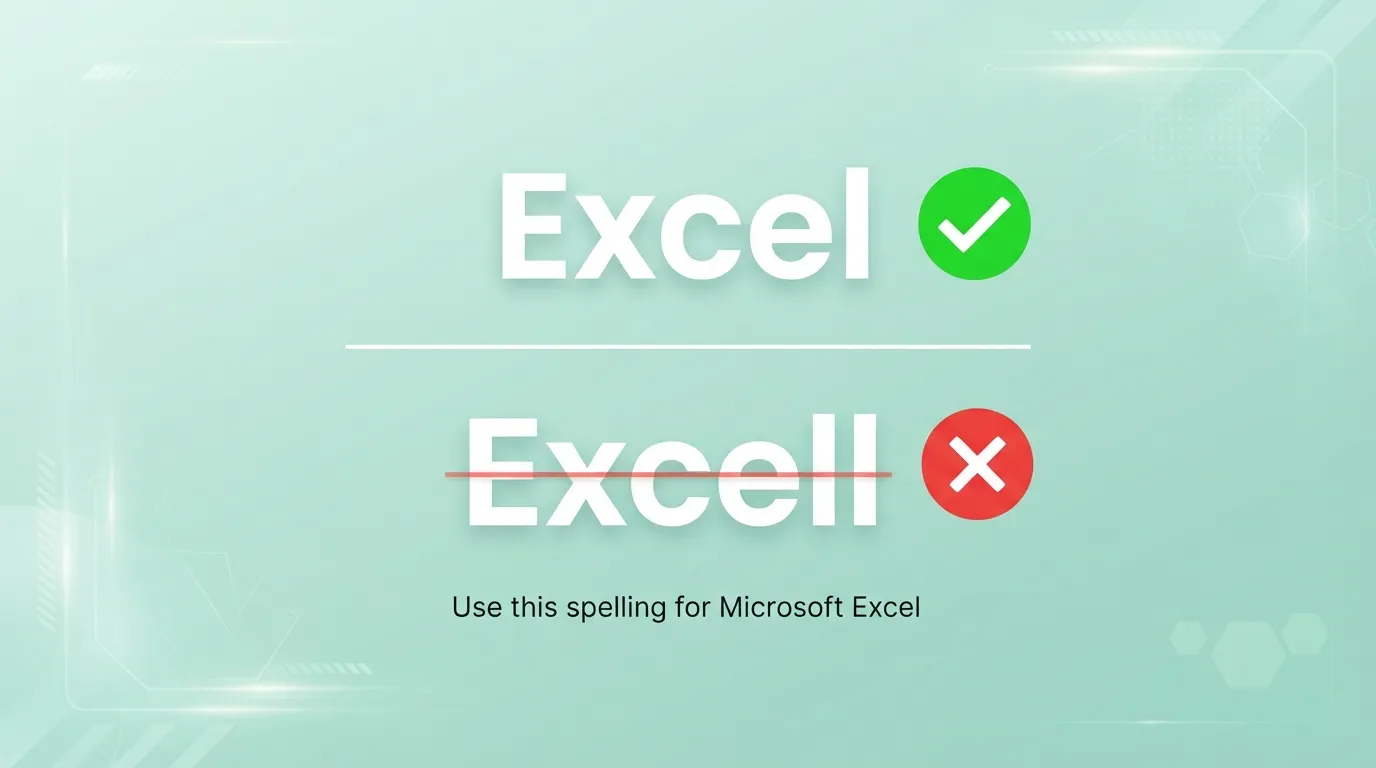
Excel is the correct spelling, whether you mean the Microsoft spreadsheet program or the verb meaning to perform extremely well. Excell is a common misspelling and is never correct in standard English.
I once watched a job applicant list “Advanced Excell skills” on their resume, right at the top of the page. That single extra letter probably cost them the interview before anyone even read the rest. Spelling mistakes on skill claims tend to stand out the most.
This mix up happens constantly, and honestly, it makes sense. Plenty of English words double their final consonant when you add an ending, like “travel” becoming “travelling” in British English. Your brain expects that pattern here too, and it guesses wrong.
This guide clears up the confusion once and for all. You will learn why Excel only has one L, where the word comes from, and how to make sure you never type it wrong again, whether you are writing a resume, an email, or a spreadsheet formula.
Excel or Excell: Quick Answer
Excel is always spelled with one L at the end, no matter how you use it. It works as a verb meaning to be outstandingly good at something, and it is also the official name of Microsoft’s spreadsheet software.
Excell is simply a misspelling. It is not a variant, not a regional difference, and not an alternate accepted form anywhere in English.
A quick example makes the rule permanent. “She continues to excel in mathematics” is correct. “She continues to excell in mathematics” is not.
The Origin of Excel
Excel comes from the Latin word excellere, which combines ex meaning “out” and celsus meaning “high.” Together, the word literally meant to rise above or stand out from the rest.
English absorbed this word through French in the 14th century, keeping the double L from its Latin root but trimming the spelling down as it settled into everyday use. By the time Microsoft launched its spreadsheet software in 1985, the company chose the word Excel specifically because it captured the idea of outperforming other tools on the market at the time.
The confusion with “Excell” likely comes from English spelling patterns elsewhere. Words like “spell,” “sell,” and “tell” all end in double L, so writers instinctively apply that same pattern here. Excel simply breaks the rule.
Excel vs Excell: Key Differences
| Term | Meaning | When to Use | Region/Context |
|---|---|---|---|
| Excel | To perform very well, or Microsoft’s spreadsheet software | Always, in every context | Universal, all English regions |
| Excell | Not a real word | Never | Not applicable |
Example with Excel (verb): He worked hard every semester to excel in his engineering courses.
Example with Excel (software): Our finance team tracks the entire budget in Excel.
There is no situation where “Excell” is the correct choice. Unlike other confusing word pairs on this site, this one is not a case of two valid options. It is a single correct spelling and one very common mistake.
Excel Cheat Sheet
Keep this quick reference nearby whenever you write:
- Correct spelling: Excel, always one L at the end.
- Related word forms: excellent, excellence, excelled, excelling, all keep the double L only after adding a vowel ending.
- Memory trick: Excel rhymes with “cell,” which also has just one L before the final letter.
- Software name: Microsoft Excel, never Microsoft Excell, in any official documentation.
- Common trap: Doubling the L happens naturally when adding “ed” or “ing,” but the base word itself never doubles.
Which Version Should You Use?
For students and professionals writing resumes, always use Excel. A misspelled skill listing undermines your credibility instantly, especially for a skill meant to show attention to detail.
For anyone referencing the software, use Excel exactly as Microsoft spells it, including in emails, tutorials, and job postings that mention spreadsheet requirements.
For writers using the word as a verb, use Excel to describe outstanding performance, whether in sports, academics, or business.
There is no audience, region, or context where “Excell” becomes acceptable. This is one of the rare word pairs on this site with a single, universal answer.
Common Mistakes with Excel and Excell
| Mistake | Correction | Why It Happens |
|---|---|---|
| “I have strong Excell skills.” | “I have strong Excel skills.” | Writers assume the software name doubles its final letter like many other English words. |
| “She wants to excell at her new job.” | “She wants to excel at her new job.” | The base verb form gets an extra letter added out of habit, even though it only needs one L. |
| “He excells in every subject.” | “He excels in every subject.” | The present tense form only needs one L, since the doubling rule does not apply here. |
| “Excellling in Excel takes practice.” | “Excelling in Excel takes practice.” | Writers add an extra L out of habit when forming the ing ending. |
| Assuming Excell is a British spelling variant | There is no regional variant, Excel is universal | People often assume double L words are simply a UK versus US spelling issue. |
A simple rule locks this in permanently. The base word Excel has one L. Only when you add certain endings like “ing” or “ed” does a second L appear, and even then it stays as one added letter, never two doubled at the base.
Excel in Real World Examples
Professional email: “I have attached the updated Excel spreadsheet with this quarter’s sales figures.”
News headline: “Local student continues to excel academically despite competing in national athletics.”
Social media post: “Just finished an Excel course and my spreadsheet game has never been stronger!”
Formal document: “All financial reports must be submitted using the standard Excel template provided by the finance department.”
Resume bullet point: “Proficient in Excel, including pivot tables, formulas, and data visualization tools.”
Each example reinforces the same rule. Whether you mean the software or the verb, Excel always keeps its single L.
Excel vs Excell: Data, Trends and Usage
Search volume for “Excel or Excell” stays consistently high year round, driven largely by job seekers writing resumes and students formatting assignments. The software’s massive global user base keeps this search steady across nearly every industry.
Interest spikes noticeably during hiring seasons and the start of school terms, when people update resumes and cover letters that list spreadsheet skills. Business professionals, data analysts, and finance students represent the largest share of searchers looking to confirm this spelling.
The search intent here is almost entirely informational, though it carries real consequences, since a misspelled skill on a resume can quietly cost someone a job opportunity. This matters right now because remote work and data heavy roles have made Excel proficiency one of the most commonly listed skills across job platforms.
Standalone Comparison Table
| Term/Variant | Meaning | Region/Context | Best Used When |
|---|---|---|---|
| Excel | To perform excellently, or Microsoft’s spreadsheet program | Universal, all industries and regions | Always, in every written or spoken context |
| Excell | Misspelling with no accepted meaning | Not applicable | Never |
Frequently Asked Questions
Q: What does Excel mean? A: Excel means to perform extremely well at something, and it is also the name of Microsoft’s widely used spreadsheet software.
Q: Is Excell ever a correct spelling? A: No, Excell is not a recognized word in any English dictionary or regional variant. It is simply a common misspelling of Excel.
Q: Excel vs Excell, what is the difference? A: There is no real difference in meaning, since Excell is not a valid word. Excel is the only correct spelling in every context.
Q: Is Excel acceptable in formal writing? A: Yes, Excel is completely standard in formal writing, whether referencing the software or using the word to describe outstanding performance.
Q: Why do people spell it Excell by mistake? A: Many English words double their final consonant when adding endings, so writers assume Excel follows the same pattern, even though it does not.
Q: Where does the word Excel come from? A: Excel comes from the Latin word excellere, meaning to rise above or stand out, and it entered English through French in the 14th century.
Q: Does Excel double its L when you add an ending? A: Yes, but only when adding certain endings like ing or ed, as in excelling and excelled. The base word Excel itself always keeps just one L.
Q: Can Excell be used as a brand or company name? A: Some companies do use Excell as a stylized brand name, but this is a deliberate trademark choice, not a standard English spelling.
Read More: Mantel or Mantle: The Complete Guide to Getting It Right
Final Thoughts
Excel is the only correct spelling, full stop. Whether you are praising someone’s performance or opening a spreadsheet, that single L makes all the difference between a polished piece of writing and an easily avoidable mistake.
Remember the cheat sheet: Excel rhymes with cell, keeps one L at its base, and only gains an extra letter when you add ing or ed. Excell simply does not exist as a correct word anywhere in English.
Now you know exactly how to spell Excel every single time, so go update that resume or spreadsheet with total confidence. Bookmark this guide and share it with anyone still typing that extra letter.
Read More: Gen Z vs Millennial: The Real Difference Explained

My name is Ayesha Sadiqah, the writer behind this website. I write in-depth articles on English spelling, word comparisons, grammar, and vocabulary to help learners make better language choices. Every guide is carefully researched and designed to provide accurate, practical, and easy-to-understand information.