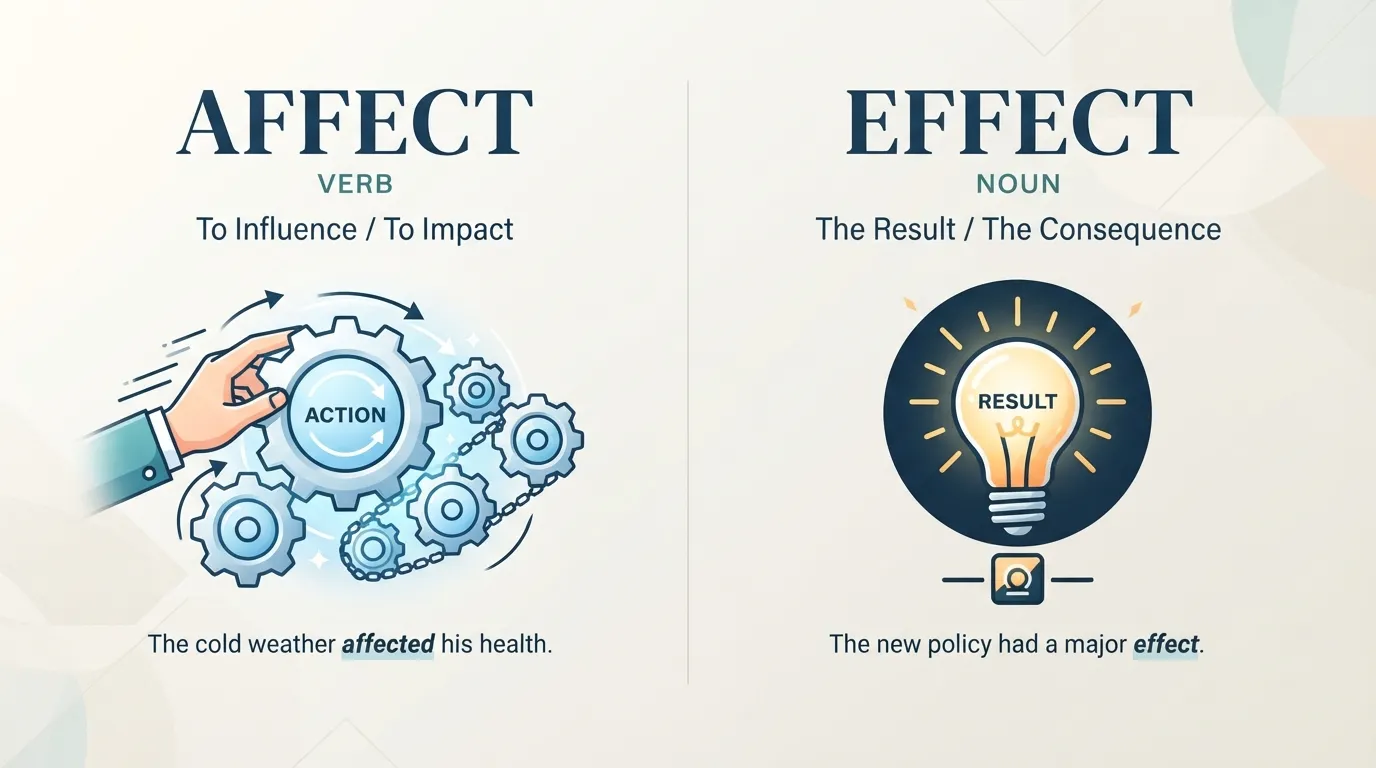
Affect is almost always a verb meaning to influence something, while effect is almost always a noun meaning the result of a change. One acts on something. The other is the outcome.
I once submitted a college paper with the line “the medication had a strong affect on my energy levels,” and my professor circled that single word in red ink. I stared at it, confused, since the sentence felt completely normal to me. That small correction stuck with me for years.
This mix up might be the single most common spelling confusion in the English language. Millions of people search for the difference every single month, and honestly, that number makes sense. These two words sound almost identical, share a Latin root, and both deal with cause and consequence.
This guide clears up the confusion for good. You will learn exactly when to use affect, when to use effect, and a simple trick that makes the choice automatic every time you write.
Affect or Effect Quick Answer
Affect functions as a verb in nearly every sentence. It means to influence, change, or have an impact on something.
Effect functions as a noun in nearly every sentence. It means the result or outcome that follows a cause.
Here is a simple example. “The rain will affect our picnic plans” uses affect as an action. “The effect of the rain was a canceled picnic” uses effect as the result.
The Origin of Affect and Effect
Both words trace back to Latin. Affect comes from afficere, meaning to influence or act upon something. Effect comes from efficere, meaning to bring about or accomplish.
Notice how close those Latin roots already are. Both words share the base facere, meaning to do or make. English inherited them separately through French, and over centuries, their meanings settled into the verb and noun roles they hold today.
The confusion exists because the words sound nearly identical when spoken. Add in the fact that they both relate to cause and consequence, and it becomes easy to see why so many writers mix them up, even after years of using English every day.
Affect vs Effect Explained: Key Differences
| Term | Meaning | When to Use | Part of Speech |
|---|---|---|---|
| Affect | To influence or change something | Describing an action or impact | Verb, in almost all cases |
| Effect | A result or outcome | Describing the consequence of something | Noun, in almost all cases |
Example with affect: Stress can affect your sleep quality.
Example with effect: Poor sleep quality is often an effect of ongoing stress.
There is a helpful memory trick here. Affect starts with A, like Action. Effect starts with E, like End result. That small connection can save you from second guessing every single time.
Which Version Should You Use?
For most everyday sentences describing influence or change, use affect. If you can replace the word with “influence” or “impact” as a verb, affect is correct.
For most sentences describing a result, outcome, or consequence, use effect. If you can replace the word with “result” or “outcome,” effect is correct.
For less common cases, both words can switch roles. Affect can function as a noun in psychology, referring to a person’s emotional expression. Effect can function as a verb, meaning to bring something about, as in “effect change.” These uses are rare, so stick to the standard pattern unless you are writing in a specialized field.
Common Mistakes with Affect and Effect
| Mistake | Correction | Why It Happens |
|---|---|---|
| “The medicine had a strong affect on me.” | “The medicine had a strong effect on me.” | Writers default to affect since it feels more familiar in casual speech. |
| “This decision will effect our future plans.” | “This decision will affect our future plans.” | The verb role gets confused since effect sounds similar and relates to consequences too. |
| “I want to affect real change in my community.” | “I want to affect real change in my community.” | This one is actually correct, since affect as a verb fits here. |
| “The new policy will have a big affect on employees.” | “The new policy will have a big effect on employees.” | Writers assume affect works as a noun, though effect is the standard noun choice. |
| Mixing up the words in formal writing | Slow down and ask if you need an action or a result | Fast writing often skips the mental check that catches this mistake. |
A simple test locks this in. Try swapping in “influence” for affect and “result” for effect. If the swap makes sense, you picked the right word.
Affect and Effect in Real World Examples
Professional email: “We wanted to update you on how the new schedule will affect your weekly hours.”
News headline: “Economists warn that rising interest rates could have a lasting effect on housing prices.”
Social media post: “Getting eight hours of sleep really does affect my mood the next day.”
Formal document: “The report outlines the long term effects of the proposed infrastructure changes.”
Each example follows the same reliable pattern. Affect shows up as the action word. Effect shows up as the outcome word.
Affect vs Effect Data, Trends and Usage
Search interest in “affect or effect” dominates every other confused word pair in English, with over one million monthly searches across the United States alone. This makes it the single most searched spelling confusion tracked in recent language data.
Students, writers, and professionals drive most of this search volume, often while actively writing an email, essay, or report and pausing to confirm their word choice. Interest stays consistently high year round, without any strong seasonal pattern, since the confusion applies to everyday writing rather than a specific event or season.
The search intent behind this keyword is almost entirely informational, though it carries real consequences for professional writing credibility. This matters because a misused affect or effect is one of the fastest ways a reader notices a writing mistake, even in an otherwise well written piece.
Standalone Comparison Table
| Term/Variant | Meaning | Region/Context | Best Used When |
|---|---|---|---|
| Affect | To influence or change something | Universal, all English speaking regions | Describing an action or impact |
| Effect | A result or outcome | Universal, all English speaking regions | Describing a consequence or result |
Frequently Asked Questions
Q: What does affect mean? A: Affect means to influence, change, or have an impact on something. It almost always functions as a verb in everyday writing.
Q: What does effect mean? A: Effect means a result or outcome that follows a cause. It almost always functions as a noun in everyday writing.
Q: Affect vs effect, what is the easiest way to remember the difference? A: Affect starts with A for action, since it is usually a verb. Effect starts with E for end result, since it is usually a noun.
Q: Is effect ever used as a verb? A: Yes, though rarely. Effect can mean to bring something about, as in “effect meaningful change,” but this usage is uncommon outside formal writing.
Q: Which version is correct, affect or effect, when describing an emotional reaction? A: Affect is correct when describing how something influences your emotions, as in “the movie affected me deeply.”
Q: Where do affect and effect come from? A: Both words trace back to Latin roots sharing the base word facere, meaning to do or make, which explains why they feel so closely related.
Q: Can affect be used as a noun? A: Yes, but only in psychology, where affect refers to a person’s visible emotional expression. This usage rarely appears outside clinical or academic writing.
Q: Is this mix up common even among experienced writers? A: Yes, extremely common. Affect and effect top the list of most searched word confusions in America, with over one million monthly searches for this pair alone.
Final Thoughts
Affect and effect might be the trickiest word pair in English, but the rule behind them is refreshingly simple. Affect acts on something. Effect is the result of that action.
Remember the shortcut: A for action, E for end result. That small anchor will guide you through nearly every sentence you write from here on.
Now you know exactly how to use affect and effect with total confidence. Bookmark this guide so you never second guess this pair again, and share it with anyone still mixing them up.
See More: Excel or Excell: The Correct Spelling Explained

I’m Zain. I got interested in commonly confused words while helping non-native English speakers prep for writing exams, where a single misused word could cost real marks. That experience shaped how I write now: I try to explain not just which spelling is correct, but why the confusion exists in the first place, since understanding the reason is what actually makes it stick.