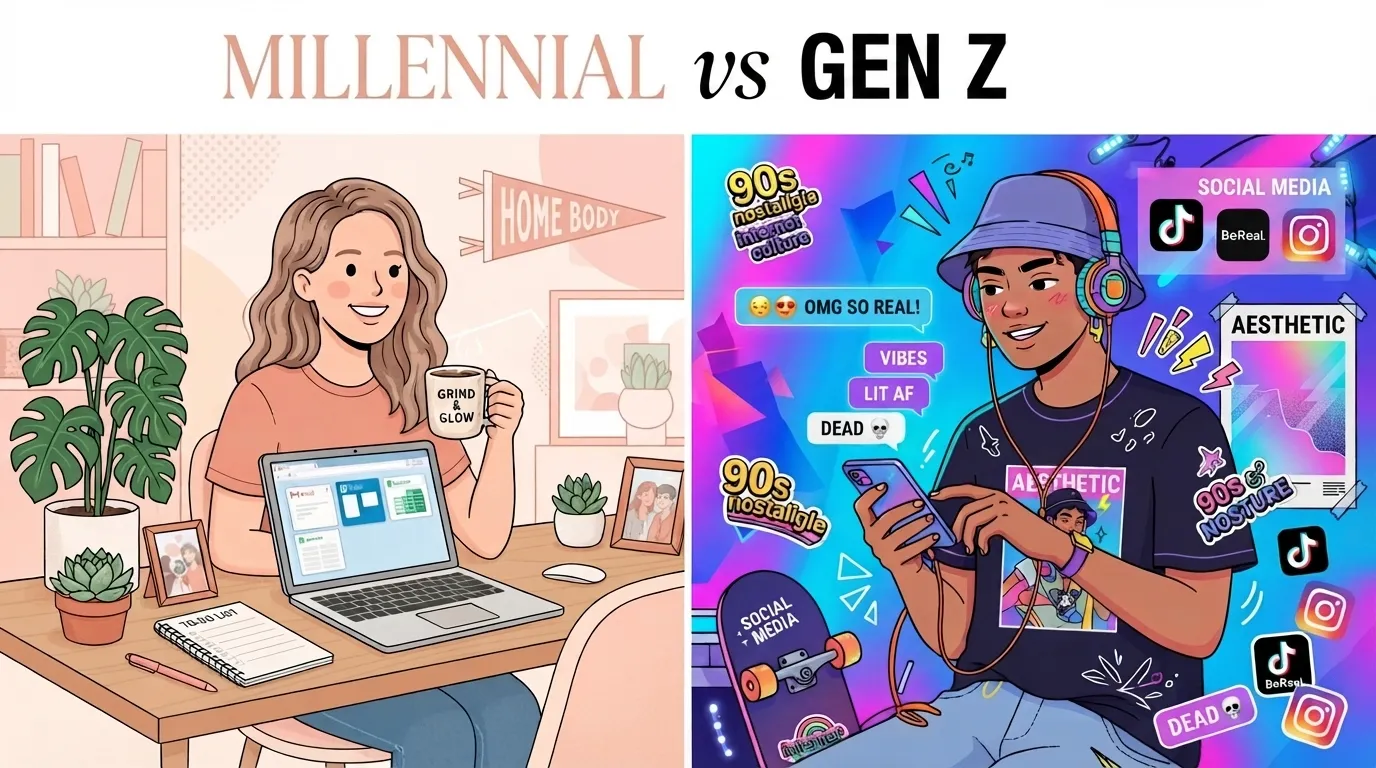
Millennials were born between 1981 and 1996, growing up alongside the early internet, while Gen Z was born between 1997 and 2012, growing up as full digital natives who never knew life without smartphones.
My younger cousin once laughed at me for saying “totes adorbs” and then asked why I still use Facebook. I laughed right back when she told me she gets her news from fifteen second videos instead of articles. We are only nine years apart, yet our entire approach to technology, work, and communication feels like two different worlds.
That conversation stuck with me because it captures exactly why people constantly search for the difference between Gen Z and Millennials. The generations blur together in everyday conversation, especially online, where terms get tossed around loosely. But the actual differences run deeper than slang or social media habits.
This guide breaks down exactly what separates Gen Z from Millennials, from birth years to values to how each group works and communicates. By the end, you will know exactly which generation you are talking about, and why it matters.
Gen Z vs Millennial: Quick Answer
Millennials, also called Generation Y, were born roughly between 1981 and 1996. They came of age during the rise of the internet, social media, and the 2008 financial crisis.
Gen Z was born roughly between 1997 and 2012. They grew up with smartphones already in hand, shaped by social media, streaming, and constant connectivity from childhood.
Both groups make up a massive share of the population. Millennials number in the tens of millions across the US alone, and Gen Z is close behind, already overtaking Millennials in some countries as the largest living generation.
A simple example shows the split clearly. A Millennial remembers dial up internet and burning CDs. A Gen Z reader has never used a landline phone at all.
Cheat Sheet: Gen Z vs Millennial at a Glance
| Category | Millennial | Gen Z |
|---|---|---|
| Birth years | 1981 to 1996 | 1997 to 2012 |
| Current age range | Late twenties to mid forties | Teens to late twenties |
| Formative tech | Early internet, flip phones, social media arrival | Smartphones, streaming, social media from birth |
| Formative event | 2008 financial crisis | Global pandemic and remote learning |
| Workplace priority | Stability and work life balance | Purpose driven work and mental health support |
| Communication style | Email and Facebook | Text, TikTok, and short form video |
The Origin of the Gen Z and Millennial Labels
Millennials earned their name because the oldest members came of age right around the turn of the millennium, in the year 2000. Researchers Neil Howe and William Strauss popularized the term in their generational research during the 1990s.
Gen Z simply continues the alphabet after Generation X and Generation Y, another name for Millennials. Some call this group iGen or Zoomers, nicknames that reflect their deep connection to the internet and smartphones from birth.
The confusion between the two groups grows because pop culture often blends them into one giant “young person” category. But a person born in 1995 and a person born in 2005 experienced radically different childhoods, technology, and world events.
Gen Z vs Millennial: Key Differences
| Term | Meaning | When to Use | Region/Context |
|---|---|---|---|
| Millennial | Born 1981 to 1996 | Referring to adults now in their late twenties to early forties | Global, especially workplace and marketing contexts |
| Gen Z | Born 1997 to 2012 | Referring to teens and young adults raised on smartphones | Global, especially social media and education contexts |
Example with Millennial: Millennials entered the workforce during the 2008 recession, which shaped their cautious approach to spending and saving.
Example with Gen Z: Gen Z grew up watching YouTube tutorials before they could write in full sentences.
The core difference comes down to technology exposure and formative events. Millennials adapted to the digital world as it emerged. Gen Z never knew a world without it.
Which Term Should You Use?
For marketers targeting young professionals in their thirties, use Millennial. This group values experiences, work life balance, and brand authenticity shaped by early internet culture.
For marketers targeting teens and young adults, use Gen Z. This group values speed, short form video content, and brands that feel genuine on platforms like TikTok.
For employers building workplace policies, understand both. Millennials often prioritize flexibility and purpose, while Gen Z prioritizes mental health support and clear career growth paths.
For general conversation about someone’s age, check their birth year first. A quick mental math check prevents an awkward generational mislabel.
Common Mistakes with Gen Z and Millennial
| Mistake | Correction | Why It Happens |
|---|---|---|
| Calling every young person a Millennial | Use Gen Z for anyone born after 1996 | Millennial became a catch all term for “young person” in media. |
| Assuming Gen Z and Millennials share identical values | Research each generation separately | Their formative experiences with technology and economics differ sharply. |
| Using Gen Z and Millennial interchangeably in marketing | Target each group with distinct strategies | Their platform habits and content preferences are not the same. |
| Believing generational cutoffs are exact worldwide | Treat birth year ranges as general guidelines | Different researchers define slightly different start and end years. |
| Assuming older Gen Z members act like teenagers | Recognize that Gen Z now includes adults in their twenties | The oldest Gen Z members are already well into their careers. |
A helpful cheat sheet fixes this fast. Millennials remember life before smartphones. Gen Z does not. That single test settles most confusion instantly.
Gen Z and Millennials at Work
Workplace behavior is where these two generations diverge the most, and it is also the number one reason employers search for this comparison.
Millennials entered the job market during a recession. That experience made many of them prioritize job security over job satisfaction. Stability, steady pay, and a clear career ladder tend to matter more to this group than chasing a dream role right away.
Gen Z entered the job market during a period of remote work and rising education costs. That shaped a different mindset. Many Gen Z workers weigh the cost of a degree more heavily and lean toward finding meaningful work early, even if it means more job hopping to get there.
Parental influence also plays a bigger role for Gen Z than most people expect. Having grown up in constant contact with parents through texting and social media, many young Gen Z workers still lean on family advice when making career decisions, more so than Millennials did at the same age.
Quick workplace cheat sheet:
- Millennials tend to value long term stability over immediate passion
- Gen Z tends to value purpose and mental health support early in a career
- Gen Z shows more concern about education costs and student debt
- Gen Z leans more on parental guidance during job decisions
- Millennials adapted to hybrid work, while Gen Z often expects it by default
Employers who understand these patterns build stronger recruiting pitches and retention plans, since a one size fits all approach to benefits and culture rarely works across both groups.
Gen Z and Millennial in Real World Examples
Professional email: “Our marketing team is split evenly between Millennial and Gen Z employees, which gives us a strong mix of perspectives.”
News headline: “Gen Z reshapes workplace expectations as they enter the job market in record numbers.”
Social media post: “Millennial humor versus Gen Z humor is a debate that never gets old on this app.”
Formal document: “This report analyzes spending habits across Millennial and Gen Z consumers in the retail sector.”
Classroom discussion: “Millennials grew up watching cable television, while Gen Z grew up watching streaming platforms.”
Each example shows how the terms function differently depending on context, from workplace strategy to casual humor.
Gen Z vs Millennial: Data, Trends and Usage
Search interest in “Gen Z vs Millennial” spikes heavily among marketers, HR professionals, and content creators trying to understand generational differences for targeting or workplace planning. Businesses increasingly need this knowledge to communicate effectively across age groups.
Millennials dominate search interest in topics like homeownership, career advancement, and parenting, since most now fall into their thirties and forties. Gen Z dominates search interest in topics like education, first jobs, and social media trends, reflecting their younger life stage.
The intent behind this keyword is mostly informational, though it carries strong commercial value for brands and businesses. This distinction matters right now because Gen Z has become the largest generation entering the workforce and consumer market, making generational fluency a genuine business skill.
Standalone Comparison Table
| Term/Variant | Meaning | Region/Context | Best Used When |
|---|---|---|---|
| Millennial | Born 1981 to 1996 | Workplace, marketing, economic discussions | Discussing adults shaped by early internet and the 2008 recession |
| Gen Z | Born 1997 to 2012 | Social media, education, early career discussions | Discussing young adults raised entirely with smartphones |
Frequently Asked Questions
Q: What does Millennial mean? A: Millennial refers to the generation born roughly between 1981 and 1996, named for coming of age around the turn of the millennium.
Q: What does Gen Z mean? A: Gen Z refers to the generation born roughly between 1997 and 2012, known for growing up with smartphones and social media from an early age.
Q: Gen Z vs Millennial, what is the main difference? A: The main difference is technology exposure and timing. Millennials adapted to the internet as it grew, while Gen Z was born into a fully digital world.
Q: Is Gen Z considered adults yet? A: Yes. The oldest members of Gen Z are already in their late twenties, working full time jobs and building careers.
Q: Which generation comes after Gen Z? A: Generation Alpha follows Gen Z, generally referring to those born from around 2013 onward.
Q: Where do the terms Gen Z and Millennial come from? A: Millennial comes from researchers Neil Howe and William Strauss in the 1990s, while Gen Z simply continues the generational naming pattern after Generation X.
Q: Can someone born in 1996 or 1997 be either generation? A: Yes, birth years right at the cutoff are sometimes called cusp years, and different researchers may classify them slightly differently.
Q: Do Gen Z and Millennials share the same values? A: Not entirely. Both value authenticity and flexibility, but Gen Z leans more toward mental health awareness and short form content, while Millennials lean toward stability and work life balance.
Q: How do Gen Z and Millennials differ at work? A: Millennials generally prioritize stability and steady career growth, while Gen Z prioritizes purpose driven roles, mental health support, and flexibility, often shaped by rising education costs and closer contact with parents during decision making.
Final Thoughts
Gen Z and Millennials share more overlap than people assume, yet their formative experiences created two genuinely distinct generations. Millennials grew up watching the internet arrive. Gen Z grew up never knowing a world without it.
Understanding this difference helps in marketing, workplace communication, and even everyday conversation, since assuming everyone under forty thinks the same way leads to missed connections and missed opportunities.
Bookmark this guide so you always know exactly which generation you are talking about, and share it with anyone still mixing up Gen Z and Millennials.
See More: Childish or Childlike: The Complete Guide to Using Both Right

I’m Zain. I got interested in commonly confused words while helping non-native English speakers prep for writing exams, where a single misused word could cost real marks. That experience shaped how I write now: I try to explain not just which spelling is correct, but why the confusion exists in the first place, since understanding the reason is what actually makes it stick.