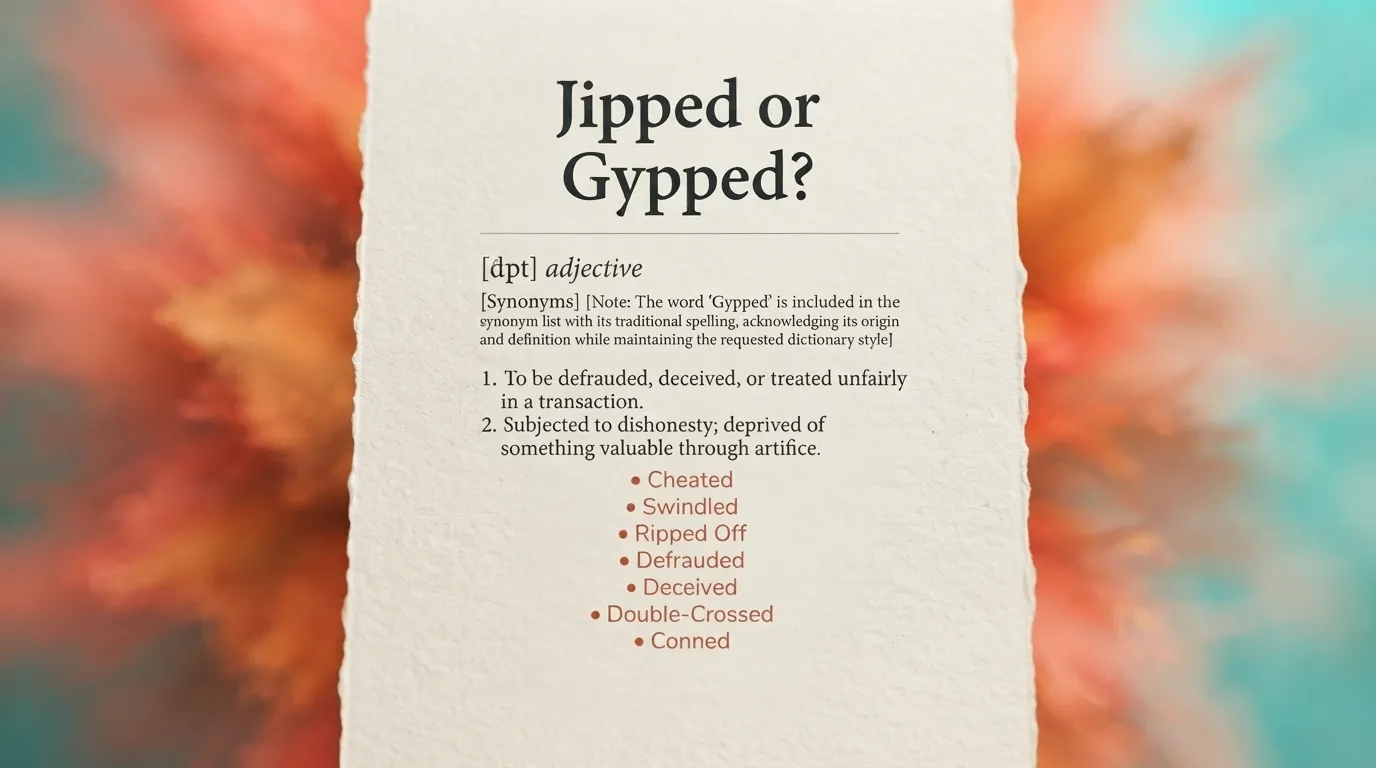
Gypped is the standard dictionary spelling. It means to be cheated or swindled. Jipped is a common informal respelling of the same word. People often use jipped to avoid an old ethnic association some hear in gypped.
I once heard a coworker say she got “jipped” on a return refund. Another coworker corrected her spelling in the group chat five minutes later. He insisted the real word was “gypped.” Neither of them was fully right. Neither was fully wrong either. That small exchange left me curious enough to dig into where this word actually came from.
This is not a simple spelling mistake. Most word pairs on this site come down to a typo or a mixed up sound. This one is different. It touches on language, history, and the weight some words carry long after most people forget where they started.
So let’s clear it up. This guide breaks down where gypped and jipped came from. You will also learn which spelling dictionaries recognize, and how to use either word thoughtfully in your own writing.
Jipped or Gypped Quick Answer
Gypped is the spelling you will find in major dictionaries. It means to cheat, trick, or swindle someone out of money or property.
Jipped, on the other hand, is not a standard dictionary entry. It works as an informal, phonetic respelling. Some writers choose it specifically to sidestep the word’s more complicated origin.
Here is a quick example. “I think I got gypped on this deal” and “I think I got jipped on this deal” mean exactly the same thing to most listeners. Only the spelling changes.
The Origin of Gypped and Jipped
Most language references trace gypped back to an old and outdated term once used for the Romani people. That term implied a stereotype accusing Romani travelers of trickery and deceit. It was a harmful idea, not a fact.
Not every linguist agrees on the exact path this word took. Some dictionaries describe the connection as “probable” rather than fully confirmed. Even so, the link is widely accepted. Many style guides now flag the word as potentially offensive because of it.
Jipped likely came later, as a spoken variation. Over time, it made its way into informal writing too. Because it drops the visual tie to that older term, some writers use it to avoid reinforcing the stereotype. Still, both words sound identical out loud.
Gypped vs Jipped Key Differences
| Term | Meaning | When to Use | Region/Context |
|---|---|---|---|
| Gypped | To be cheated or swindled | Standard, dictionary recognized spelling | Widely used across English speaking regions |
| Jipped | Same meaning, informal respelling | Casual speech and writing | Common in North America, especially online |
Example with gypped: He felt like he got gypped after paying full price for a broken appliance.
Example with jipped: She said the street vendor jipped her out of ten dollars.
Both sentences share the exact same idea. Only the spelling and the sensitivity behind it set them apart.
Which Version Should You Use?
For formal writing, journalism, and professional content, skip both words if you can. Try “cheated,” “swindled,” or “shortchanged” instead. Each one carries the same meaning without any historical baggage.
For casual conversation, gypped remains the more recognized spelling, if you choose to use the term at all.
For writers who want a softer option, jipped is the more common informal choice. However, it does not fully erase the word’s history, since it sounds identical when spoken aloud.
For anyone writing about or with the Romani community, avoid both words entirely. The connection to a harmful stereotype is too well known to ignore.
Common Mistakes with Jipped and Gypped
| Mistake | Correction | Why It Happens |
|---|---|---|
| Assuming jipped is simply a misspelling of gypped | Treat jipped as a deliberate informal respelling, not an error | Many writers do not know the word’s background. |
| Using gypped without knowing its origin | Choose a neutral alternative like cheated or swindled | The word feels common and harmless in casual speech. |
| Treating the word origin as fully confirmed | Note that the link is widely believed, though still debated among linguists | Some writers overstate certainty around disputed word origins. |
| Using either word in formal writing | Swap in a neutral synonym instead | Formal writing calls for language that feels comfortable to every reader. |
| Assuming jipped removes all sensitivity | Remember both words sound the same out loud | A new spelling does not change how a word sounds when spoken. |
Here is a simple rule to remember. When a word has any link to an ethnic group, even a disputed one, a neutral synonym is almost always the safer choice.
Jipped and Gypped in Real World Examples
Professional email: “We understand you feel the pricing was unfair, and we want to make sure you were not shortchanged on this order.”
News headline: “Consumers say ticket resale sites leave buyers feeling cheated out of hundreds of dollars.”
Social media post: “Ngl I feel so jipped after waiting two hours for a table that was already reserved.”
Formal document: “The report found that several customers were financially disadvantaged due to misleading sales practices.”
Notice the pattern here. Professional and formal writing avoid both gypped and jipped completely. Casual social posts, meanwhile, keep the informal tone readers expect online.
Jipped vs Gypped Data, Trends and Usage
Search interest in “jipped or gypped” comes mostly from writers, students, and curious readers. Most want to confirm the correct spelling before using the word in a sentence, email, or post. Many are also trying to figure out if the word is offensive.
Gypped shows up more in dictionaries and older, formal reference material. Jipped, by contrast, appears more often in casual online writing, forums, and text based conversation.
This search intent blends two goals: confirming spelling and understanding sensitivity. That second goal has grown as more writers pay closer attention to language tied to marginalized groups. As a result, audiences today notice word choices tied to old stereotypes more than ever, even in casual writing.
Standalone Comparison Table
| Term/Variant | Meaning | Region/Context | Best Used When |
|---|---|---|---|
| Gypped | To be cheated, dictionary recognized spelling | Widely used across English speaking regions | Informal contexts, if used at all |
| Jipped | Same meaning, informal respelling | Common in North American casual writing | Casual speech, still carries similar sensitivity |
Frequently Asked Questions
Q: What does gypped mean? A: Gypped means to be cheated, tricked, or swindled out of money or something of value. It is the spelling recognized in most standard dictionaries.
Q: What does jipped mean? A: Jipped carries the same meaning as gypped. It is an informal respelling some writers use instead of the traditional spelling.
Q: Jipped vs gypped, what is the actual difference? A: The meaning is identical. Only the spelling changes, along with how much awareness each writer brings to the word’s history.
Q: Is gypped acceptable in formal writing? A: Most style guides now suggest avoiding it. The word carries a widely believed connection to a stereotype about the Romani people.
Q: Which version is correct, jipped or gypped? A: Gypped is the version found in dictionaries. Jipped remains an informal variant that most major dictionaries have not formally adopted.
Q: Where does the word gypped come from? A: Most language references trace it to an old term for the Romani people, though the exact history stays debated among linguists.
Q: Can jipped or gypped be used in professional documents? A: It is best to avoid both. Neutral words like cheated or swindled communicate the same idea, without any risk.
Q: Is it offensive to use gypped in everyday conversation? A: Many people use it without any intent to offend. Even so, its historical link means some listeners may find it uncomfortable.
Final Thoughts
Gypped and jipped mean the same thing. They carry different levels of recognition, though, along with different amounts of hidden history. Gypped holds the dictionary backed spelling. Jipped exists as an informal workaround many people reach for without knowing why.
Here is the real takeaway. Whenever a common word has any link to a marginalized group, a neutral alternative like cheated or swindled almost always serves your writing better.
Now you know the real story behind jipped and gypped. Use that knowledge to make an informed choice the next time you write either word. Share this guide with anyone who has wondered which spelling was correct.
Read More: Excel or Excell: The Correct Spelling Explained

Hey, I’m Ayeza. I started this site because I kept hitting the same wall over and over: typing a word, freezing, and not trusting my own instinct on the spelling. Now I research these mix-ups properly so you don’t have to, and I write every guide the way I wish these explanations had been written for me.