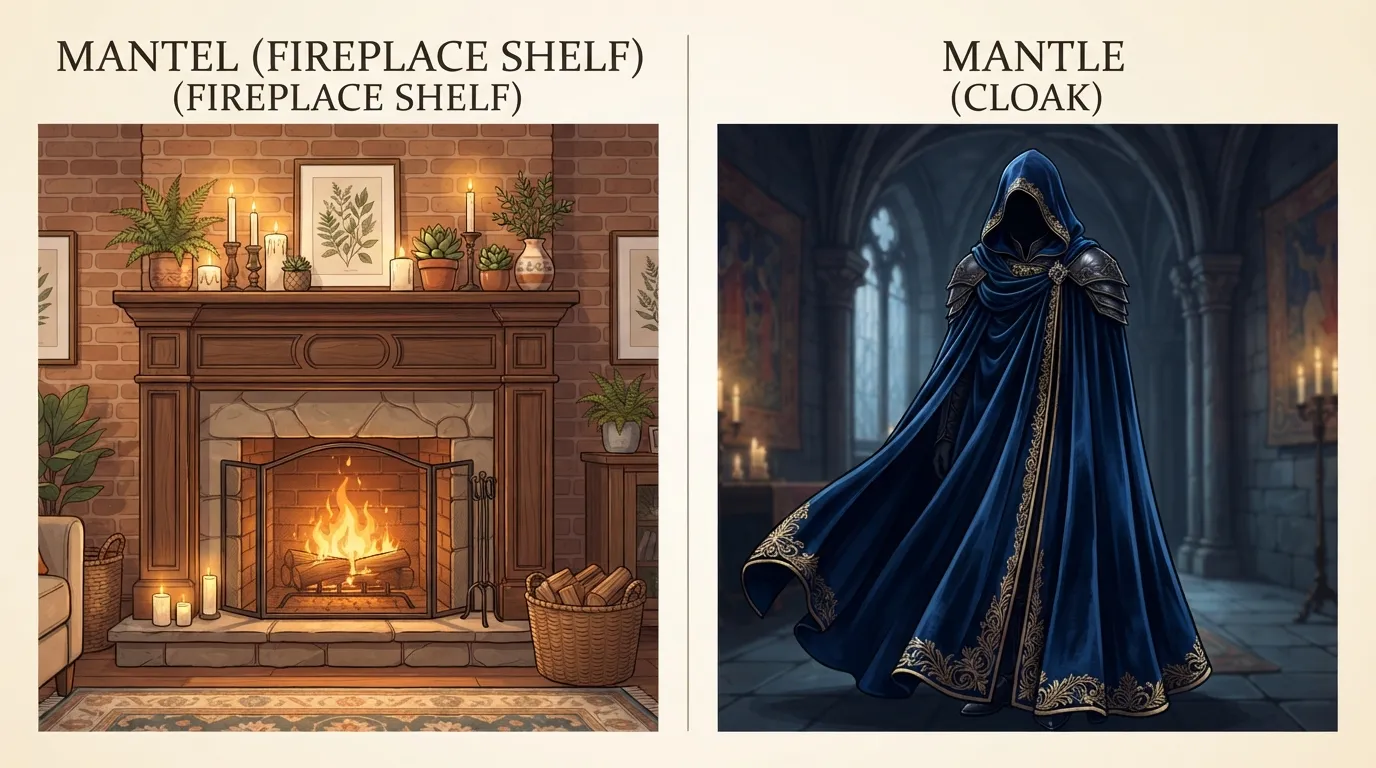
Mantel refers to the shelf or frame above a fireplace, while mantle refers to a cloak, a covering layer, or the layer of the Earth beneath the crust.
I once wrote a home renovation caption that said “new mantle installed above the fireplace” and got a comment correcting me within minutes. I felt embarrassed, but I also understood why it happened. These two words sound completely identical when spoken out loud.
That is the entire problem. Mantel and mantle are homophones, which means your ears cannot tell them apart even though your eyes should. Autocorrect does not help much either, since both are real, valid words.
This guide settles the confusion for good. You will learn exactly what each word means, where they diverge, and how to remember which one to use without hesitation ever again.
Mantel or Mantle: Quick Answer
Mantel is a noun that refers specifically to the shelf or decorative frame built above and around a fireplace opening.
Mantle is a noun and verb with several meanings, including a loose cloak worn over clothing, a covering layer of something, and the thick layer of rock inside the Earth between the crust and the core.
A quick example shows the split clearly. You place holiday stockings on the mantel. A queen wears a royal mantle.
The Origin of Mantel and Mantle
Both words actually share the same root, which explains a lot of the confusion. They come from the Old French word mantel, meaning cloak or covering.
Centuries ago, English speakers used the two spellings interchangeably. Over time, the language split them into separate roles. Mantle kept the original sense of covering, cloak, and layer. Mantel narrowed down to describe the specific structure above a fireplace, since early fireplace frames resembled a hood or covering over the flames.
This shared history is exactly why the words feel so tangled today. They are not unrelated look alikes like other confusing pairs. They are branches of the same original word that grew apart in meaning while staying identical in sound.
Mantel vs Mantle: Key Differences
| Term | Meaning | When to Use | Region/Context |
|---|---|---|---|
| Mantel | Shelf or frame above a fireplace | Home design, decor, architecture | Universal, primarily interior design |
| Mantle | Cloak, covering, or Earth layer | Fashion, science, figurative speech | Universal, spans multiple fields |
Example with mantel: She decorated the mantel with candles and fresh pine branches for the holidays.
Example with mantle: The scientist explained how heat moves through the Earth’s mantle to create volcanic activity.
If your sentence involves a fireplace, always reach for mantel. If your sentence involves clothing, covering, responsibility, or geology, reach for mantle.
Which Version Should You Use?
For interior designers and homeowners, use mantel whenever you describe the shelf above a fireplace, including its decor, material, or style.
For writers covering science or geology, use mantle to describe the Earth’s internal layers, since this is the standard scientific term.
For fashion and historical writing, use mantle when referencing cloaks, capes, or ceremonial coverings worn over the shoulders.
For figurative writing, use mantle in phrases like “take up the mantle of leadership,” since this idiom always uses the covering sense of the word, never the fireplace shelf.
Common Mistakes with Mantel and Mantle
| Mistake | Correction | Why It Happens |
|---|---|---|
| “The clock sits on the mantle.” | “The clock sits on the mantel.” | Writers default to the more common spelling without checking context. |
| “She wore a beautiful mantel over her gown.” | “She wore a beautiful mantle over her gown.” | The fireplace meaning is more familiar, so it gets applied everywhere. |
| “He took up the mantel of responsibility.” | “He took up the mantle of responsibility.” | This idiom is often misspelled because mantel looks more common in daily use. |
| “The Earth’s mantel is incredibly hot.” | “The Earth’s mantle is incredibly hot.” | Science writers sometimes confuse the spelling under deadline pressure. |
| Using mantel and mantle interchangeably | Match the word to its specific meaning every time | Since they sound alike, spellcheck rarely flags the error. |
A useful memory trick separates them permanently. Mantel and fireplace both contain the letter combination “el” pattern feel, while mantle shares its spelling with words like gentle and subtle, which describe softer, covering qualities. Picture a fireplace mantel as furniture, and a mantle as fabric or layers.
Mantel and Mantle in Real World Examples
Professional email: “Our contractor recommends a wood mantel to match the living room’s existing trim.”
News headline: “Volcanic activity linked to shifting pressure deep within the Earth’s mantle.”
Social media post: “Finally finished styling our fireplace mantel for fall! Swipe to see the before and after.”
Formal document: “The geological survey measured temperature variations across multiple layers of the mantle.”
Historical writing: “The king draped a velvet mantle across his shoulders before the ceremony began.”
Each sentence proves the pattern holds steady. Furniture and fireplace context always signals mantel. Fabric, coverage, and geology always signal mantle.
Mantel vs Mantle: Data, Trends and Usage
Search interest for “mantel or mantle” rises sharply during home renovation season and the winter holidays, when homeowners decorate fireplaces and search for design inspiration. Interior design blogs and home improvement sites drive most of this traffic.
Mantle searches spike separately among students and science enthusiasts, especially around geology lessons covering plate tectonics and volcanic activity. The scientific usage stays consistent year round rather than following a seasonal pattern.
The search intent behind this keyword is mostly informational, with many searchers actively writing a sentence and pausing to confirm spelling. This matters because a misspelled word in a home decor blog or scientific article can quietly undercut a writer’s credibility, even when the surrounding content is strong.
Standalone Comparison Table
| Term/Variant | Meaning | Region/Context | Best Used When |
|---|---|---|---|
| Mantel | Fireplace shelf or frame | Interior design, architecture | Describing a fireplace feature or decor |
| Mantle | Cloak, covering, or Earth layer | Science, fashion, figurative speech | Describing clothing, coverage, or geology |
Frequently Asked Questions
Q: What does mantel mean? A: Mantel refers to the shelf, ledge, or decorative frame built directly above a fireplace opening, often used for displaying decor.
Q: What does mantle mean? A: Mantle refers to a cloak or covering garment, a layer that covers something, or the thick rock layer inside the Earth beneath the crust.
Q: Mantel vs mantle, what is the difference? A: Mantel always relates to fireplaces, while mantle covers several meanings including clothing, coverings, and Earth science, despite both words sharing the same sound.
Q: Is mantle acceptable in formal writing? A: Yes, mantle appears often in formal writing, especially in science, history, and figurative expressions like taking up a mantle of leadership.
Q: Which version is correct, mantel or mantle, for describing a fireplace shelf? A: Mantel is correct. Mantle should never be used to describe a fireplace shelf, even though it is a common mistake.
Q: Where do mantel and mantle come from? A: Both words descend from the Old French term for cloak or covering, which later split into two distinct meanings in English.
Q: Can mantle be used as a verb? A: Yes, mantle can function as a verb meaning to cover or envelop something, as in “fog began to mantle the valley at dusk.”
Q: How can I remember the difference quickly? A: Mantel matches mantel piece furniture above a fireplace, while mantle matches softer words like gentle and subtle, hinting at fabric and layers.
Final Thoughts
Mantel and mantle share a common ancestor, but their modern meanings sit worlds apart. Mantel belongs to your fireplace and home decor. Mantle belongs to cloaks, coverings, and the deep layers of the Earth.
Whenever you catch yourself unsure which spelling fits, picture the object in your sentence. A physical shelf above flames always means mantel. Anything else almost always means mantle.
Bookmark this guide so you never mix up mantel and mantle again, and share it with anyone who has ever second guessed this pair while decorating or writing.
Read More: Gen Z vs Millennial: The Real Difference Explained

Hi, I’m Zara. Words that look almost identical but mean completely different things have always fascinated me, that’s what pulled me toward writing about spelling and usage. I focus on digging into where these mix-ups actually come from, whether it’s a British-American split or just a rule English never bothered to make consistent. My goal with every guide is simple: give you the answer fast, then explain it well enough that you never have to look it up again.