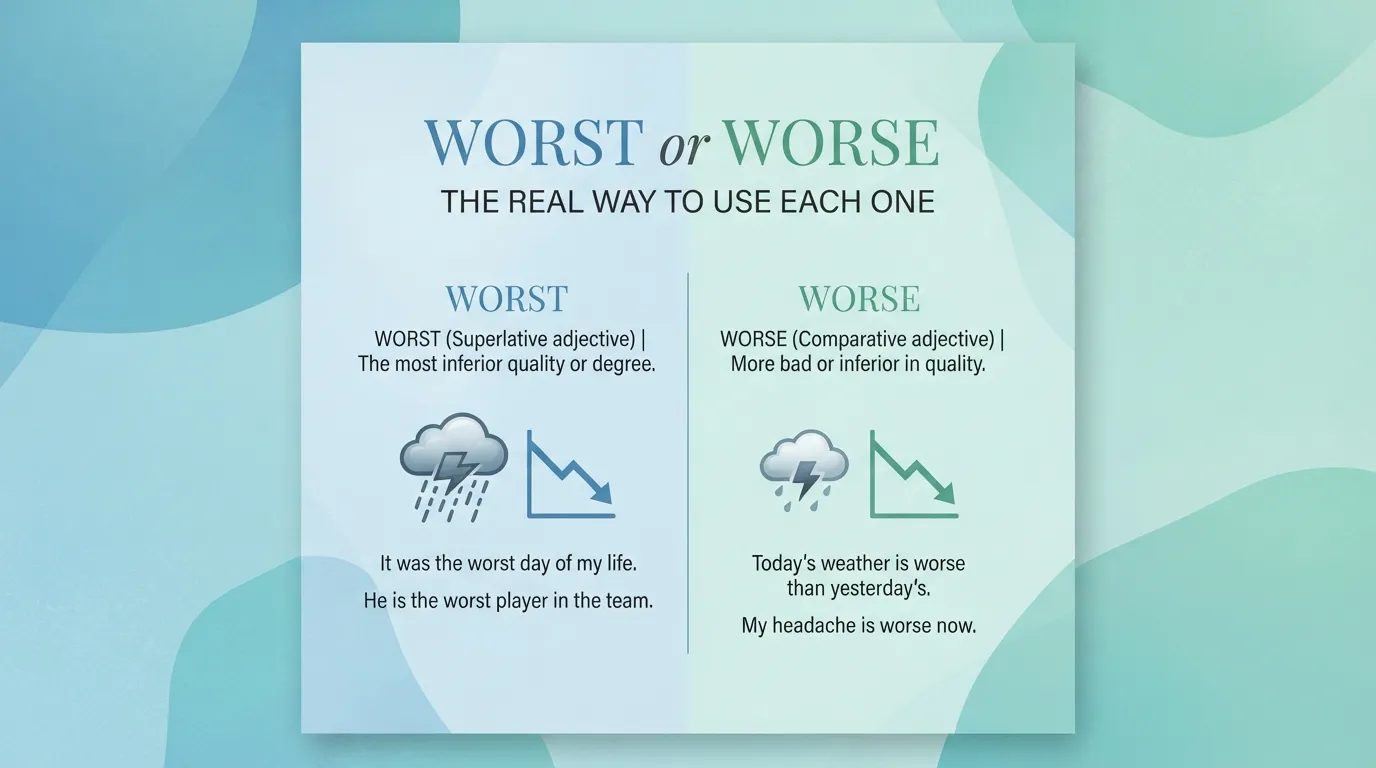
Worse means more bad, and it compares two things. Worst means most bad, and it compares three or more things or picks the single lowest point.
Sarah once texted her boss, “This is the worse mistake I’ve made all year.” She meant to sound serious. Instead, she sounded unsure of her own grammar, and her boss noticed.
That tiny slip happens to smart people every single day. Worse and worst look almost like twins, and your brain wants to treat them the same way. It won’t warn you when you pick the wrong one.
Here’s the good news. Once you understand the simple rule behind them, you will never second guess yourself again. This guide breaks down worst or worse in plain language, with real examples you can actually remember, a comparison table, and a quick decision guide you can use on the spot.
By the end, you’ll spot the difference instantly, in texts, emails, or even a job interview.
And you won’t be alone in this struggle. Even native English speakers with years of writing experience pause on this exact pair of words. Teachers see it in student essays. Managers see it in performance reviews. Editors see it in published articles that somehow slipped past a first read.
The reason is simple. Worse and worst share the same root word, bad, and both describe something negative. Your brain locks onto the negative feeling first and worries about grammar second. That’s completely normal, and it’s exactly the gap this guide closes.
Worst Or Worse, Quick Answer
Worse is the comparative form of bad. Use it when you compare exactly two things. “Monday was bad, but Tuesday was worse.”
Worst is the superlative form of bad. Use it when you compare three or more things, or when something holds the lowest possible rank. “Tuesday was bad, Wednesday was worse, but Friday was the worst.”
Think of it like a ladder. Worse moves you one step down. Worst puts you at the very bottom rung.
The Origin Of Worse And Worst
Both words trace back to Old English, from wyrsa and wyrst, which already followed the same comparative and superlative pattern seen in modern English. Bad, worse, and worst form what grammarians call an irregular comparison, similar to good, better, and best.
Most adjectives just add er or est, like tall, taller, tallest. Bad broke that pattern centuries ago, and English speakers never fixed it. That irregularity is exactly why so many people mix up worst or worse today. Your brain expects a pattern that simply doesn’t exist here.
This kind of irregular comparison isn’t rare in English. Good becomes better and best. Little becomes less and least. Far becomes farther and farthest. Once you notice the pattern of irregular pairs, worse and worst start to feel far less random, and much easier to remember for good.
Worst Or Worse Explained, Key Differences
The core difference comes down to counting. Worse always compares two items, states, or moments. Worst always compares three or more, or names an absolute low point.
| Term | Meaning | When To Use | Region/Context |
| Worse | More bad, comparing two things | “This coffee is worse than yesterday’s.” | Standard everywhere |
| Worst | Most bad, comparing three or more | “This is the worst coffee I’ve ever had.” | Standard everywhere |
Here’s a quick real world test. If you can swap in the word more, use worse. If you can swap in the word most, use worst. “This traffic is worse” becomes “more bad traffic,” which checks out. “This is the worst traffic” becomes “most bad traffic,” which also checks out.
Which Version Should You Use?
For students and formal writers, follow the strict two versus three or more rule. Grammar checkers and teachers expect it, and breaking it can cost you marks on an essay or a professional report.
For casual texting or speech, native speakers sometimes stretch worst to emphasize a single terrible thing, even without a direct comparison, as in “worst day ever.” It’s common, but it still leans on the idea of comparing this day against every other day you’ve had.
For global or business communication, stick with the textbook rule. Clear, correct grammar builds trust with readers who may not share your native language or dialect.
Common Mistakes With Worst Or Worse
Mistake 1: “This is the worse restaurant in town.” Correction: “This is the worst restaurant in town.” This happens because the writer is ranking one restaurant against many others, which calls for the superlative worst, not worse.
Mistake 2: “My headache is worst today than yesterday.” Correction: “My headache is worse today than yesterday.” Only two days are being compared here, so worse is correct. People slip into worst because it feels more dramatic.
Mistake 3: “That was the worse experience of my life.” Correction: “That was the worst experience of my life.” “Of my life” signals a comparison against every experience you’ve ever had, which is far more than two, so worst fits.
Mistake 4: Using “more worse” or “most worst.” Correction: Just say “worse” or “worst” alone. Worse and worst already carry the comparison built in, so adding more or most creates an unnecessary double comparison.
Mistake 5: Confusing worse with the verb “worsen.” Correction: “The weather worsened” not “the weather worsted.” Worsen is a separate action verb meaning to become worse, and it’s easy to blend the two when speaking quickly.
Worst Or Worse In Real World Examples
Professional email: “Unfortunately, this quarter’s results were worse than last quarter’s, and we need a new strategy.”
News headline: “City Traffic Named Worst In The Region For Third Year Running”
Social media post: “Just had the worst customer service call of my entire life. Never ordering from them again.”
Formal report: “Compared to the prior fiscal year, employee turnover was worse, though still not the worst figure recorded in company history.”
Notice how worse always sits between two points, while worst always claims the bottom spot among many.
Worst Or Worse, Data, Trends, And Usage
Searches for worst or worse spike heavily around school exam seasons, since students hunt for quick grammar clarity before writing essays. English learners in India, the Philippines, and parts of Europe also search this phrase often, since irregular comparatives don’t exist the same way in their native languages.
This search intent is mostly informational. People aren’t shopping, they’re trying to avoid embarrassment in an email, essay, or job application. That’s exactly why a clear, direct answer matters more here than flashy marketing language.
Grammar tools like spell checkers still miss context based errors like worst versus worse, since both words are spelled correctly. That gap keeps this topic searched heavily, year after year.
Comparison Table
| Term/Variant | Meaning | Region/Context | Best Used When |
| Worse | Comparative, more bad | Global standard English | Comparing exactly two things |
| Worst | Superlative, most bad | Global standard English | Comparing three or more, or naming the lowest point |
| Worsen | Verb, to become worse | Global standard English | Describing a situation getting more bad over time |
Worst Or Worse In Common Phrases And Idioms
English is full of set phrases that lock in one specific form, and native speakers rarely question them. Knowing these by heart makes you sound far more natural.
- “Worst case scenario” describes the single most extreme bad outcome someone can imagine, so it always uses worst, never worse.
- “If worst comes to worst” is a classic idiom meaning if the most extreme bad outcome actually happens. Some speakers say “if worse comes to worst,” and both versions are widely accepted today.
- “For better or worse” is a fixed phrase, often heard in wedding vows, and it always uses worse, since it compares only two outcomes, better or worse.
- “None the worse for wear” means someone survived a tough situation without lasting damage, and it always uses worse, comparing their current state to their previous one.
- “Worst nightmare” always uses worst, since it points to the single most extreme fear someone holds among every fear they’ve ever had.
Memorizing these fixed phrases removes the guesswork entirely, since you won’t need to calculate the comparison each time. You’ll simply recall the phrase as a whole.
Why This Small Grammar Rule Actually Matters
Some readers assume tiny grammar slips don’t matter much in casual writing. In reality, they quietly shape how capable you seem, especially in professional settings.
A single misplaced worst or worse in a cover letter, a client email, or a college application can plant a small doubt in the reader’s mind, even if they can’t name exactly why. Clear grammar builds instant credibility, while small errors chip away at it, one sentence at a time.
Learning this one rule takes a few minutes. Using it correctly for the rest of your life takes zero extra effort once it clicks.
Frequently Asked Questions
Q: What does worst or worse actually mean?
A: Worse means more bad and compares two things. Worst means most bad and compares three or more things, or marks the absolute lowest point in a group.
Q: How do you use worse correctly in a sentence?
A: Use worse when only two items, days, or situations are being compared, such as “today is worse than yesterday.” If you can replace it with “more bad,” you’re using it correctly.
Q: Worst vs worse, what’s the real difference?
A: The real difference is the number of things being compared. Worse handles two, worst handles three or more, or a single extreme case measured against everything else.
Q: Is it correct to say “worst case” or “worse case”?
A: The correct phrase is “worst case,” as in “worst case scenario,” because it refers to the single most extreme possibility among many outcomes, not just two.
Q: Which version is correct, “more worse” or just “worse”?
A: Just “worse” is correct. Worse already means more bad on its own, so adding “more” in front creates a redundant, incorrect double comparison.
Q: Where does the irregular pattern of bad, worse, worst come from?
A: It comes from Old English roots, wyrsa and wyrst, which never followed the regular er and est pattern that most English adjectives use today.
Q: Can worst be used without comparing multiple things directly?
A: Yes, in casual speech people say things like “worst day ever” without listing every other day. It still implies a comparison against your whole life experience, so it stays grammatically sound.
Conclusion
Worst or worse doesn’t have to trip you up anymore. Remember the simple test: two things call for worse, three or more call for worst. Swap in “more bad” or “most bad” whenever you’re unsure, and the right word will reveal itself instantly.
This tiny grammar rule shows up everywhere, from casual texts to formal business reports, so getting it right builds real credibility with your readers. Watch out for sneaky mistakes like “more worse” or mixing up worst with worsen, since those slip past most spell checkers unnoticed.
Now you know exactly how to use worst or worse correctly, so go try it in your next email or essay with total confidence. Bookmark this guide so you never second guess yourself again, and share it with a friend who’s always mixing the two up.
Read More: Benefitting or Benefiting: Which Spelling Is Correct?

Hey, I’m Ayeza. I started this site because I kept hitting the same wall over and over: typing a word, freezing, and not trusting my own instinct on the spelling. Now I research these mix-ups properly so you don’t have to, and I write every guide the way I wish these explanations had been written for me.