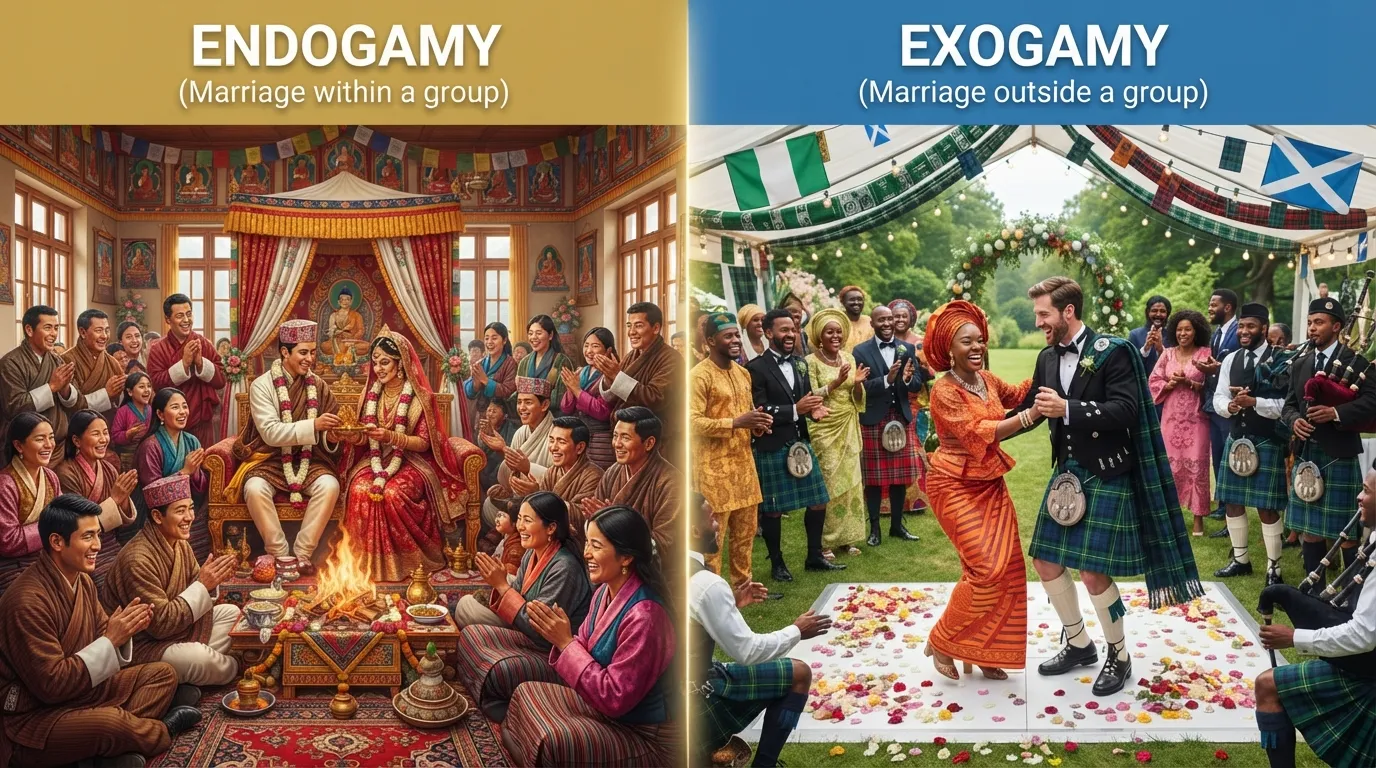
Endogamy means marrying within your own social group, such as your caste, religion, clan, or community. Exogamy means marrying outside that group. They describe opposite marriage patterns, not two spellings of the same word.
I remember sitting in a college anthropology class, completely lost, as the professor used both terms back to back without pausing to explain either one. I nodded along, quietly hoping nobody would call on me to explain the difference out loud.
Later that night, I read the textbook chapter twice before it finally clicked. These two words look and sound similar, but they describe two completely opposite social patterns, which makes mixing them up an easy trap to fall into.
Students researching sociology, anthropology students preparing for exams, and writers covering cultural traditions all search this pair constantly. The confusion usually comes from the similar structure of both words rather than any overlap in actual meaning.
This guide breaks the difference down clearly. You will learn exactly what each term means, where the concepts come from, and how to use both correctly in academic or everyday writing.
Endogamy or Exogamy: Quick Answer
Endogamy describes marriage within a specific group, where partners share the same caste, religion, ethnicity, clan, or community.
Exogamy describes marriage outside that group, where partners come from different social, religious, or cultural communities rather than the one they were born into.
Example: A community that requires members to marry only within the same religious group practices endogamy.A community that requires members to marry outside their own clan practices exogamy.
The Origin and Background of Endogamy and Exogamy
Both words come from Greek roots combined with the word gamos, meaning marriage. Endo means within, giving endogamy its meaning of marrying within a group. Exo means outside, giving exogamy its meaning of marrying outside a group.
Anthropologists and sociologists developed these terms in the nineteenth century to study marriage patterns across different cultures and societies. Early researchers noticed that many communities followed strict, often unwritten rules about who members were allowed to marry.
Endogamy historically appeared in caste systems, religious communities, and royal families, often used to preserve wealth, status, religious identity, or cultural traditions within a defined group. Exogamy historically appeared in tribal societies, where marrying outside the immediate clan helped prevent inbreeding and built alliances between separate groups.
The confusion between the two words usually comes from their nearly identical structure. Both terms share the same ending and length, differing only in that small endo versus exo prefix, which makes them easy to mix up without careful attention.
Endogamy vs Exogamy Explained: Key Differences and Variations
| Term | Meaning | When to Use | Region/Context |
|---|---|---|---|
| Endogamy | Marriage within a specific group | Describing caste, religious, or community marriage rules | Common across many cultures worldwide |
| Exogamy | Marriage outside a specific group | Describing tribal or clan based marriage rules | Common in many traditional and indigenous societies |
| Homogamy | Marriage between people with similar social characteristics | Describing broader social pattern research | Common in sociology and demographic studies |
Endogamy and exogamy sit at opposite ends of the same spectrum, while homogamy describes a related but distinct concept focused on similarity rather than group boundaries.
Which Term Should You Use?
Sociology and Anthropology Students
Use both terms precisely, based on the specific pattern you are describing, since exam and essay questions often test the ability to distinguish them clearly.
Writers Covering Cultural or Religious Traditions
Use endogamy when describing communities that expect marriage within a shared religion, caste, or ethnicity, and exogamy when describing communities that require marriage outside a specific clan or lineage.
Researchers Studying Family and Marriage Patterns
Use the term that matches your actual data. Endogamy applies to in group marriage patterns, while exogamy applies specifically to out group marriage requirements.
General Readers and Casual Writers
Focus on the core distinction. Endogamy keeps marriage inside a defined group, while exogamy pushes marriage outside that same group.
Global or Comparative Cultural Writing
Clarify which specific group boundary you are discussing, such as caste, religion, or clan, since both endogamy and exogamy can apply differently depending on the type of social group involved.
If you remember only one rule, remember this: endogamy stays in, and exogamy goes out.
Common Mistakes with Endogamy and Exogamy
Mistake 1: Confusing the Prefixes Endo and Exo
Correction: Remember that endo means within, similar to endoskeleton, while exo means outside, similar to exoskeleton.
Mistake 2: Assuming Both Terms Describe the Same Pattern
Correction: Endogamy and exogamy describe opposite marriage patterns, not two versions of the same concept.
Mistake 3: Using the Terms Without Specifying the Relevant Group
Correction: Always clarify which group boundary applies, such as caste, religion, or clan, since the meaning shifts depending on context.
Mistake 4: Overlooking Regional and Cultural Variation
Correction: Different cultures apply endogamy and exogamy differently, so avoid assuming one universal rule applies across every society.
Mistake 5: Confusing Exogamy with Interfaith or Interracial Marriage Broadly
Correction: Exogamy specifically refers to marrying outside a defined social group, which may or may not align exactly with religious or racial categories depending on the society being studied.
Each of these mistakes happens because the two terms sound structurally similar, even though their actual meanings point in completely opposite directions.
Endogamy and Exogamy in Real World Examples
Professional Email
“Our research team is analyzing endogamy rates within specific religious communities across three regions for the upcoming publication.”
News Headline
“Study Reveals Declining Endogamy Rates Among Younger Generations in Urban Communities”
Social Media Post
“Learned so much in class today about exogamy and how tribal societies used marriage to build alliances between groups.”
Formal Document
“This anthropological report examines both endogamous and exogamous marriage practices across the surveyed indigenous communities.”
Notice how both terms appear naturally in academic, journalistic, and casual contexts, as long as the writer clearly signals which specific pattern is being discussed.
Endogamy and Exogamy: Data, Trends, and Usage
Searches comparing endogamy and exogamy happen consistently among sociology and anthropology students, particularly during exam seasons and research paper deadlines.
Researchers studying marriage patterns, cultural anthropologists, and journalists covering religious or cultural communities also search these terms regularly, especially when reporting on changing marriage trends.
This search falls almost entirely into the informational category. Readers want a clear, accurate explanation of two related but opposite concepts, not a lengthy academic lecture.
Growing academic and public interest in cultural identity, caste systems, and changing marriage patterns continues to keep both terms relevant across sociology, anthropology, and cultural studies fields.
Standalone Comparison Table
| Term/Variant | Meaning | Region/Context | Best Used When |
|---|---|---|---|
| Endogamy | Marriage within a specific group | Global, especially caste and religious contexts | Describing in group marriage requirements |
| Exogamy | Marriage outside a specific group | Global, especially tribal and clan contexts | Describing out group marriage requirements |
Frequently Asked Questions
What does endogamy mean?
Endogamy means marrying within a specific social group, such as the same caste, religion, ethnicity, or community, often to preserve shared identity, status, or tradition.
How do you use exogamy correctly in a sentence?
Use exogamy to describe marriage outside a defined group, such as “the community practiced exogamy, requiring members to marry outside their own clan.”
Endogamy vs exogamy, what is the actual difference?
Endogamy requires marriage within a group, while exogamy requires marriage outside that group. They describe completely opposite marriage patterns, not variations of the same concept.
Is endogamy still practiced today?
Yes. Many religious, caste based, and cultural communities around the world continue to practice or encourage endogamy, though rates have shifted significantly in some regions over recent decades.
Which term applies to arranged marriages within the same caste?
Endogamy applies here, since it specifically describes marriage practices that keep partnerships within the same defined social group, such as a caste or religious community.
Where do the terms endogamy and exogamy come from?
Both terms come from Greek roots combined with gamos, meaning marriage. Endo means within, and exo means outside, giving each word its opposite meaning.
Can a society practice both endogamy and exogamy at the same time?
Yes. Many societies apply endogamy at a broader level, such as religion, while applying exogamy at a narrower level, such as requiring marriage outside an immediate clan or family line.
Final Thoughts
Endogamy and exogamy describe two opposite marriage patterns, not two versions of the same word. Endogamy keeps marriage within a defined group, while exogamy pushes marriage outside that same group.
Keep the core distinction in mind. Endo means within, exo means outside, and both terms depend heavily on which specific social group is being discussed.
Bookmark this guide so you never second guess these terms again, and share it with a classmate or colleague working through the same anthropology or sociology material.
See More: Pannel or Panel: The Correct Spelling Explained

Hi, I’m Zara. Words that look almost identical but mean completely different things have always fascinated me, that’s what pulled me toward writing about spelling and usage. I focus on digging into where these mix-ups actually come from, whether it’s a British-American split or just a rule English never bothered to make consistent. My goal with every guide is simple: give you the answer fast, then explain it well enough that you never have to look it up again.