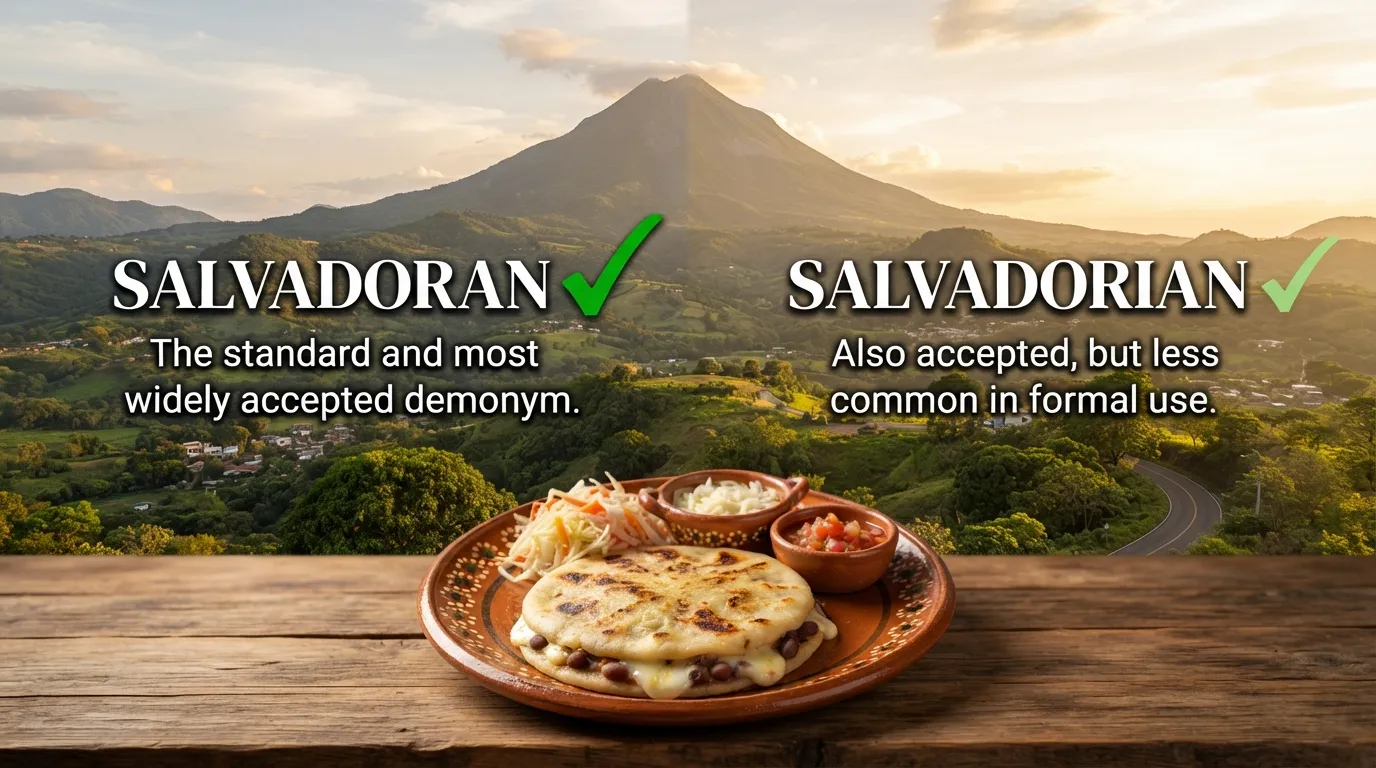
Salvadoran is the preferred and most widely accepted term for someone from El Salvador. Salvadorian is a recognized variant that still appears in some dictionaries and casual writing, but Salvadoran is the standard choice in journalism, academic writing, and official communication.
I once wrote a travel article and used Salvadorian throughout the entire piece, feeling confident about my word choice. My editor sent it back with nearly every instance circled, asking me to switch to Salvadoran instead.
I had genuinely never questioned it before that moment. Both words sounded equally natural to my ear, and nothing about the spelling had ever felt wrong.
This mix up happens constantly, especially among writers who learned the word casually rather than through a style guide. Demonyms, the words we use for people from a specific place, often carry small variations that never get taught directly.
This guide settles the question clearly. You will learn which term to use, why both versions exist, and how to write about El Salvador and its people with accuracy and respect.
Salvadoran or Salvadorian: Quick Answer
Salvadoran describes a person from El Salvador, or something related to the country, and it is the term preferred by major dictionaries, news organizations, and style guides.
Salvadorian carries the exact same meaning and is not incorrect, but it appears far less often in formal, edited writing.
Example: “The Salvadoran community in Los Angeles continues to grow” reflects standard usage. “The Salvadorian community in Los Angeles continues to grow” is understood but less common in professional publications.
The Origin and Background of Salvadoran
El Salvador takes its name from Spanish, meaning The Savior, a name given by Spanish colonizers in the sixteenth century. In Spanish, a person from the country is called salvadoreño or salvadoreña, depending on gender.
English speakers needed a way to adapt that Spanish term into a natural sounding English demonym. Language naturally settled on multiple possible endings, since English forms demonyms in several different ways depending on the country, including endings like an, ian, and ese.
Salvadoran emerged as the dominant form partly because it closely mirrors the pattern used for other countries ending in a similar sound, much like Mexican from Mexico or Cuban from Cuba. Salvadorian likely developed from writers applying the more common ian ending found in words like Canadian or Australian, even though El Salvador does not follow that exact naming pattern.
Over time, dictionaries and major style guides, including the Associated Press, settled firmly on Salvadoran as the standard term, while acknowledging Salvadorian as an existing but secondary variant still used by some speakers and publications.
Salvadoran Explained: Key Differences and Variations
| Term | Meaning | When to Use | Region/Context |
|---|---|---|---|
| Salvadoran | Person or thing from El Salvador | Journalism, academic writing, formal contexts | Preferred term worldwide |
| Salvadorian | Same meaning, secondary variant | Casual writing, some regional or personal preference | Used informally in various English speaking regions |
| Salvadorean | Same meaning, older variant spelling | Occasionally in British or historical writing | Rare in modern usage |
All three terms describe the same nationality and carry no difference in meaning. The variation exists purely in spelling convention, not in respect or accuracy, as long as the term is used correctly and respectfully.
Which Term Should You Use?
Journalists and News Writers
Use Salvadoran. Major style guides, including AP style, list it as the standard term expected in professional news writing.
Academic and Research Writing
Use Salvadoran for consistency with published academic sources, dictionaries, and formal citation standards.
Travel Writers and Content Creators
Use Salvadoran as your default choice, since it reads as more polished and aligns with how most major publications describe the country and its people.
Casual Writing and Everyday Conversation
Either term generally works and gets understood clearly, though Salvadoran remains the safer, more widely recognized choice.
When Referring to Individuals Directly
Whenever possible, follow the preference of the specific person or community you are writing about, since personal identity always takes priority over general style guide recommendations.
If you remember only one rule, remember this: Salvadoran is the standard, and Salvadorian is understood but less commonly used in polished writing.
Common Mistakes with Salvadoran and Salvadorian
Mistake 1: Assuming Salvadorian Is Incorrect or Disrespectful
Correction: Salvadorian is a recognized variant, not a mistake or an offensive term. It simply appears less often in formal writing than Salvadoran.
Mistake 2: Using El Salvadorian as a Combined Term
Correction: The demonym does not need the word El attached. Simply use Salvadoran or Salvadorian on its own, without repeating the country’s full name.
Mistake 3: Confusing the Demonym with the Spanish Term
Correction: Salvadoreño and salvadoreña are the Spanish language terms. Salvadoran and Salvadorian are the English adaptations, and mixing languages mid sentence can confuse readers.
Mistake 4: Applying Inconsistent Spelling Within One Document
Correction: Choose either Salvadoran or Salvadorian at the start of your writing and use that same spelling consistently throughout the entire piece.
Mistake 5: Assuming the Demonym Follows the Same Pattern as Nearby Countries
Correction: Not every Latin American country shares the same demonym ending, so it helps to verify each country’s accepted term individually rather than guessing based on a neighboring country’s pattern.
Each of these mistakes happens because demonyms rarely follow one single predictable rule across every country, which makes memorization more reliable than pattern guessing.
Salvadoran in Real World Examples
Professional Email
“Our marketing team is preparing outreach materials specifically for the Salvadoran community in the greater Los Angeles area.”
News Headline
“Salvadoran Officials Announce New Trade Agreement Aimed at Boosting Regional Exports”
Social Media Post
“So proud to share my Salvadoran heritage this weekend at the cultural festival downtown.”
Formal Document
“This report examines migration patterns among Salvadoran nationals residing in the United States over the past two decades.”
Notice how Salvadoran fits naturally into every tone, from a heartfelt personal post to a formal government report. That consistency reflects its status as the widely accepted standard.
Salvadoran and Salvadorian: Data, Trends, and Usage
Searches comparing Salvadoran and Salvadorian happen steadily, often from writers, students, and content creators working on articles related to El Salvador, immigration, or Central American culture.
Journalists, travel writers, and academic researchers make up a large share of this search traffic, especially when preparing content meant for publication or formal review.
This search falls almost entirely into the informational category. Readers want a clear, respectful answer about correct usage, not an extended grammar lecture.
Growing interest in Central American history, immigration policy, and cultural representation continues to keep this term relevant, especially as more writers aim to describe communities accurately and respectfully.
Standalone Comparison Table
| Term/Variant | Meaning | Region/Context | Best Used When |
|---|---|---|---|
| Salvadoran | Person or thing from El Salvador | Preferred globally | Formal, academic, and journalistic writing |
| Salvadorian | Same meaning, secondary variant | Casual or informal writing | Everyday conversation or personal preference |
Frequently Asked Questions
What does Salvadoran mean?
Salvadoran describes a person, culture, or item originating from El Salvador. It functions as both a noun referring to a person and an adjective describing something related to the country.
How do you use Salvadoran correctly in a sentence?
Use Salvadoran as a noun, such as “she is Salvadoran,” or as an adjective, such as “Salvadoran cuisine features pupusas as a signature dish.”
Salvadorian vs Salvadoran, what is the actual difference?
There is no difference in meaning. Salvadoran is the preferred, standard term, while Salvadorian is a recognized but less common variant used mainly in casual writing.
Is Salvadorian acceptable in formal writing?
Generally, formal writing favors Salvadoran, since most style guides and dictionaries list it as the primary term, though Salvadorian is not considered offensive or entirely incorrect.
Which version is correct, Salvadoran or Salvadorian?
Salvadoran is correct and preferred. Salvadorian is also understood and used by many people, but it appears less frequently in edited, professional writing.
Where does the term Salvadoran come from?
Salvadoran comes from adapting the Spanish term salvadoreño into English, following a naming pattern similar to demonyms like Mexican or Cuban.
Can Salvadoran be used to describe food, culture, or traditions?
Yes. Salvadoran works as an adjective describing anything connected to El Salvador, including food, music, art, and cultural traditions, not only people.
Final Thoughts
Salvadoran stands as the clearest, most widely accepted term for describing people and culture connected to El Salvador. Salvadorian remains understood and used by many, but it carries less weight in formal, edited writing.
Keep the key takeaways in mind. Salvadoran fits journalism, academic work, and professional communication, while Salvadorian works best in casual or conversational contexts. Either way, respect and accuracy matter more than perfect spelling alone.
Bookmark this guide so you never second guess this term again, and share it with any writer preparing content about El Salvador or its vibrant community.
Explore More: Armour or Armor: The Correct Spelling Explained

Hey, I’m Ayeza. I started this site because I kept hitting the same wall over and over: typing a word, freezing, and not trusting my own instinct on the spelling. Now I research these mix-ups properly so you don’t have to, and I write every guide the way I wish these explanations had been written for me.