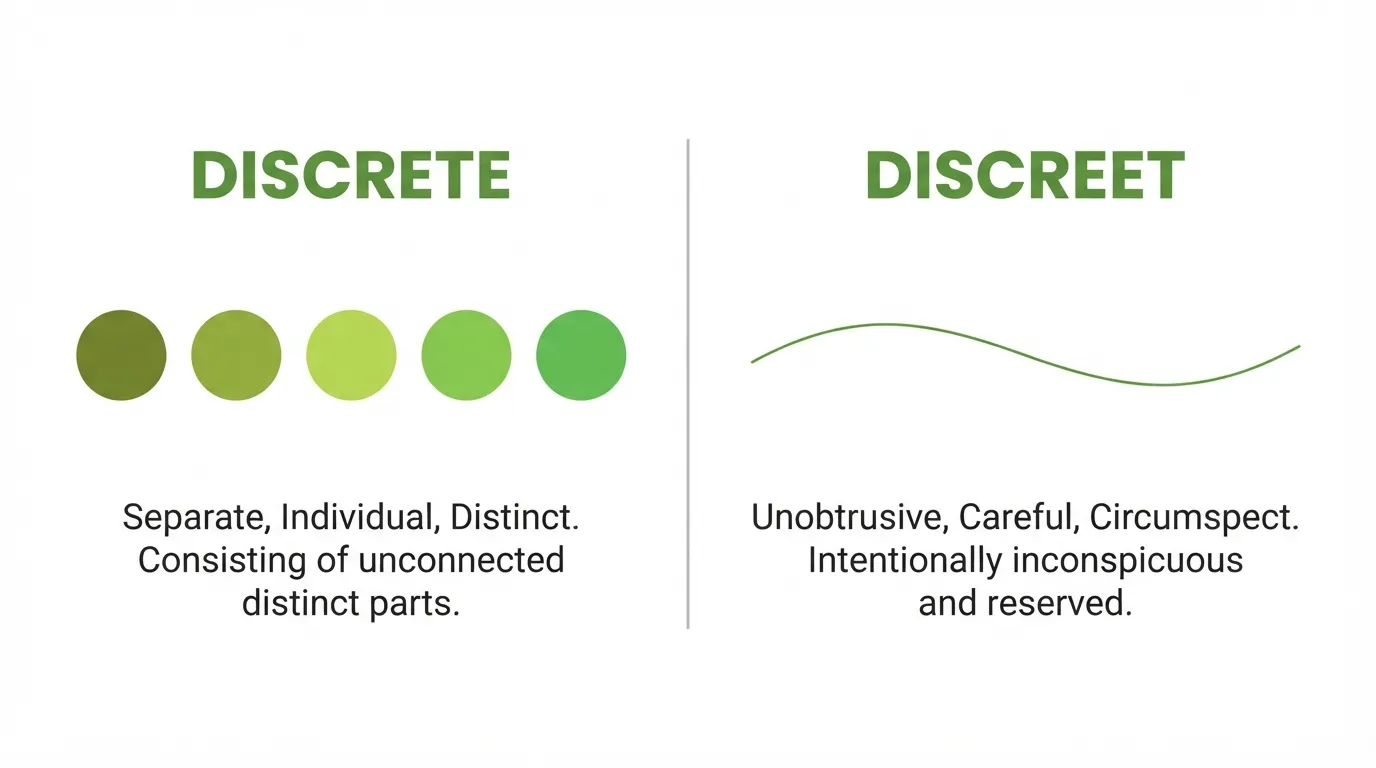
Discrete means separate or distinct, while discreet means careful, private, or tactful, and the two words are not interchangeable despite looking almost identical.
The Spelling Mix Up That Costs People Credibility
I once watched a colleague send a company wide email promising “discrete handling” of layoff details. She meant private and careful. What she actually wrote suggested the details would be treated as separate, unrelated pieces of information.
Nobody caught it before send. A few people noticed, and one even replied asking what she meant. That small typo made a serious message look sloppy, right when tone mattered most.
This mix up happens constantly, and it’s not because people are careless writers. These two words sound identical when spoken, share almost every letter, and only differ by where the E and T land.
By the end of this guide, you’ll know exactly which word fits which sentence, every single time. No more pausing mid email wondering if you picked the right one.
Discrete or Discreet: Quick Answer
Discrete describes things that are separate, distinct, or individually countable. Think of discrete units, discrete categories, or discrete steps in a process.
Discreet describes behavior that is careful, private, or tactful. Think of a discreet conversation, a discreet compliment, or someone acting discreetly to avoid drawing attention.
Example: “The report breaks the budget into five discrete categories” uses the separate meaning. “She gave him a discreet nod across the room” uses the careful, subtle meaning.
The Origin of Discrete and Discreet
Both words trace back to the same Latin root, discretus, meaning separated or distinguished. Centuries ago, English speakers used them almost interchangeably, since both carried a sense of distinction or judgment.
Over time, the language split the meanings apart. Discreet kept the idea of exercising good judgment, especially judgment about what to keep private. Discrete kept the more literal sense of being separate or individually distinct.
That shared history is exactly why the confusion persists today. The words aren’t just similar by accident, they’re cousins from the same root, which makes the spelling feel almost arbitrary even though the meanings drifted apart completely.
Discrete or Discreet Explained: Key Differences and Variations
Here’s where the distinction becomes genuinely practical, not just academic.
| Term | Meaning | When to Use | Region or Context |
| Discrete | Separate, distinct, individually identifiable | Describing categories, units, data points, or steps | Common in science, math, statistics, and technical writing |
| Discreet | Careful, private, tactful, low key | Describing behavior, conversations, or actions meant to avoid attention | Common in everyday, professional, and social writing |
| Discretely | In a separate or distinct manner | Rare, mostly technical writing | Statistics and data analysis |
| Discreetly | In a careful, quiet, or tactful manner | Common in everyday speech and writing | Describing subtle actions or behavior |
A simple test: if you can replace the word with “separate,” you need discrete. If you can replace it with “careful” or “private,” you need discreet.
Which Version Should You Use?
For scientific, technical, or data focused writing, use discrete. Statisticians talk about discrete variables, meaning values that are countable and separate, unlike continuous data that flows without gaps.
For everyday, social, or professional writing about behavior, use discreet. This covers anything involving privacy, tact, or avoiding unwanted attention, from a discreet question to a discreet exit from a party.
For global or general audiences, think about your sentence’s actual meaning first. If you’re describing separate things, go discrete. If you’re describing careful behavior, go discreet. The meaning always points you to the right spelling.
Common Mistakes with Discrete or Discreet
Mistake 1: Writing “discrete” when you mean private behavior. Correction: “Please be discreet about the surprise party,” not “discrete.” You’re describing careful behavior, not separate categories.
Mistake 2: Writing “discreet” when you mean separate items. Correction: “The survey has five discrete sections,” not “discreet.” You’re describing distinct, individually countable parts.
Mistake 3: Assuming spellcheck will catch the error. Correction: Both words are spelled correctly on their own, so spellcheck won’t flag the wrong one. You have to catch this manually every time.
Mistake 4: Mixing up the adverb forms, discretely and discreetly. Correction: “The data points were plotted discretely” describes separation. “She handled the situation discreetly” describes tact. Match the ending to the meaning you actually intend.
Mistake 5: Assuming the words are simply British versus American spelling. Correction: This isn’t a regional spelling difference like color versus colour. Both words exist in every English speaking region, and both carry genuinely different meanings.
These errors happen because the words are true homophones, meaning they sound completely identical out loud. Only the spelling gives away which meaning you intended, so context and memory matter more than sound.
Discrete or Discreet in Real World Examples
Professional email: “Please keep this reorganization plan discreet until we announce it company wide next Monday.”
News headline: “City Council Splits Budget Into Five Discrete Funding Categories for Transparency.”
Social media post: “Trying to be discreet about my surprise trip planning, but my search history is not helping. 😅”
Formal document or report: “The dataset contains twelve discrete variables, each measured independently across the sample population.”
Notice the pattern. Whenever behavior, privacy, or tact is involved, discreet fits. Whenever separation, counting, or distinct categories are involved, discrete fits.
Discrete or Discreet: Data, Trends, and Usage
Search interest in this exact comparison stays steady year round, since it’s one of the most commonly confused word pairs in English. Most searches fall under informational intent, people want a fast, clear answer, not a lengthy grammar lecture.
Students, professionals, and content writers search this term most often, especially anyone working with data, statistics, or careful workplace communication where getting it wrong looks unprofessional.
Interest spikes noticeably around academic seasons, when students write research papers involving discrete data or discrete variables in math and statistics courses. Interest also spikes when professionals draft sensitive workplace communications, where discreet handling of information matters most.
This distinction matters right now because clear, precise writing carries more weight than ever in professional and academic settings. A single wrong letter can undercut an otherwise polished piece of writing, and readers notice more than writers expect.
Comparison Table: Discrete vs Discreet at a Glance
| Term or Variant | Meaning | Region or Context | Best Used When |
| Discrete | Separate or distinct | Science, math, statistics, technical writing | Describing individually countable items or categories |
| Discreet | Careful or private | Everyday, professional, and social writing | Describing tactful, low key behavior |
| Discretely | In a separate manner | Technical and statistical writing | Describing how data points or items are arranged |
| Discreetly | In a careful, quiet manner | Everyday speech and writing | Describing subtle or tactful actions |
Frequently Asked Questions
Q: What does discrete or discreet actually mean?
A: Discrete means separate or distinct, describing individually identifiable things. Discreet means careful or private, describing tactful behavior meant to avoid drawing attention.
Q: How do you use discrete and discreet correctly?
A: Use discrete when describing separate categories, units, or data points. Use discreet when describing careful, tactful, or private behavior in social or professional situations.
Q: Discrete vs discreet, what’s the real difference?
A: Discrete relates to separation and distinction, common in technical writing. Discreet relates to tact and privacy, common in everyday and professional communication about behavior.
Q: Is discreet acceptable in formal writing?
A: Yes, discreet is completely standard in formal writing, especially in workplace communication involving sensitive or confidential topics that require careful handling.
Q: Which version is correct, discrete or discreet?
A: Both are correct, but only one fits your specific sentence. Check whether you mean “separate” or “careful and private,” then choose the matching spelling.
Q: Where does discrete or discreet come from?
A: Both words descend from the Latin discretus, meaning separated or distinguished. English split the meanings apart over time, keeping one sense for each spelling.
Q: Can discrete or discreet be used in casual conversation?
A: Yes, though discreet appears far more often in casual speech, since everyday conversation rarely involves discussing separate, countable categories the way discrete does.
Final Thoughts on Discrete or Discreet
Here’s the core takeaway. Discrete means separate, distinct, and individually countable. Discreet means careful, private, and tactful. They share a Latin root, but their meanings went in completely different directions over time.
Use discrete for categories, data, and countable items. Use discreet for behavior, privacy, and tact. When in doubt, ask yourself whether you mean “separate” or “careful,” and let that answer guide your spelling.
Now you know exactly how to use discrete or discreet, so go apply it confidently in your next email or report. Bookmark this guide so you never second guess the spelling again, and share it with someone who’s been mixing these up for years.
See More: Laying or Lying: The Complete Guide to Getting It Right

Hi, I’m Zara. Words that look almost identical but mean completely different things have always fascinated me, that’s what pulled me toward writing about spelling and usage. I focus on digging into where these mix-ups actually come from, whether it’s a British-American split or just a rule English never bothered to make consistent. My goal with every guide is simple: give you the answer fast, then explain it well enough that you never have to look it up again.