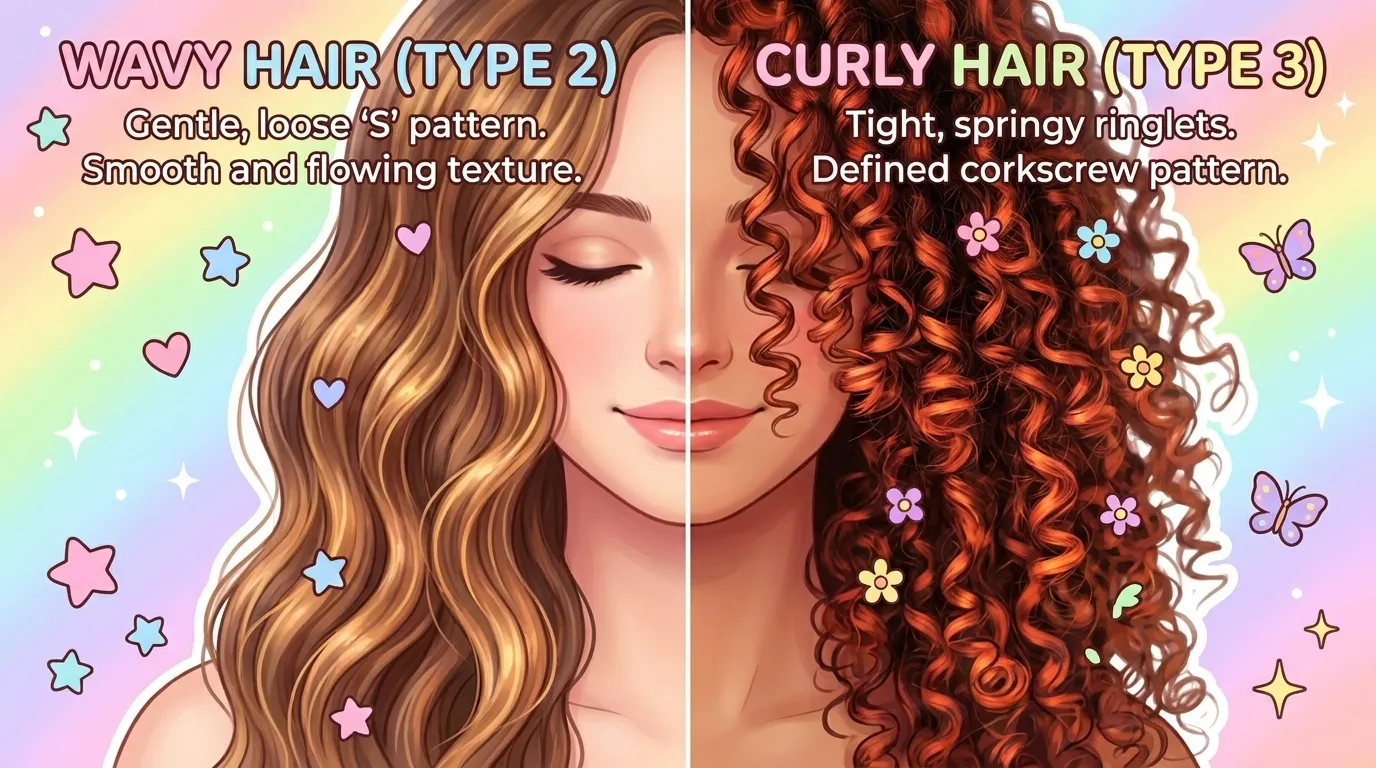
Wavy hair forms loose, S shaped bends and often lies flatter near the roots. Curly hair forms tighter, more defined loops or coils from root to tip. The main difference comes down to curl pattern and how tightly the hair strand twists.
For years, I told my hairdresser I had curly hair, and she kept gently correcting me. Turns out, I had wavy hair the whole time, and that one word changed every product recommendation she gave me.
That mix up is incredibly common. Wavy and curly hair often get lumped together, especially since both fall somewhere between straight and coily on the hair texture chart.
This guide breaks down exactly how to tell wavy and curly hair apart, why the confusion happens so often, and how to pick the right products and routine once you know your actual hair type.
Wavy vs Curly Hair: Quick Answer
Wavy hair forms a loose S shape. It usually lies flat near the scalp and only starts waving further down the strand. Think of gentle beach waves after a day in the ocean.
Curly hair forms tighter loops or spirals, often starting closer to the roots. Think of hair that naturally coils around a pencil or forms distinct springy ringlets.
The simplest test is this. If you can run your fingers through it easily without much resistance, it is likely wavy. If your fingers catch on defined loops, it is likely curly.
The Origin of Hair Typing
Hair typing as we know it today mostly comes from a system created by celebrity hairstylist Andre Walker in the 1990s. He divided hair into four main types, straight, wavy, curly, and coily, each further split into subcategories like 2A, 2B, 3A, and so on.
Before this system became popular, people mostly relied on vague, inconsistent words like frizzy, curly, or kinky, which often meant different things to different stylists. Walker’s system gave people a shared, more precise vocabulary, which is exactly why wavy and curly finally became separate, clearly defined categories instead of interchangeable terms.
This system is not perfect, and many people naturally have a mix of types across their head, but it remains the most widely used reference point today.
Key Differences and Variations
| Term | Meaning | When to Use | Region or Context |
| Wavy hair | Loose S shaped bends, flatter near roots | Describing type 2 hair patterns | Global hair typing system |
| Curly hair | Defined loops or spirals from root to tip | Describing type 3 hair patterns | Global hair typing system |
| Coily hair | Tight, dense coils, often described as type 4 | Describing very tightly coiled hair | Global hair typing system |
| Straight hair | No natural bend or curl pattern | Describing type 1 hair | Global hair typing system |
Notice that wavy sits closer to straight on the spectrum, while curly sits closer to coily, which explains why wavy hair often looks flatter and less voluminous by comparison.
Which Version or Approach Should You Use?
For hair that lies flat at the roots and only bends loosely toward the ends, describe it as wavy. Lightweight products like sea salt sprays and mousses usually work best here.
For hair with visible loops or spirals starting closer to the scalp, describe it as curly. Richer creams and curl defining gels usually work better for this texture.
For hair that shows a mix of both patterns across different sections, it is completely normal to describe it as wavy curly or simply mention both, since many people have combination textures rather than one single, uniform pattern.
Common Mistakes with Wavy and Curly Hair
Mistake 1: Calling loose waves curly hair. Correction: Call it wavy unless the strand actually forms a full loop or spiral shape. This mistake happens because people assume any bend automatically counts as curly.
Mistake 2: Using heavy curl creams on fine, wavy hair. Correction: Use lightweight products, since heavy creams often weigh wavy hair down and flatten the natural bend completely.
Mistake 3: Assuming curl pattern stays the same throughout your whole life. Correction: Hormones, humidity, hair length, and even hair damage can shift your pattern over time, so reassessing occasionally makes sense.
Mistake 4: Writing wavy and curly as if they follow the exact same care routine. Correction: While there is overlap, curly hair generally needs more moisture and gentler handling to avoid frizz and breakage, compared to wavy hair. This confusion happens because both types fall under the broader umbrella of non straight hair.
Wavy and Curly Hair in Real World Examples
Professional email (salon booking): “I have wavy hair with a bit of frizz, and I’m hoping to book a cut that works with the natural texture instead of against it.”
News headline: “Curly Hair Brands See Major Growth as More People Embrace Natural Texture”
Social media caption: “Finally learned my hair is wavy, not curly, and my whole routine just got so much easier.”
Product description: “This lightweight mousse is designed specifically for wavy hair, enhancing natural bend without weighing strands down.”
Notice how curly hair content often leans into moisture and definition language, while wavy hair content focuses more on lightweight enhancement and natural texture.
Data, Trends, and Usage
Searches for wavy vs curly hair test spike heavily among people trying to identify their exact hair type for the first time, often after cutting layers or growing hair out.
Searches for best products for curly hair and best products for wavy hair trend consistently, especially among younger audiences influenced by natural hair movements on social media.
Both terms fall under a mix of informational and commercial search intent, since people first want to understand their hair type, then quickly move toward buying the right products for it.
This distinction matters now more than ever, since the natural hair movement has pushed brands to create far more type specific products, making an accurate hair type identification genuinely useful rather than just a fun fact.
Standalone Comparison Table
| Term or Variant | Meaning | Region or Context | Best Used When |
| Wavy hair | Loose S shaped bends | Global hair typing | Describing hair that lies flatter, gently bends |
| Curly hair | Defined loops or spirals | Global hair typing | Describing hair with clear, springy loop shapes |
| Coily hair | Tight, dense coils | Global hair typing | Describing very tightly coiled natural texture |
| Combination texture | Mix of wavy and curly patterns | Global, common in practice | Describing hair with more than one pattern present |
Frequently Asked Questions
Q: What does wavy hair mean? A: Wavy hair describes a loose, S shaped bend pattern that usually lies flat near the roots and only starts waving further down the strand.
Q: How do you tell if your hair is curly? A: Look for defined loops or spirals starting closer to the scalp, along with more visible volume and shrinkage compared to wavy hair.
Q: Wavy vs curly hair, what’s the difference? A: Wavy hair forms loose bends, while curly hair forms tighter, more defined loops, with curly hair generally sitting closer to the roots.
Q: Is wavy hair considered a curl type? A: Yes, wavy hair falls under type 2 in most hair typing systems, sitting between straight and curly on the overall texture spectrum.
Q: Which products work better for curly hair? A: Richer creams, curl defining gels, and heavier moisturizers generally work better for curly hair, since it tends to need more moisture and hold.
Q: Where does the wavy vs curly hair typing system come from? A: It largely comes from a hair typing system popularized by stylist Andre Walker in the 1990s, dividing hair into straight, wavy, curly, and coily categories.
Q: Can hair be both wavy and curly at once? A: Yes, many people naturally have a combination texture, with some sections closer to wavy and others closer to curly, especially across different parts of the head.
Final Thoughts
Wavy and curly hair might sit close together on the texture spectrum, but they behave very differently in real life. Wavy hair bends loosely and often lies flatter. Curly hair loops tightly and holds more volume from root to tip.
Remember these key points. Wavy means loose S shaped bends. Curly means defined, springy loops. And your product routine should match your actual pattern, not just a guess.
Now you know exactly how to tell wavy and curly hair apart, so go take a closer look at your own strands next time you style.
Bookmark this guide so you never second guess your hair type again, and share it with a friend who still isn’t sure if they’re wavy or curly.
Read More: Jist or Gist: The Correct Spelling Explained

My name is Ayesha Sadiqah, the writer behind this website. I write in-depth articles on English spelling, word comparisons, grammar, and vocabulary to help learners make better language choices. Every guide is carefully researched and designed to provide accurate, practical, and easy-to-understand information.