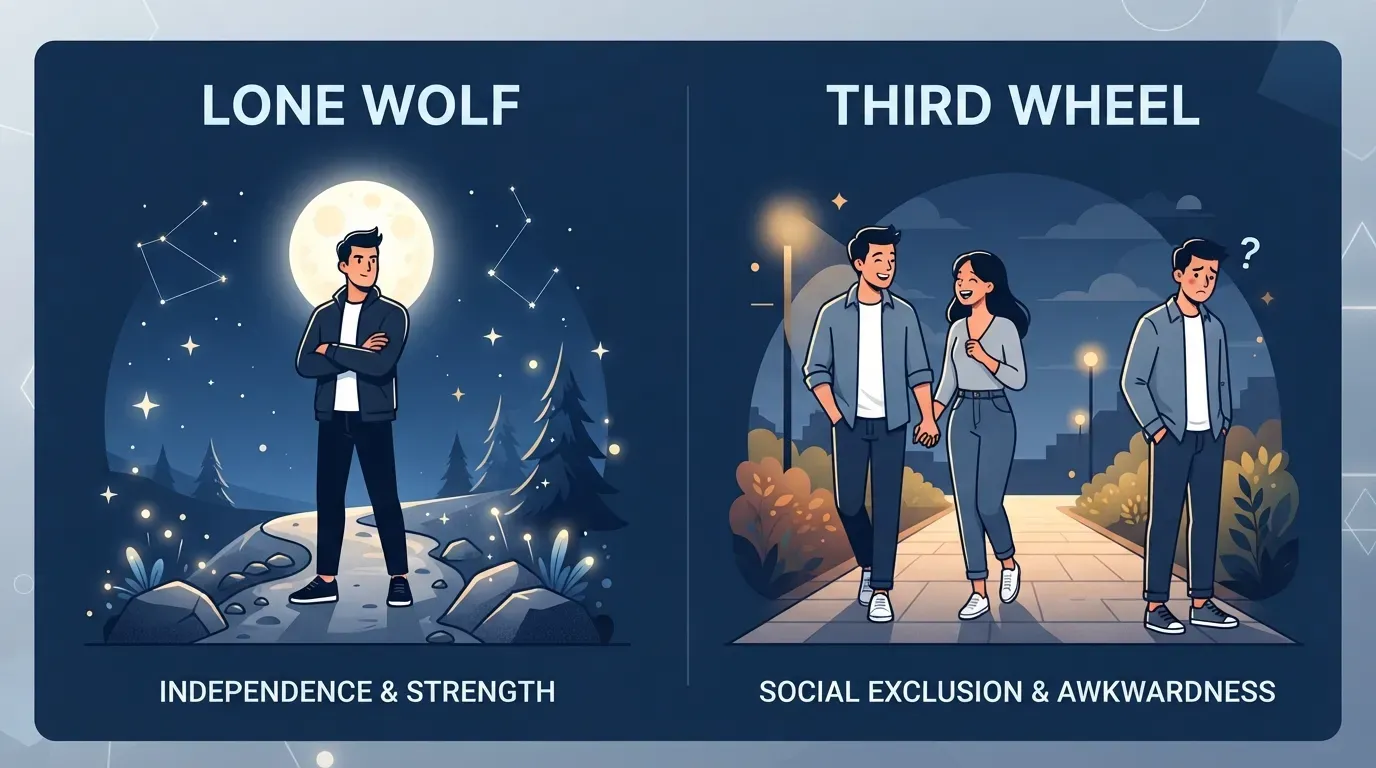
A lone wolf is someone who prefers doing things alone by choice, while a third wheel is someone who feels unwanted or out of place when tagging along with a couple. One describes independence. The other describes an awkward social position.
I still remember the exact moment I learned these two phrases were not interchangeable. A friend called me a lone wolf at a party, and ten minutes later, a different friend joked that I was being a third wheel on their date. Same night, same person, two completely different labels.
That mix up is more common than you think. Both phrases describe someone standing slightly apart from a group. But the reasons behind that distance are almost opposite.
This guide breaks down exactly what each phrase means, where they came from, and how to use them correctly without embarrassing yourself in conversation.
Lone Wolf vs Third Wheel: Quick Answer
A lone wolf chooses solitude. They enjoy their own company and often avoid group activities on purpose. Think of a coworker who eats lunch alone every day, not because nobody invited them, but because they genuinely prefer the quiet.
A third wheel does not choose their position. They end up tagging along with a couple, often at a dinner or a movie, and end up feeling like the extra, unnecessary part of the group. Picture a single friend joining two people on a date night, watching them hold hands across the table.
One is about personal preference. The other is about social positioning.
The Origin of These Two Phrases
Lone wolf comes from real wolf behavior. Most wolves live and hunt in packs, but occasionally, a wolf leaves the pack and survives on its own. Writers borrowed this image in the early twentieth century to describe humans who work or live independently, away from groups or teams.
Third wheel has a more mechanical origin. Picture an old fashioned bicycle or cart. Two wheels move smoothly together. A third wheel added to that setup becomes useless, wobbly, and unnecessary. By the mid twentieth century, people started using the phrase to describe someone who felt like an unnecessary extra person around a couple.
Both phrases borrowed physical images, animals and machines, to describe very human social situations.
Key Differences and Variations
| Term | Meaning | When to Use | Region or Context |
| Lone wolf | A person who prefers being alone by choice | Describing independence, self reliance, or a solo worker | Common in American and British English, business and casual settings |
| Third wheel | A person who feels excluded while with a couple | Describing an awkward social moment involving three people | Very common in casual, youth, and social media English worldwide |
| Loner | A person who avoids social contact, sometimes negatively | Describing someone isolated, not always by full choice | Slightly more negative tone than lone wolf |
| Odd one out | Someone who does not fit in with a group for any reason | Broader phrase, not limited to couples | Neutral, general English usage |
Notice that lone wolf carries a confident, almost admirable tone. Third wheel usually carries an awkward or slightly embarrassing tone. That emotional difference matters just as much as the literal meaning.
Which Version or Approach Should You Use?
For describing someone who genuinely enjoys solo time, use lone wolf. It works great for personal branding, dating profiles, or describing a coworker who thrives working independently.
For describing an awkward moment involving a couple and one extra person, use third wheel. It fits casual conversation, social media captions, and stories about hanging out with couple friends.
For a more neutral, less playful phrase, consider independent instead of lone wolf, or odd one out instead of third wheel, especially in formal writing where slang feels out of place.
Common Mistakes with Lone Wolf and Third Wheel
Mistake 1: Calling someone a third wheel simply because they are alone at a party. Correction: Third wheel only applies when someone joins a couple, not when someone is simply solo in a crowd. This mistake happens because people confuse general solitude with the specific couple plus one situation.
Mistake 2: Using lone wolf to describe someone who is lonely against their will. Correction: Use loner or isolated instead, since lone wolf implies choice and confidence. People often borrow the cooler sounding phrase without checking whether the tone actually fits.
Mistake 3: Writing lone wolf as two separate unrelated words without connecting them contextually. Correction: Lone wolf works as a single descriptive phrase, almost like a nickname, not as two random words in a sentence.
Mistake 4: Assuming third wheel always means unwanted. Correction: Sometimes the third wheel enjoys the outing fine. The phrase describes the position, not always the emotional experience. This confusion happens because the phrase carries a built in assumption of awkwardness that is not always accurate.
Lone Wolf and Third Wheel in Real World Examples
Professional email: “Sarah works best as a lone wolf on research projects, so we assigned her the independent data analysis task.”
Social media caption: “Guess who’s the third wheel on date night again. Send snacks.”
News headline: “Local Entrepreneur Embraces Lone Wolf Lifestyle to Build Startup From Scratch”
Casual text message: “Don’t invite me, I’ll just be a third wheel while you two are all cute together.”
Notice how lone wolf shows up in confident, achievement focused contexts, while third wheel almost always appears in light, joking, social contexts.
Data, Trends, and Usage
Lone wolf searches spike around career content, personality quizzes, and true crime coverage, since the phrase also describes solo criminals acting without a group.
Third wheel searches spike around relationship content, especially among younger audiences on social platforms, where friend group dynamics get discussed constantly.
Both phrases fall under informational search intent. People search them to confirm meaning, check usage, or find relatable content about social situations. Interest in both phrases has grown steadily as more casual, personality driven language spreads through social media captions and dating app bios.
This matters now because brands, writers, and everyday users increasingly borrow casual phrases like these for headlines, captions, and personal branding, so getting the tone right avoids sounding out of touch.
Standalone Comparison Table
| Term or Variant | Meaning | Region or Context | Best Used When |
| Lone wolf | Someone who prefers solitude by choice | Global, casual and professional | Describing independence or solo success |
| Third wheel | Someone who feels extra around a couple | Global, mostly casual | Describing an awkward group of three situation |
| Loner | Someone isolated, sometimes unwillingly | Global, casual | Describing isolation without implying confidence |
| Odd one out | Someone who does not match the group | Global, neutral | Describing mismatch in any group setting, not just couples |
Frequently Asked Questions
Q: What does lone wolf mean? A: Lone wolf describes a person who prefers working or spending time alone by personal choice. It carries a confident, independent tone rather than a lonely or sad one.
Q: How do you use third wheel correctly? A: Use third wheel when describing a single person joining two people who are romantically involved, especially when that extra presence feels awkward or unnecessary.
Q: Lone wolf vs loner, what’s the difference? A: Lone wolf implies confident, chosen independence, while loner often implies unwanted isolation. The emotional tone is the main difference between them.
Q: Is third wheel acceptable in formal writing? A: Third wheel is casual slang, so it fits blog posts, social captions, and informal writing well, but formal reports usually avoid it in favor of neutral language.
Q: Which version is correct, lone wolf or lonewolf? A: Lone wolf is written as two separate words in standard English. Lonewolf as one word is not the accepted or correct spelling.
Q: Where does the phrase third wheel come from? A: It comes from the image of a useless extra wheel on a two wheeled cart or bicycle, later applied to an unnecessary extra person in a group of two.
Q: Can lone wolf be used in a professional context? A: Yes, lone wolf works well in professional writing to describe someone who works independently, especially in performance reviews or personality descriptions.
Final Thoughts
Lone wolf and third wheel might sound similar at first glance, but they describe two very different social experiences. One celebrates choosing solitude. The other pokes fun at an awkward, unplanned social position.
Remember these three takeaways. Lone wolf means chosen independence. Third wheel means an unplanned, awkward extra spot in a couple’s outing. And the emotional tone behind each phrase matters just as much as the dictionary definition.
Next time someone calls you a lone wolf, take it as a compliment about your independence. Next time you end up the third wheel, just remember to bring snacks.
Bookmark this guide so you never mix up these two phrases again, and share it with a friend who still gets them confused.
Read More: Wavy hair vs Curly Hair: How to Tell the Difference for Good

Hi, I’m Zara. Words that look almost identical but mean completely different things have always fascinated me, that’s what pulled me toward writing about spelling and usage. I focus on digging into where these mix-ups actually come from, whether it’s a British-American split or just a rule English never bothered to make consistent. My goal with every guide is simple: give you the answer fast, then explain it well enough that you never have to look it up again.