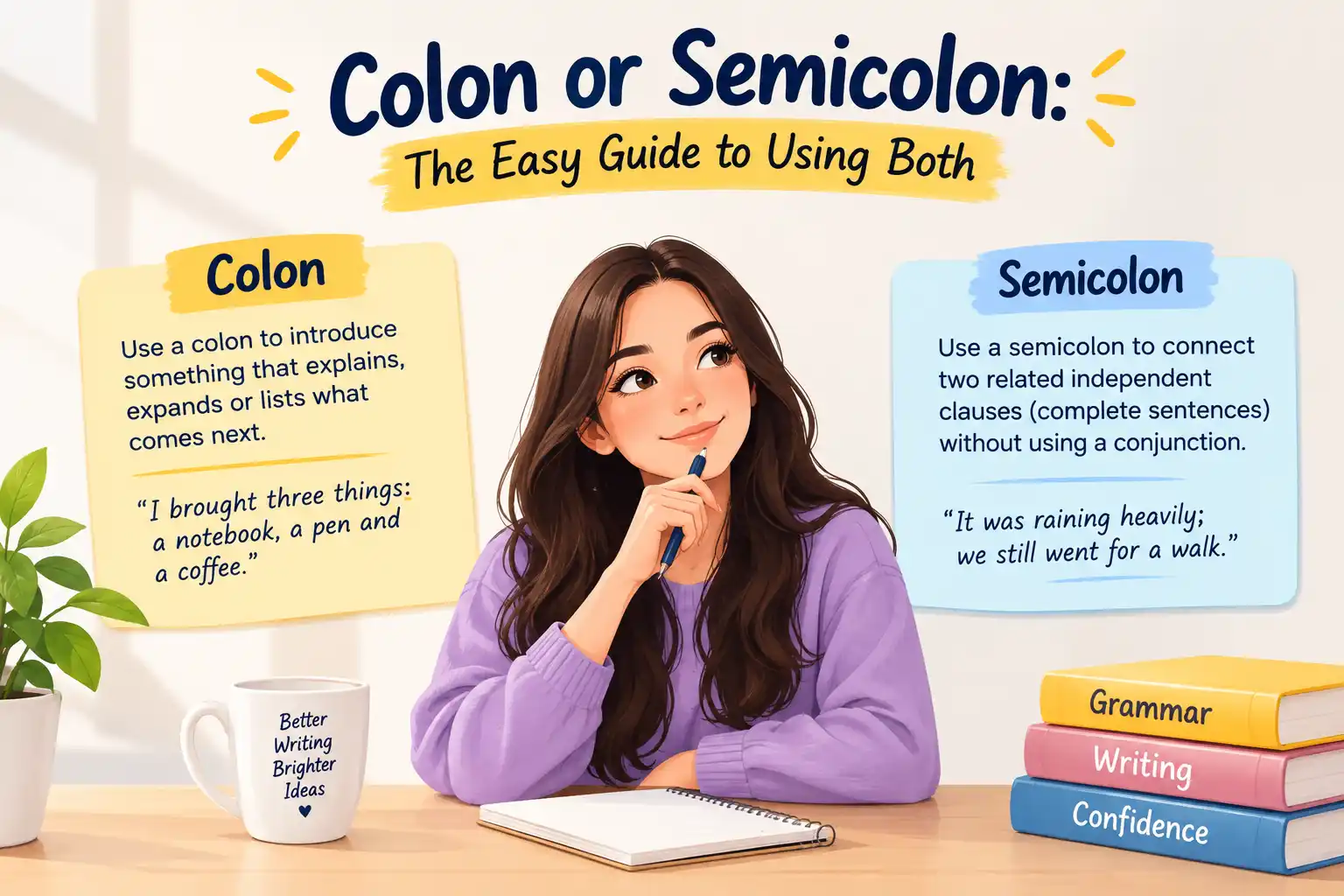
Colon or semicolon means choosing between two punctuation marks. Use a colon to point ahead to a list, an example, or an explanation. Use a semicolon to join two full sentences that are closely related.
I have taught English for more than ten years. Every year, the same thing happens. A student hands me a good essay. Then I spot a semicolon sitting in the middle of a list of names. Or a colon hiding after the word “like.”
I never blame the student. These two marks look alike. They even share a dot. But they do very different jobs.
Maybe you have stared at a sentence and wondered which one to use. Maybe you picked one and hoped for the best. That is normal. Most people guess.
This guide fixes that. You will learn what each mark does. You will see clear examples. And You will get simple tests you can use in ten seconds, You will also find cheat sheets you can save and use again.
By the end, you will not guess anymore. You will know.
Let us start with the basics.
Colon or Semicolon: Quick Answer
A colon (:) says, “Look at what comes next.” It opens the door to a list, an example, a quote, or an explanation.
A semicolon (;) says, “These two ideas belong together.” It joins two complete sentences without using a word like “and” or “but.”
Here are two simple examples.
- Colon: I packed three things: a book, a pen, and a snack.
- Semicolon: I love reading; my brother prefers movies.
See the difference? The colon leads to something. The semicolon connects two equals.
The Origin of the Colon and Semicolon
The word colon comes from the Greek word kolon. It meant a limb or a part. Later, it came to mean a part of a sentence. That fits well. A colon points to a new part of the sentence.
The word semicolon is easy to break apart. “Semi” means half. So a semicolon is a “half colon.” It is a mark that pauses more than a comma but less than a full stop.
The semicolon has a fun history. Many writers credit an Italian printer named Aldus Manutius. He worked in Venice in the late 1400s. His printed books used the mark in a way that later writers copied. Over time, English writers adopted it.
Why do people still mix them up? There are a few reasons.
- The two marks look almost the same.
- Their names sound alike.
- Many of us never learned them well in school.
- Some writers avoid both, so we rarely see good examples.
That is why the confusion never goes away. But it is easy to fix once you see the pattern.
Colon or Semicolon Explained: Key Differences
| Term | Meaning | When to Use | Region or Context |
|---|---|---|---|
| Colon (:) | Points ahead to more information | Before a list, example, quote, or explanation | All English writing |
| Semicolon (;) | Joins two related full sentences | When a period feels too strong and a comma is too weak | All English writing, common in formal text |
| Colon in time | Separates hours and minutes | Writing 10:30 or 7:15 | Common in the US; some UK writers use a period |
| Colon after a greeting | Opens a formal letter | Dear Ms. Khan: | Mostly American business writing |
| Semicolon in a long list | Separates items that already have commas | Lists of cities, dates, or people with details | Formal and academic writing |
How the Colon Works
The colon has a few clear jobs.
1. It introduces a list. But the part before the colon must be a full sentence.
- Correct: You will need three tools: a hammer, a nail, and a board.
2. It introduces an explanation. The second part explains the first.
- She had one fear: failing in front of everyone.
3. It introduces a quote.
- My teacher said it best: “Read every day.”
4. It shows time and ratios.
- The class starts at 9:00.
- The mix is 2:1 water to juice.
5. It separates a title from a subtitle.
- Punctuation Made Simple: A Guide for Students
How the Semicolon Works
The semicolon has fewer jobs. But each one matters.
1. It joins two full sentences that are closely related.
- The rain stopped; the streets began to dry.
Each side could stand alone as a sentence. That is the key.
2. It joins sentences with a word like “however” or “therefore.” Put the semicolon before the word. Put a comma after it.
- I wanted to go; however, the roads were closed.
3. It separates long list items that already have commas.
- We visited Lahore, Pakistan; Dubai, UAE; and Istanbul, Turkey.
Without semicolons, that list would be a mess of commas.
4. It can join long sentences that already contain commas, even when you use “and” or “but.”
- After weeks of practice, the team finally felt ready; but the storm, which no one expected, ruined the day.
Which Mark Should You Use?
Here is direct advice for each type of reader.
- For students: Use a colon for lists and explanations. Use a semicolon only when you can test it. (You will learn the test below.) Your teacher will thank you.
- For business writers: Use colons in emails and reports. They make your message clear and easy to scan. Use semicolons sparingly, mostly in formal reports.
- For bloggers and social media writers: Use colons often. They feel natural and friendly. Skip semicolons unless your tone is formal.
- For academic writers: Use both. Semicolons help in long, careful sentences and complex lists.
- For global or neutral use: Colons are safe everywhere. Semicolons are also fine, but use them with care.
When you are unsure, do this: write two short sentences instead. A period never confuses anyone.
Cheat Sheets You Can Save
1st Cheat Sheet: The Ten Second Test
Semicolon test: Replace the semicolon with a period. Do both sides still work as full sentences? If yes, the semicolon is correct. If no, change it.
Colon test: Read only the words before the colon. Do they make a full sentence? If yes, the colon is correct. If no, remove it.
2nd Cheat Sheet: Colon Rules at a Glance
- Use it after a full sentence.
- Use it before a list, quote, or explanation.
- Use it in times like 6:45.
- Use it in ratios like 3:1.
- Use it after a formal greeting in American letters.
- Do not use it after “such as,” “like,” “including,” or “is.”
3rd Cheat Sheet: Semicolon Rules at a Glance
- Use it between two full sentences that are closely linked.
- Use it before “however,” “therefore,” or “meanwhile” when they join two sentences.
- Use it to separate list items that already have commas.
- Do not use it before a list.
- Do not use it to join a full sentence and a fragment.
- Do not capitalize the word after it, unless it is a name.
Cheat Sheet 4: Memory Tricks
- Colon = a pointing finger. It points to what comes next.
- Semicolon = a soft stop. It ends one thought and gently links the next.
- Colon = “here it comes.”
- Semicolon = “and here is a close partner.”
Save these four cheat sheets. They solve most problems.
Common Mistakes with Colon or Semicolon
Let us look at the five most common errors. Each one shows the mistake and the fix.
Mistake 1: Using a semicolon before a list
- Wrong: I bought several fruits; apples, bananas, and grapes.
- Right: I bought several fruits: apples, bananas, and grapes.
Why it happens: People think a semicolon is a “stronger comma.” But a list needs a colon to introduce it.
Mistake 2: Using a colon after an unfinished phrase
- Wrong: My favorite fruits are: apples and mangoes.
- Right: My favorite fruits are apples and mangoes.
- Also right: I have two favorite fruits: apples and mangoes.
Why it happens: We pause when we speak, so we add a mark. But the words before the colon are not a full sentence.
Mistake 3: Joining a sentence and a fragment with a semicolon
- Wrong: She left early; because she was tired.
- Right: She left early because she was tired.
Why it happens: The second part cannot stand alone. A semicolon needs two full sentences.
Mistake 4: Using a comma when you need a semicolon
- Wrong: The bus was late, I missed the meeting.
- Right: The bus was late; I missed the meeting.
Why it happens: This error is called a comma splice. A comma alone cannot join two full sentences.
Mistake 5: Overusing semicolons
- Wrong: I like tea; she likes coffee; they like juice; we like water.
- Right: I like tea. She likes coffee. They like juice. We like water.
Why it happens: New writers think semicolons sound smart. Too many make writing heavy. Short sentences are often better.
Colon or Semicolon in Real World Examples
Let us see how both marks work in real writing.
In a professional email
Hi Sara,
Here is the plan for Monday: we will review the budget, approve the schedule, and assign tasks. The budget is ready; the schedule still needs one more check.
The first colon introduces the plan. The semicolon joins two close ideas.
In a news headline
- Storm Hits Coast: Thousands Lose Power
Headlines use the colon to split the main event from the detail. It is short and clear.
In a social media post
- Three things I learned this week: patience matters, sleep helps, and small steps win.
The colon makes the post easy to scan. Social posts rarely need a semicolon.
In a formal report
- The survey included students from Lahore, Pakistan; Manchester, England; and Toronto, Canada. The results were similar in each city; however, response rates were higher online.
Here the semicolons separate places that already contain commas. Then one more semicolon comes before “however.”
Colon or Semicolon: Data, Trends and Usage
People usually search for this topic in the middle of writing. They are stuck on one sentence. They want a quick answer and a clear rule. That tells us the search intent is informational. Readers want to learn and then get back to work.
Who cares most about this question?
- Students writing essays and reports
- English learners studying grammar
- Bloggers and content writers polishing their work
- Office workers writing emails and documents
- Editors and teachers checking style
I am not quoting exact search numbers here. I would rather stay honest than invent figures. But the pattern is easy to see. This question comes up whenever people write more, and today many of us write all day.
Here is one insight that matters now. Most of our writing is short: texts, chats, and posts. In short writing, the colon thrives. The semicolon gets less use. That is why many people feel unsure about it. Knowing when to use it, and when to skip it, gives your writing a polished edge.
Standalone Comparison Table
| Term or Variant | Meaning | Region or Context | Best Used When |
|---|---|---|---|
| Colon before a list | Introduces items | All English | A full sentence comes first |
| Colon before an explanation | Shows the reason or detail | All English | The second part explains the first |
| Colon in time | Separates hours and minutes | Standard in the US; a period is common in some UK styles | Writing clock times |
| Colon after a greeting | Opens a formal letter | Mostly American | Business letters |
| Semicolon between sentences | Links two related full sentences | All English | Both sides can stand alone |
| Semicolon with “however” | Joins sentences with a linking word | All English | Formal or careful writing |
| Semicolon in a complex list | Separates items that contain commas | Formal and academic | Lists of places or people with details |
| Comma | Small pause | All English | Simple lists and short breaks |
| Period | Full stop | All English | When you want the safest choice |
FAQ
Q: What does colon or semicolon mean? A: It means choosing between two punctuation marks. A colon points ahead to a list, quote, or explanation. A semicolon joins two closely related full sentences.
Q: How do you use a colon or semicolon correctly? A: Use a colon after a full sentence when you want to introduce something. Use a semicolon when two full sentences belong together. Test the semicolon by swapping it for a period.
Q: What is the difference between a colon and a semicolon? A: A colon leads to more information. A semicolon connects two equal ideas. The colon looks forward. The semicolon links what is on both sides.
Q: Is a semicolon acceptable in formal writing? A: Yes. It is common in essays, reports, and academic papers. But use it only when it makes the sentence clearer. In casual writing, a period often works better.
Q: Which is correct: a colon or a semicolon before a list? A: Use a colon. A semicolon before a list is a common mistake. The one exception is a list where the items themselves contain commas, but the semicolons go between the items, not before the list.
Q: Where do the colon and semicolon come from? A: Colon comes from the Greek word kolon, meaning a limb or part. Semicolon means “half colon.” Writers began using the semicolon in printed books in the late 1400s.
Q: Can I use a colon or semicolon in a text message or social post? A: You can. Colons are common and friendly. Semicolons are rare in casual posts, though some people use them for style. Your reader will understand either way.
Conclusion
Let us review the key points.
- A colon points ahead. Use it after a full sentence to introduce a list, quote, or explanation.
- A semicolon joins two full sentences that are closely linked.
- Do not use a semicolon before a list. Do not use a colon after an unfinished phrase.
- When in doubt, use a period. Two short sentences are always safe.
My final advice is simple. Use the ten second test. Read the words before the colon. Swap the semicolon for a period. If the test passes, your punctuation is right. If it fails, fix it. You will get faster every time.
Good punctuation is not about sounding fancy. It is about helping your reader. And now you know exactly how to do that.
Bookmark this guide so you never second guess colon or semicolon again. Share it with a friend who is still guessing.
Read More: Through or Thru: The Real Answer Once and for All

Hey, I’m Ayeza. I started wordiums.com because I kept freezing over words that look almost the same, unsure which one was right. Now I explain every word comparison in plain language, so you can pick the right word with confidence and move on.