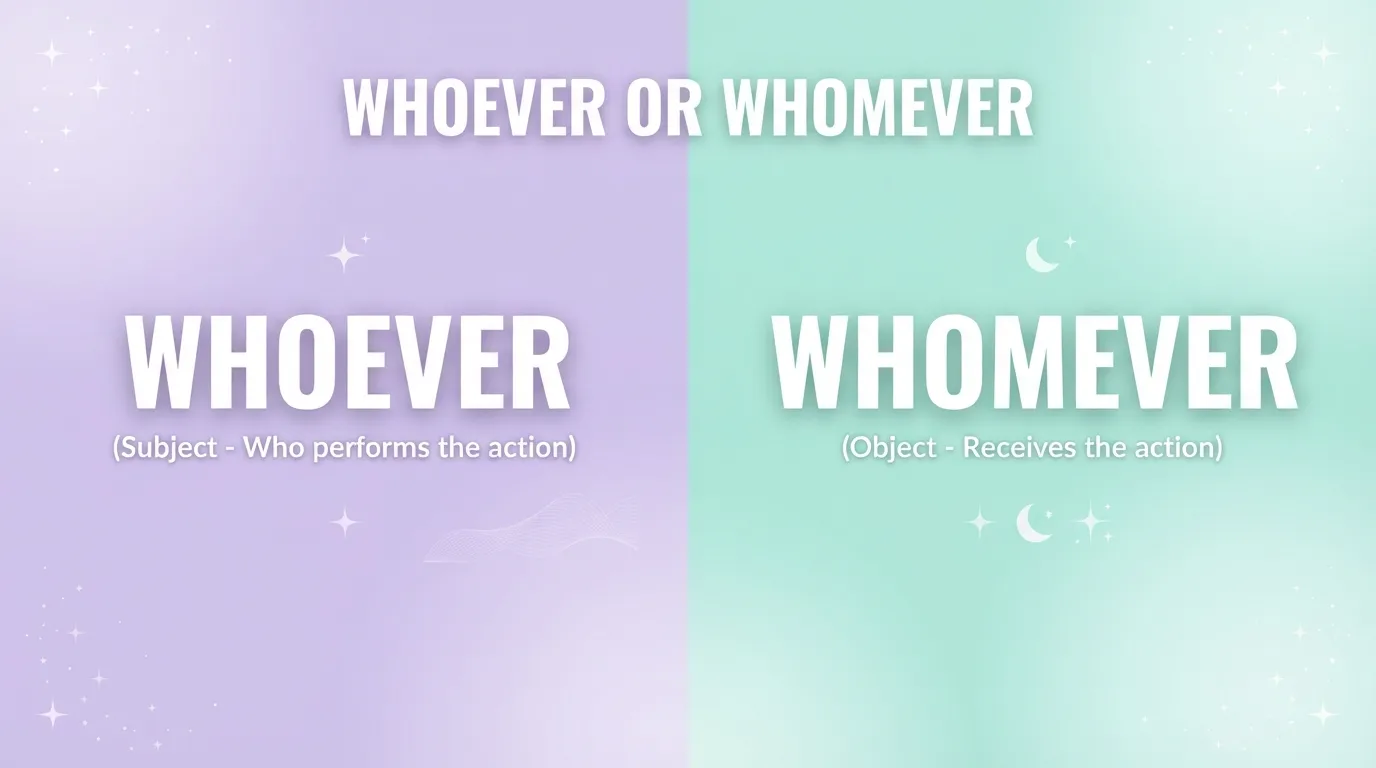
Use whoever when it acts as the subject of a verb, and use whomever when it acts as the object of a verb or a preposition.
My Own Mix Up With This Word
A few years ago I sent a work email that read, “Please give this task to whoever finishes first.” My manager circled the word and wrote one note beside it: check your grammar. I stared at that sentence for ten minutes. It felt wrong to use “whoever” after the word “to.” Shouldn’t it be “whomever”? I was sure I had made a mistake.
I hadn’t.
That single email sent me down a rabbit hole of grammar guides, old textbooks, and confusing forum threads. Most of them made the rule sound harder than it needed to be. So today I want to give you the plain, simple version I wish someone had given me back then. By the end of this guide, you will never freeze over “whoever” or “whomever” again.
Let’s get into it.
Whoever or Whomever – Quick Answer
Both words come from the same root: who. Think of whoever as the subject form, like “he” or “she.” Think of whomever as the object form, like “him” or “her.”
Two quick examples:
- “Whoever left this jacket should come get it.” (Whoever is doing the action of leaving.)
- “Give the prize to whomever you choose.” (Whomever is receiving the action of choosing.)
That’s the whole rule in one paragraph. Everything else in this guide just helps you spot the pattern faster.
The Background Behind Whoever and Whomever
English kept a small piece of an old system called case marking. Long ago, pronouns changed their spelling depending on their job in a sentence. Most of that system faded away, but a few pairs survived: he and him, she and her, they and them, and who and whom.
Whoever and whomever are simply the “compound” cousins of who and whom. They get used when you are talking about an unknown or general person instead of a named one.
Confusion happens because everyday spoken English has mostly dropped whom and whomever. Most people say “who did you talk to” instead of “whom did you talk to.” That habit spills into writing, and it makes whomever feel old fashioned or overly formal, even when it is the correct choice.
Grammar teachers noticed this shift decades ago. Many style guides now admit that whom and whomever sound stiff in casual talk, even while they still stay correct in careful writing. That gap between what sounds natural and what counts as technically right is exactly why so many writers pause before typing either word.
Language keeps changing, and pronoun rules often change slowest of all. Whoever and whomever sit in that slow lane. They still follow the old logic, even though most of English around them has moved on. Understanding that background makes the rule feel less like a random trap and more like a small piece of history still doing its job.
Whoever or Whomever Explained: Key Differences
Here’s a simple table that lays out how each word behaves.
| Term | Meaning | When to Use | Region/Context |
| Whoever | Subject form, does the action | Before a verb, as the doer | Used everywhere, common in speech and writing |
| Whomever | Object form, receives the action | After a verb or a preposition, as the receiver | Common in formal writing, letters, reports |
A quick trick that works almost every time: replace whoever or whomever with he or him.
- If he fits, use whoever.
- If him fits, use whomever.
Try it: “Give the prize to (whoever/whomever) arrives first.” Say “him arrives” or “he arrives.” “He arrives” sounds right, so the answer is whoever, since it is the subject of “arrives,” not the object of “to.”
Which Version Should You Use?
Different readers, different needs. Here is honest, practical advice for each group.
- For students and test takers: Learn the swap trick above. It works for almost every sentence you will face on an exam.
- For business writers and professionals: Whomever still matters in formal emails, contracts, and reports. Getting it right adds polish.
- For everyday casual writing and texting: Whoever is usually safe, since spoken English leans that way and few readers will notice or mind.
- For global or neutral writing, such as blog posts or instructions: Stick with the swap trick, and when in doubt, rewrite the sentence to avoid the choice altogether. For example, change “give it to whomever needs it most” to “give it to the person who needs it most.”
Common Mistakes with Whoever and Whomever
Here are the errors people make again and again, along with the fix.
- Mistake: “Give it to whoever you trust most.” Correction: “Give it to whomever you trust most.” Why it happens: writers only look at the word right before whoever or whomever, in this case “to,” and assume it always needs the object form. But you must check the word’s job inside its own clause, not just the word before it.
- Mistake: “Whomever calls first will get the job.” Correction: “Whoever calls first will get the job.” Why it happens: whomever sounds fancier, so writers reach for it when they want to sound formal, even when the subject form is correct.
- Mistake: “I will hire whomever is qualified.” Correction: “I will hire whoever is qualified.” Why it happens: the sentence starts right after a verb, “hire,” so it feels like an object slot. But “is qualified” needs a subject, and that subject is whoever.
- Mistake: “Tell whoever you meet about the event.” Correction: “Tell whomever you meet about the event.” Why it happens: the clause “you meet” already has its own subject, “you,” so the pronoun becomes the object of “meet” instead.
- Mistake: Avoiding the word entirely out of fear, and writing awkward sentences like “the person, whoever that may be, should call.” Why it happens: writers who are unsure would rather sound clumsy than risk being wrong. The swap trick removes this fear completely.
A pattern worth noticing across all five mistakes: the confusion almost never comes from the pronoun itself. It comes from the word sitting right in front of it, whether that word is “to,” “hire,” or “tell.” Your eye jumps to that nearby word and assumes it controls the choice. The fix is always the same. Pause, find the clause that whoever or whomever actually belongs to, and run the swap trick inside that smaller piece of the sentence.
Whoever and Whomever in Real World Examples
Seeing the words in real settings helps the rule stick.
A professional email: “Please forward this file to whoever is covering the account this week.”
A news headline: “Award Goes to Whoever Solves the City’s Traffic Problem First”
A social media post: “Shoutout to whoever left this sweet comment on my page today!”
A formal report: “The committee will grant funding to whomever the board selects during the March review.”
Notice the pattern each time. When the word starts its own action, it is whoever. When the word receives an action from someone else, it is whomever.
Whoever and Whomever: Data, Trends, and Usage
Searches for “whoever or whomever” spike heavily among students, content writers, and job seekers drafting cover letters. This is mostly an informational search, meaning people want a clear explanation rather than a product or service.
English learners search this term often, since their native languages may not have a similar subject and object pronoun split. Writers producing business documents also search it frequently, since formal writing still expects whom and whomever in the right spots.
This topic matters right now because more communication happens through quick digital writing, like email, chat, and social posts. Small grammar slips get noticed fast in professional settings, so getting whoever and whomever right can quietly boost how polished your writing looks.
Hiring managers and editors often mention pronoun slips as a small but memorable red flag on a resume or cover letter. A single misused whomever will not ruin an application, but a clean, correct sentence quietly signals care and attention. That small signal is often the real reason this topic keeps trending among job seekers and new professionals building their writing habits.
Standalone Comparison Table
| Term/Variant | Meaning | Region/Context | Best Used When |
| Whoever | Subject pronoun | Used worldwide in English | The word performs the action in its clause |
| Whomever | Object pronoun | Common in formal or written English | The word receives the action in its clause |
Quick Cheat Sheet You Can Save
Keep this short list nearby whenever you write:
- Ask yourself: does this word do something, or does it have something done to it?
- Swap it with he or him inside the clause.
- He fits? Use whoever.
- Him fits? Use whomever.
- Look at the whole clause, not just the word right before the pronoun.
- When still unsure, rewrite the sentence with “the person who” or “the person whom.”
- Casual writing leans toward whoever. Formal writing still respects whomever.
Print this list, save it as a note on your phone, or pin it above your desk. It turns a confusing grammar rule into a five second check.
Test Your Knowledge: Whoever or Whomever Quiz
Try these five sentences. Pick whoever or whomever, then check your answers below.
- Give the award to ___ deserves it most.
- ___ finishes the race first wins a prize.
- I will support ___ the team chooses as leader.
- ___ calls this number will reach our support team.
- Send the invitation to ___ you think should attend.
Answers: 1. whoever, 2. whoever, 3. whomever, 4. whoever, 5. whomever
How did you score?
- 5 correct: You have mastered this rule.
- 3 to 4 correct: You are close, review the swap trick once more.
- 0 to 2 correct: Save the cheat sheet above and try the quiz again in a day.
Frequently Asked Questions
Q: What does whoever mean? A: Whoever means “any person who,” and it works as the subject of a verb inside its own clause. It performs the action, the way “he” or “she” would.
Q: How do you use whoever and whomever correctly? A: Swap the pronoun with he or him in your head. If he sounds right, use whoever. If him sounds right, use whomever.
Q: Whoever vs whomever, what is the real difference? A: Whoever is a subject pronoun, meaning it does the action. Whomever is an object pronoun, meaning it receives the action from a verb or comes after a preposition.
Q: Is whomever acceptable in formal writing? A: Yes, and it is often expected there. Reports, contracts, and professional letters still follow this traditional rule closely.
Q: Which version is correct, whoever or whomever, after the word “to”? A: It depends on the clause that follows, not the word “to” itself. Check what job the pronoun plays inside its own clause before deciding.
Q: Where does the whoever and whomever rule come from? A: It comes from an older English case system that changed pronoun spelling based on grammatical role. Who and whom, and their compound forms whoever and whomever, are among the few survivors of that older system.
Q: Can whoever be used in casual conversation or texting? A: Yes, whoever is common and accepted in casual speech and writing, even in spots where whomever would technically be correct. Most native speakers default to whoever in relaxed settings.
Final Thoughts
Whoever and whomever do not have to feel scary. Remember the core idea: whoever acts, whomever receives. Use the simple swap trick with he and him whenever you feel stuck. Keep the cheat sheet close, and revisit the quiz until it feels automatic.
You now know exactly how to use whoever and whomever with confidence. Bookmark this guide so you never second guess these two words again, and share it with a friend or coworker who has been stuck on the same question.
See More: Farther or Further: The Real Rule Explained Simply

I’m Zain. I got interested in commonly confused words while helping non-native English speakers prep for writing exams, where a single misused word could cost real marks. That experience shaped how I write now: I try to explain not just which spelling is correct, but why the confusion exists in the first place, since understanding the reason is what actually makes it stick.