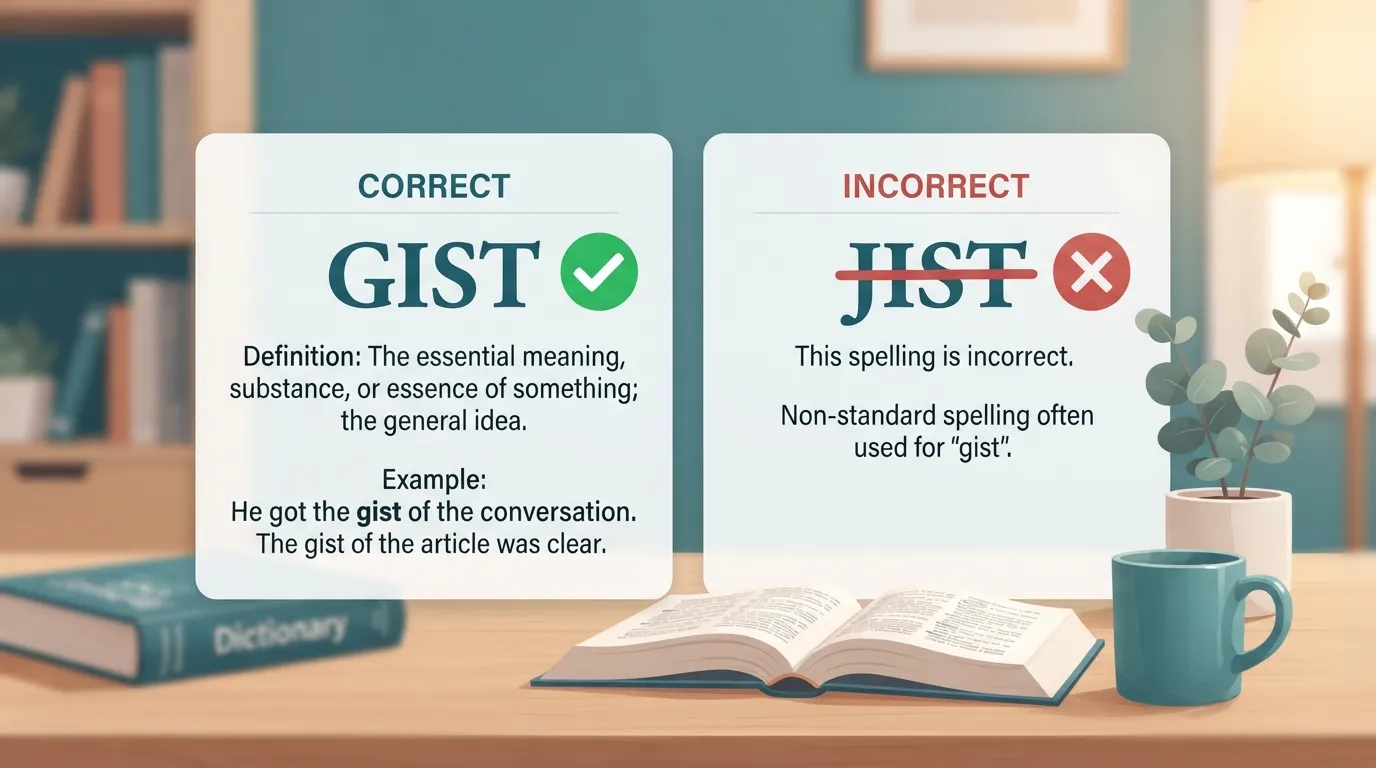
Gist is the correct spelling. It means the main point or general meaning of something. Jist is simply a common misspelling, not an accepted alternative, though it shows up often because of how the word sounds when spoken.
Last week a friend sent me a text that just said “give me the jist of it.” I knew exactly what she meant. She wanted the short version, the main idea, not the whole story. But that spelling stopped me for a second.
Was jist actually a real word? Or had autocorrect just let something slide?
I checked. It had not slid. Jist is not correct. Gist is the only accepted spelling, and once you understand why, you will never mix them up again.
This confusion happens because English spelling does not always match pronunciation. Gist sounds like it starts with a soft J sound, so writing jist feels natural. Your ears are not wrong. Your fingers just followed the wrong logic.
By the end of this guide, you will know exactly why gist is correct, where the confusion comes from, and how to use the word properly in emails, articles, and everyday conversation.
Jist or Gist: Quick Answer
Gist means the essential point or overall meaning of something, especially a longer piece of writing or speech. You use it when you want the short version of a bigger idea.
For example, “The gist of the report is that sales dropped last quarter.” Or, “I did not read the whole email, but I got the gist.”
Jist is not a word in standard English. It appears often in casual writing, text messages, and social media, but dictionaries do not recognize it as a valid spelling.
The Origin of Gist
Gist comes from Anglo French, a legal term from the phrase “cest action gist,” meaning “this action lies.” In old legal usage, gist referred to the real basis of a legal claim, the actual point that made a case valid.
Over time, the word moved out of courtrooms and into everyday English. By the eighteenth century, gist had settled into its modern meaning: the essential substance or main point of something.
The soft G sound at the start is the real source of all this confusion. English usually pairs a soft G with the letter I in words like giant or ginger. But gist keeps its G despite the soft sound, and that inconsistency is exactly why so many people guess jist instead.
Gist Explained: Why the Confusion Exists
English spelling rules are inconsistent, and gist sits right in the middle of that mess. Here is a breakdown of the two spellings and where each one actually stands.
| Term | Meaning | When to Use | Region or Context |
| Gist | Main point or essential meaning | Any formal or informal writing | Standard in American, British, and all global English |
| Jist | Not a real word | Never in correct writing | Common misspelling in casual texting and speech transcription |
Notice that jist is not a regional variant. It is not British versus American English. It is simply an error, though a very common one, especially in spoken to text situations like voice messages or quick chats.
Which Version Should You Use?
For formal writing, always use gist. There is no situation, academic, professional, or journalistic, where jist is acceptable.
For casual texting, gist is still correct, but jist will usually be understood anyway. That does not make it correct. It just means people are forgiving in casual contexts.
For global or neutral use, gist is universal. It appears the same way in dictionaries across every major English speaking country, so you never need to adjust spelling based on your audience.
Here is the simple rule. If you are writing anything that someone else will read and judge, whether that is a resume, an email to your boss, or a school assignment, use gist every single time.
Common Mistakes with Gist
Mistake: “Give me the jist of the meeting.” Correction: “Give me the gist of the meeting.” Why it happens: The soft G sound naturally suggests a J spelling, especially since most other soft G words in English follow that pattern with words like giant or gym.
Mistake: “I only skimmed it, but I got the jest of it.” Correction: “I only skimmed it, but I got the gist of it.” Why it happens: This mistake mixes up gist with jest, a completely different word meaning a joke. The two words sound nothing alike when spoken carefully, but they get confused in quick typing.
Mistake: Using gist to mean a summary you personally wrote. Correction: Gist refers to the core meaning itself, not a written summary document. Why it happens: People sometimes stretch the word to describe an actual written output, like a formal executive summary, when gist really describes the underlying idea, not the document.
Mistake: “The jist is clear.” Correction: “The gist is clear.” Why it happens: Simple habit. Once someone learns the wrong spelling once, it tends to repeat because it feels phonetically correct.
Gist in Real World Examples
Professional email: “Thanks for the detailed report. I have not gone through every page yet, but I understand the gist, and I agree with the recommended direction.”
News headline: “Analysts Say the Gist of the New Policy Favors Small Businesses”
Social media post: “Didn’t watch the whole debate, but here’s the gist: both candidates avoided the actual question.”
Formal document or report: “This section summarizes the gist of the committee’s findings, with full details available in Appendix B.”
Notice how gist works comfortably in every register, from a quick social post to a formal report. That flexibility is part of why it remains such a commonly used word.
Gist: Data, Trends, and Usage
Search data consistently shows that people typing “jist or gist” are almost always trying to confirm correct spelling, which makes this a purely informational search, not a commercial one.
This particular confusion spikes heavily among people typing quickly on mobile devices, since phonetic spelling mistakes are far more common in fast, informal typing than in slower, deliberate writing.
English learners also search this pair frequently, since the disconnect between spelling and pronunciation in English is one of the most common frustrations for anyone learning the language as a second language.
One insight worth noting: as voice to text tools become more common, misspellings like jist may actually decline over time, since voice transcription software is trained to output the dictionary correct spelling regardless of how casually something is spoken.
Comparison Table: Jist vs Gist
| Term or Variant | Meaning | Region or Context | Best Used When |
| Gist | The main or essential point of something | Universal across all English variants | Any formal, professional, or casual writing |
| Jist | Not a recognized word | Common misspelling only | Never appropriate in correct writing |
Frequently Asked Questions
Q: What does gist mean? A: Gist means the main point or essential meaning of something, usually a longer statement, document, or conversation. It refers to the core idea rather than every specific detail.
Q: How do you use gist correctly in a sentence? A: Use gist to describe the summarized main idea of something longer, as in “I understood the gist of the presentation even though I missed the first ten minutes.”
Q: Jist versus gist, what is the actual difference? A: There is no real difference in meaning because jist is not a legitimate word. Gist is the only correct spelling recognized by dictionaries and style guides.
Q: Is jist acceptable in formal writing? A: No. Jist should never appear in formal writing, professional communication, or academic work. Always use gist instead.
Q: Which version is correct, jist or gist? A: Gist is correct. Jist is a common misspelling that comes from how the word sounds when spoken quickly.
Q: Where does the word gist come from? A: Gist comes from Anglo French legal language, originally referring to the real basis of a legal claim, before evolving into its modern meaning of the essential point of something.
Q: Can gist be used in casual conversation? A: Yes. Gist works naturally in both casual and formal contexts, which is part of why it remains such a commonly used word across writing styles.
Conclusion
Gist is the only correct spelling, and jist is simply a phonetic mistake that has never earned dictionary status. The confusion makes sense once you realize gist breaks the usual soft G spelling pattern found in words like giant or gym.
Remember these key points. Gist means the main idea or essential point. Jist is always incorrect, in every context, formal or casual. The mix up happens because of pronunciation, not because of any real regional or historical variation. And gist has stayed remarkably consistent in meaning since its legal origins centuries ago.
Now you know exactly how to use gist correctly. Bookmark this guide so you never second guess this spelling again, and share it with anyone who has ever typed jist without thinking twice.
Read More: Tomatoes vs Tomatos: Fixing the Plural Everyone Gets Wrong

I’m Zain. I got interested in commonly confused words while helping non-native English speakers prep for writing exams, where a single misused word could cost real marks. That experience shaped how I write now: I try to explain not just which spelling is correct, but why the confusion exists in the first place, since understanding the reason is what actually makes it stick.