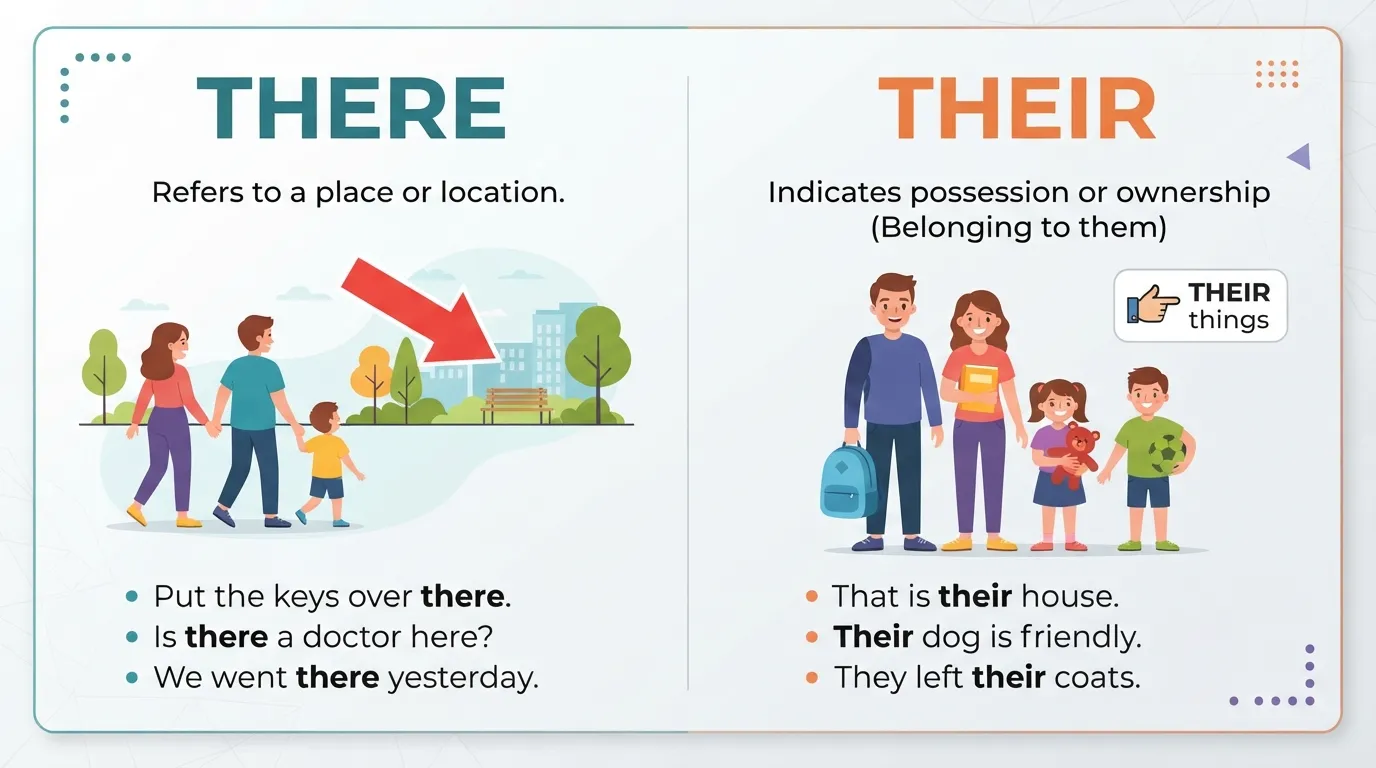
There points to a place or introduces a fact, while their shows possession, meaning something belongs to a group of people. They sound the same but serve completely different jobs in a sentence.
I once sent a work email that read, “Please leave the files over their.” My manager replied with a single word: “there?” I felt my face go red. I knew the rule. I just typed on autopilot and missed it.
That tiny slip happens to almost everyone. These words sound identical, so our brains sometimes grab the wrong one without warning.
Texts, emails, and even published articles show this mistake constantly. Spellcheck often won’t catch it, since both words are spelled correctly, just used incorrectly.
This guide breaks the confusion apart for good, with a simple trick you’ll actually remember.
There vs Their: Quick Answer
There refers to a location, or it introduces a fact or idea. Their, on the other hand, shows ownership, meaning something belongs to more than one person.
For example, “The keys are over there” points to a location. “That is their house” shows the house belongs to them.
The Origin and Background of There and Their
There comes from Old English þǣr, meaning “in that place.” It has always pointed toward location or existence, as in “there is” or “there are.”
Their, meanwhile, traces back to Old Norse þeirra, meaning “of them.” Vikings brought this possessive form into English during centuries of contact and settlement in Britain.
So the confusion isn’t really about meaning. It’s about sound. Both words evolved along separate paths, yet English pronunciation eventually made them nearly identical.
There and Their Explained: Key Differences
| Term | Meaning | When to Use | Region/Context |
| There | A place, or an introductory word | Pointing to location or stating a fact | Universal, all English writing |
| Their | Possessive form showing ownership by a group | Showing something belongs to multiple people | Universal, all English writing |
Here’s a simple trick. If you can replace the word with “here,” you need there. If you can replace it with “our” or “his and hers,” you need their.
Which Word Should You Use?
- When pointing to a location → use there, as in “put it over there.”
- When showing ownership → use their, as in “their car is parked outside.”
- When starting a sentence about existence → use there, as in “there are three options.”
If you’re ever unsure mid sentence, try the substitution trick above. It works nearly every time.
Common Mistakes with There and Their
Mistake 1: Using “there” instead of “their” for possession.
- Wrong: “The students left there books on the desk.”
- Correct: “The students left their books on the desk.”
- Why it happens: The words sound identical, so the brain autopilots to the more common spelling.
Mistake 2: Using “their” when pointing to a location.
- Wrong: “The car is parked over their.”
- Correct: “The car is parked over there.”
- Why it happens: Fast typing often swaps similar sounding words without a second glance.
Mistake 3: Confusing both with “they’re,” the contraction.
- Wrong: “Their going to the store later.”
- Correct: “They’re going to the store later.”
- Why it happens: All three words sound exactly alike, creating a classic triple mix up.
Mistake 4: Relying entirely on spellcheck to catch the error.
- Wrong: Publishing a document with the wrong word, since spellcheck sees no misspelling.
- Correct: Proofread manually, or read the sentence aloud to check the meaning fits.
- Why it happens: Spellcheck flags misspelled words, not correctly spelled words used incorrectly.
There and Their in Real World Examples
Professional email: “Please have the vendors submit their invoices by Friday.”
News headline: “Residents Gather There to Protest New Zoning Laws”
Social media post: “Can’t believe their flight got cancelled right before the trip. 😩”
Formal document: “All employees must complete their training modules by the end of the month.”
There and Their: Data, Trends, and Usage
There and their both rank among the most searched grammar questions online, especially among students and non native English speakers. People search this comparison year round, without any real seasonal spike.
Writers, students, and content editors search this topic most often. Search intent is almost entirely informational, since people simply want a quick, clear rule they can apply immediately.
This distinction matters now more than ever, as more writing happens through quick texts and social posts, where autopilot typing makes this mistake easy to miss.
There vs Their: Comparison Table
| Term/Variant | Meaning | Region/Context | Best Used When |
| There | Refers to a place or introduces a fact | Universal, all English writing | Pointing to location or existence |
| Their | Shows possession by a group | Universal, all English writing | Showing something belongs to them |
| They’re | Contraction of “they are” | Universal, all English writing | Describing an action or state they’re doing |
Frequently Asked Questions
Q: What does there mean? A: There refers to a specific place, or it introduces a fact or statement, as in “there is a problem” or “put it there.”
Q: What does their mean? A: Their is a possessive word showing that something belongs to more than one person, such as “their house” or “their decision.”
Q: There vs their, what’s the real difference? A: There points to location or introduces an idea. Their shows ownership. They sound alike but serve completely different grammatical roles.
Q: Is there acceptable in formal writing? A: Yes, both there and their are standard in formal writing, as long as you use each one correctly for its intended meaning.
Q: Which word should I use, there or their? A: Use there for location or introducing facts, and their whenever you mean something belongs to a group of people.
Q: Where does the word their come from? A: It comes from Old Norse, brought into English through Viking settlement and contact with Old English speakers centuries ago.
Q: Can there and their ever mean the same thing? A: No. Even though they sound identical, they never overlap in meaning, and swapping them always creates a grammatical error.
Final Thoughts
There and their sound the same but do completely different jobs. There points to a place or introduces an idea. Their, meanwhile, shows that something belongs to more than one person.
Next time you’re unsure, try the simple substitution trick: swap in “here” or “our” and see which one fits.
Share this with someone who’s been mixing up there and their for years.
See More: Bungalow vs Villa: Which One Actually Fits Your Dream Home?

Hi, I’m Zara. Words that look almost identical but mean completely different things have always fascinated me, that’s what pulled me toward writing about spelling and usage. I focus on digging into where these mix-ups actually come from, whether it’s a British-American split or just a rule English never bothered to make consistent. My goal with every guide is simple: give you the answer fast, then explain it well enough that you never have to look it up again.