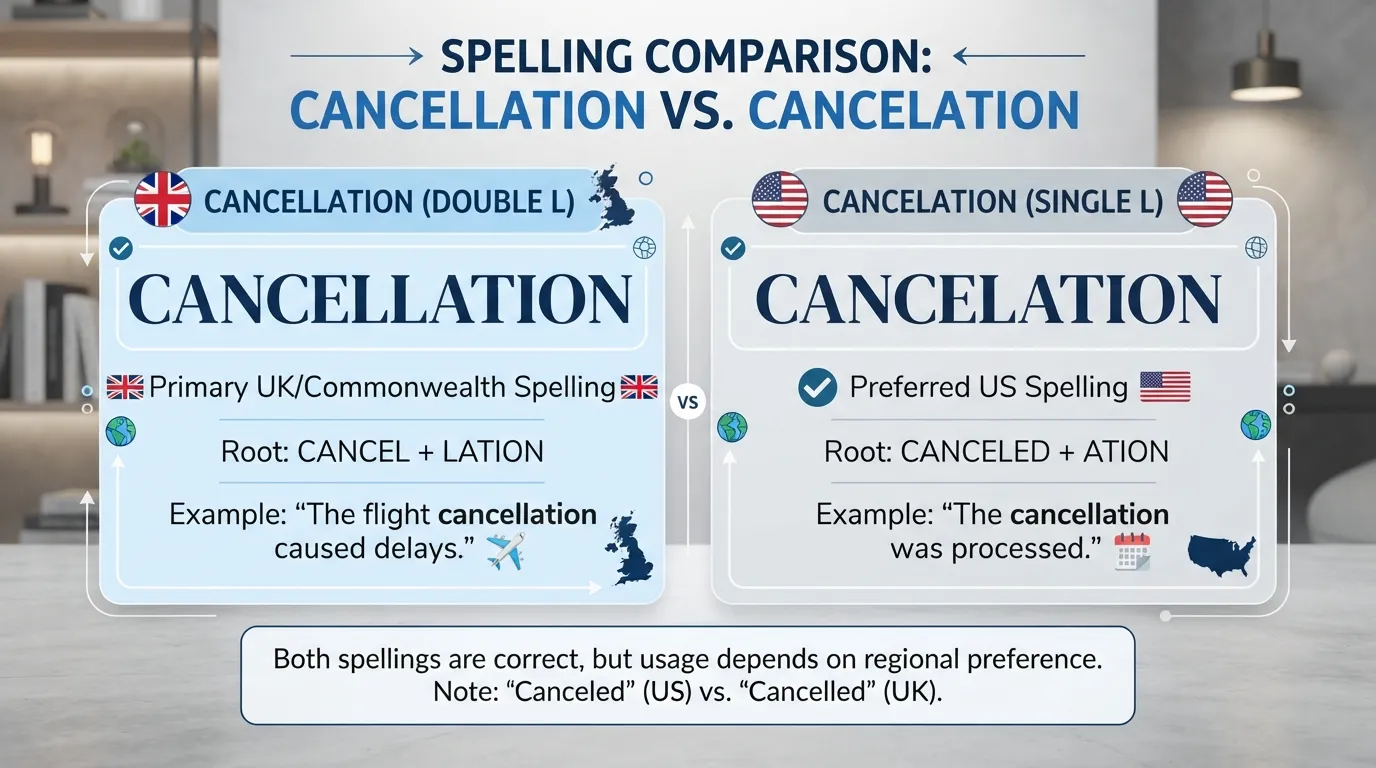
Cancellation, with two L’s, is the correct spelling in both American and British English. Cancelation, with one L, is a rare variant that most dictionaries now consider nonstandard.
A few years back, I was drafting a refund policy for a small online shop I helped manage. I typed “cancelation” without a second thought, then a customer emailed back, gently pointing out it looked misspelled. I checked, and sure enough, I had dropped a letter I didn’t even know existed.
That tiny mistake taught me something. Even confident writers slip up on this word constantly.
Spellcheck tools sometimes let both versions slide, which only makes the confusion worse. Business emails, legal notices, and even news articles show both spellings in the wild.
This guide settles the question for good, with clear reasoning, real examples, and a rule you’ll never forget.
Cancellation vs Cancelation: Quick Answer
Cancellation, spelled with two L’s, is the standard, correct spelling everywhere. Cancelation, with only one L, shows up occasionally, but most style guides and dictionaries flag it as incorrect or outdated.
For example, “Please confirm the cancellation of my subscription” is correct. “Please confirm the cancelation of my subscription,” though, reads as a typo to most editors today.
The Origin and Background of Cancellation
The word comes from the Latin cancellare, meaning “to cross out” or “to make like a lattice.” It entered English through French, picking up the doubled consonant pattern common in many words with this root.
So why does “cancelation” exist at all? English spelling rules around doubling consonants before suffixes are notoriously inconsistent. Words like “traveling” versus “travelling” show the same split between American and British habits.
Unlike travel, though, cancellation kept its double L on both sides of the Atlantic. Cancelation never gained real traction as an accepted American variant, even though some early dictionaries briefly listed it.
Cancellation and Cancelation Explained: Key Differences
| Term | Meaning | When to Use | Region/Context |
| Cancellation | The act of canceling something | Always, in modern writing | Global standard, US and UK |
| Cancelation | Rare, nonstandard spelling | Almost never | Occasional historical or informal use |
Check any major dictionary, style guide, or legal document, and cancellation appears every time. Cancelation simply doesn’t hold up in professional or academic writing.
Which Version Should You Use?
- For business and legal writing → use cancellation, since it’s the only spelling recognized in contracts and formal correspondence.
- For everyday writing and texting → use cancellation, because cancelation will likely confuse or distract your reader.
- For international audiences → use cancellation, since both American and British English agree on this one.
There’s really no context, in fact, where cancelation is the smarter or more accurate choice.
Common Mistakes with Cancellation and Cancelation
The Mistake 1: Dropping the second L by habit.
- Wrong: “We processed your cancelation request.”
- Correct: “We processed your cancellation request.”
- Why it happens: Writers often assume American English simplifies double letters, the way it does in “traveling” or “canceled.”
The Mistake 2: Confusing this word with “canceled” or “canceling.”
- Wrong: Assuming since “canceled” uses one L in American English, “cancellation” should too.
- Correct: “Canceled” uses one L in American English, but “cancellation” always uses two, in both American and British English.
- Why it happens: These related words follow different rules, and people apply one pattern to all of them.
Mistake 3: Trusting autocorrect to catch every instance.
- Wrong: Publishing a document with “cancelation” left uncorrected.
- Correct: Manually proofread, since some spellcheckers still accept the rare variant.
- Why it happens: Older or looser dictionaries built into certain software still flag “cancelation” as valid.
Mistake 4: Mixing spellings within the same document.
- Wrong: Using “cancellation” in one section and “cancelation” in another.
- Correct: Pick one spelling, cancellation, and use it consistently throughout.
- Why it happens: Copy pasting from multiple sources without a final proofread.
Cancellation in Real World Examples
Professional email: “This message confirms the cancellation of your order placed on March 3rd.”
News headline: “Airline Announces Mass Flight Cancellations Due to Severe Weather”
Social media post: “Ugh, just got a cancellation notice for the concert I’ve been waiting months for. 😩”
Formal document: “The cancellation policy allows a full refund within 14 days of purchase.”
Cancellation: Data, Trends, and Usage
Cancellation dominates search volume across booking sites, subscription services, and customer support pages. Cancelation, meanwhile, gets searched occasionally, almost always by people double checking their spelling before hitting send.
Businesses, students, and customer service teams search this comparison most often. Search intent here is clearly informational, since people simply want to confirm the correct spelling before publishing or sending something official.
This distinction matters because refund policies, legal notices, and customer emails all depend on precise language. A misspelled word like cancelation can quietly chip away at a brand’s professionalism.
Cancellation vs Cancelation: Comparison Table
| Term/Variant | Meaning | Region/Context | Best Used When |
| Cancellation | Correct standard spelling | Global, US and UK | Always, in any writing |
| Cancelation | Rare, nonstandard spelling | Occasional informal use | Never recommended |
Frequently Asked Questions
Q: What does cancellation mean? A: Cancellation means the act of stopping, ending, or calling off something, such as a subscription, reservation, or event.
Q: How do you use cancellation correctly? A: Use “cancellation” whenever you describe the act of canceling something, whether in casual writing, business emails, or legal documents.
Q: Cancellation vs cancelation, what’s the difference? A: There’s no difference in meaning, only spelling. “Cancellation” is correct and standard, while “cancelation” is a rare variant most style guides reject.
Q: Is cancelation acceptable in formal writing? A: No. Formal, legal, and professional writing should always use “cancellation.” Cancelation can look like a careless mistake.
Q: Which version is correct, cancellation or cancelation? A: Cancellation is correct, with two L’s. Cancelation appears occasionally but isn’t considered standard in modern English.
Q: Where does the word cancellation come from? A: It comes from the Latin word “cancellare,” meaning “to cross out,” which passed into English through French influence.
Q: Can cancelation ever be used in modern writing? A: Rarely, and only in very informal contexts. Stick with “cancellation” everywhere else, from emails to contracts to news articles.
Final Thoughts
This one has a clear answer. Cancellation, with two L’s, is correct, standard, and safe in every situation. Cancelation, by contrast, is a rare misspelling with almost no place in modern writing.
If you remember nothing else, remember this: two L’s, every time.
Bookmark this guide so you never second guess cancellation spelling again.
Explore more: Silk or Satin: The Real Difference Explained

My name is Ayesha Sadiqah, the writer behind this website. I write in-depth articles on English spelling, word comparisons, grammar, and vocabulary to help learners make better language choices. Every guide is carefully researched and designed to provide accurate, practical, and easy-to-understand information.