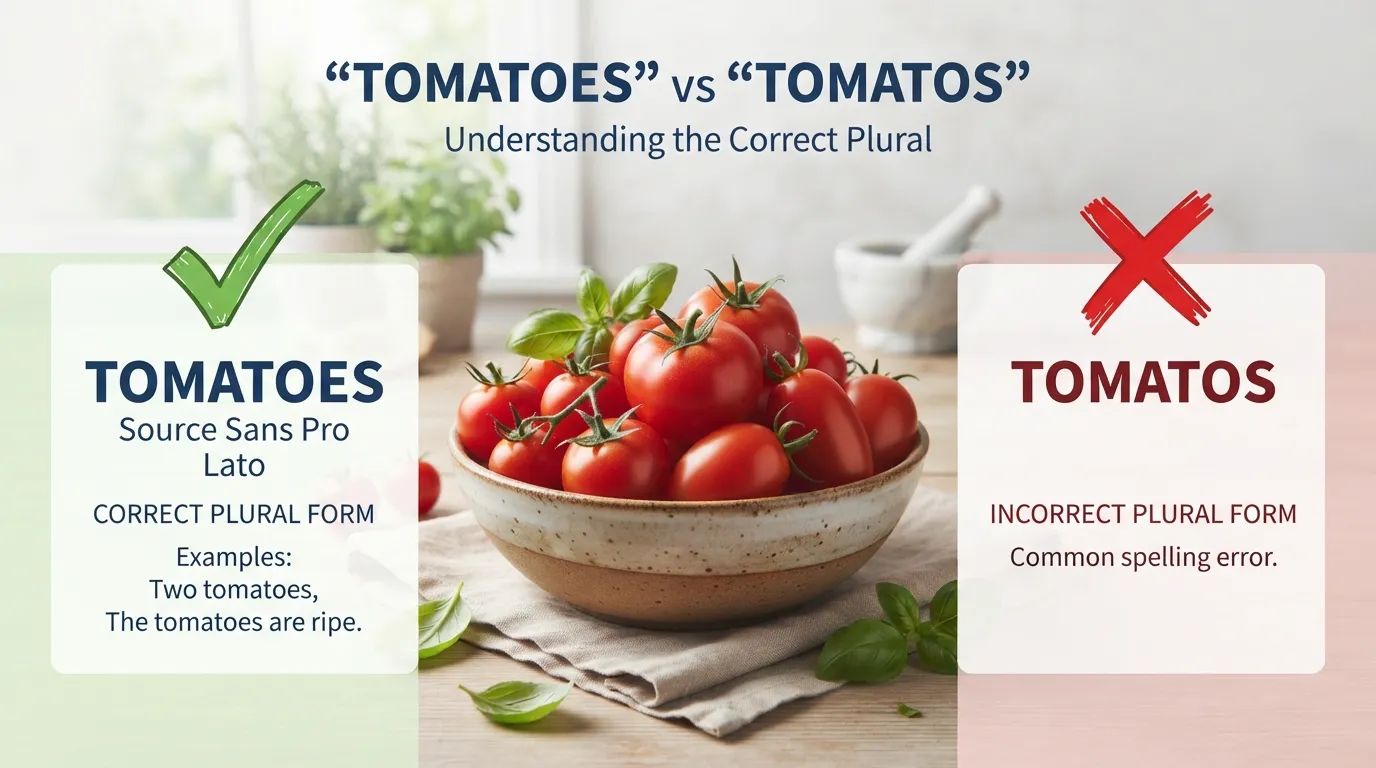
Tomatoes, ending in “es,” is the correct plural spelling in English. Tomatos, without the “e,” is a common misspelling that breaks a basic pluralization rule.
I still remember a handwritten grocery list from my college roommate that read “tomatos, potatos, avocados.” Two out of three were wrong, and at the time, none of us noticed. It wasn’t until a professor circled it in red on a lab report years later that I actually learned the rule.
This mistake shows up everywhere, from menus to shopping lists to recipe blogs. It’s an easy trap, because plenty of words ending in “o” just add an “s,” not “es.”
The tricky part is knowing which words follow which rule. Get it wrong, and it quietly signals a lack of attention to detail, especially in professional writing.
This guide clears up the confusion for good, with the reasoning behind the rule and a simple way to remember it.
Tomatoes vs Tomatos: Quick Answer
Tomatoes, spelled with “es,” is the correct plural form of tomato. Tomatos, spelled with just an “s,” is a common misspelling that doesn’t follow standard English pluralization rules.
For example, “I bought three tomatoes at the market” is correct. “I bought three tomatos at the market,” though, breaks the rule most readers expect.
The Origin and Background of Tomatoes
Tomato comes from the Nahuatl word tomatl, used by the Aztecs long before Spanish colonizers brought the word into European languages. It entered English in the 1600s, already carrying its distinctive “o” ending.
English pluralization has a quirky rule for nouns ending in a consonant plus “o.” Many of them, like tomato, potato, hero, and echo, add “es” instead of just “s.” Words ending in a vowel plus “o,” like radios and studios, simply add “s.”
Confusion happens because so many “o” ending words do just add “s,” like pianos, photos, and logos. Tomato, unfortunately, sits in the smaller, trickier group.
Tomatoes and Tomatos Explained: Key Differences
| Term | Meaning | When to Use | Region/Context |
| Tomatoes | Correct plural of tomato | Always, in modern writing | Global standard, US and UK |
| Tomatos | Common misspelling | Almost never | Casual, uncorrected writing only |
Check any dictionary, cookbook, or grocery guide, and tomatoes appears every single time. Tomatos simply isn’t recognized as a correct plural form.
Which Version Should You Use?
- For recipes and cooking content → use tomatoes, since it’s the standard spelling readers expect in food writing.
- For grocery lists and menus → use tomatoes, because tomatos can make a menu look careless or unedited.
- For any formal or published writing → always use tomatoes, since it’s the only version dictionaries recognize.
There’s genuinely no context where tomatos is the preferred or accepted spelling.
Common Mistakes with Tomatoes and Tomatos
The Mistake 1: Simply adding “s” instead of “es.”
- Wrong: “The garden produced dozens of tomatos this summer.”
- Correct: “The garden produced dozens of tomatoes this summer.”
- Why it happens: Writers apply the more common “just add s” rule without checking the exception.
The Mistake 2: Confusing tomato with words like piano or photo.
- Wrong: Assuming all “o” ending words pluralize the same way.
- Correct: Learn that tomato belongs to the smaller group requiring “es,” alongside potato and hero.
- Why it happens: English pluralization rules aren’t consistent, so people generalize from the more familiar pattern.
Mistake 3: Trusting autocorrect to catch the error.
- Wrong: Publishing a menu or recipe with “tomatos” left uncorrected.
- Correct: Manually proofread food related content, since some spellcheckers miss this specific error.
- Why it happens: Certain autocorrect tools focus on common words and skip less frequent exceptions.
Mistake 4: Copying the mistake from other casual sources.
- Wrong: Repeating “tomatos” because a recipe blog or handwritten sign used it first.
- Correct: Always double check plural spelling against a dictionary, not another casual source.
- Why it happens: Errors spread quickly online, especially in informal, unedited content.
Tomatoes in Real World Examples
Professional email: “Please confirm the delivery includes fresh tomatoes for tomorrow’s catering order.”
News headline: “Local Farmers Report Record Tomato Harvest This Season”
Social media post: “Grew way too many tomatoes in my garden this year, send help. 🍅”
Formal document: “The recipe requires two pounds of ripe tomatoes, diced and lightly salted.”
Tomatoes: Data, Trends, and Usage
Tomatoes dominates search volume across recipe sites, gardening blogs, and grocery content. Tomatos, meanwhile, gets searched occasionally, almost always by people checking their spelling before writing a list or menu.
Home cooks, gardeners, and content writers search this comparison most often. Search intent here is clearly informational, since people simply want a fast, reliable spelling check.
This distinction matters because food blogs, menus, and recipe content all depend on polished, error free writing. A small mistake like tomatos can quietly undercut a brand’s credibility.
Tomatoes vs Tomatos: Comparison Table
| Term/Variant | Meaning | Region/Context | Best Used When |
| Tomatoes | Correct plural spelling | Global, US and UK | Always, in any writing |
| Tomatos | Common misspelling | Casual, uncorrected writing | Never recommended |
| Potatoes | Similarly pluralized food word | Global, US and UK | Following the same “es” pattern |
Frequently Asked Questions
Q: What does tomatoes mean? A: Tomatoes is simply the plural form of tomato, referring to more than one of the round, red fruit commonly used in cooking.
Q: How do you use tomatoes correctly? A: Use “tomatoes” whenever you refer to more than one tomato, whether in a recipe, grocery list, or garden update.
Q: Tomatoes vs tomatos, what’s the difference? A: There’s no difference in meaning, only spelling. “Tomatoes” is correct, while “tomatos” is a common misspelling that skips the required “e.”
Q: Is tomatos acceptable in formal writing? A: No. Recipes, menus, and any published content should always use “tomatoes.” Tomatos will likely be flagged as an error.
Q: Which version is correct, tomatoes or tomatos? A: Tomatoes is correct. Tomatos doesn’t appear in standard English dictionaries and should be avoided in any writing.
Q: Where does the word tomato come from? A: It comes from the Nahuatl word “tomatl,” used by the Aztecs, which entered English through Spanish in the 1600s.
Q: Can tomatos ever be used in modern writing? A: Practically never. Stick with “tomatoes” everywhere, from casual grocery lists to professional recipe blogs.
Final Thoughts
This one has a clear answer. Tomatoes, ending in “es,” is correct, standard, and expected in every context. Tomatos, by contrast, is a common misspelling worth catching before you hit publish or send.
If you remember nothing else, remember this: tomato gets the “es,” just like potato and hero.
Now you know exactly how to spell tomatoes correctly, go update that grocery list.
Read More: Dependent or Dependant: The Spelling You Should Actually Use

Hey, I’m Ayeza. I started this site because I kept hitting the same wall over and over: typing a word, freezing, and not trusting my own instinct on the spelling. Now I research these mix-ups properly so you don’t have to, and I write every guide the way I wish these explanations had been written for me.