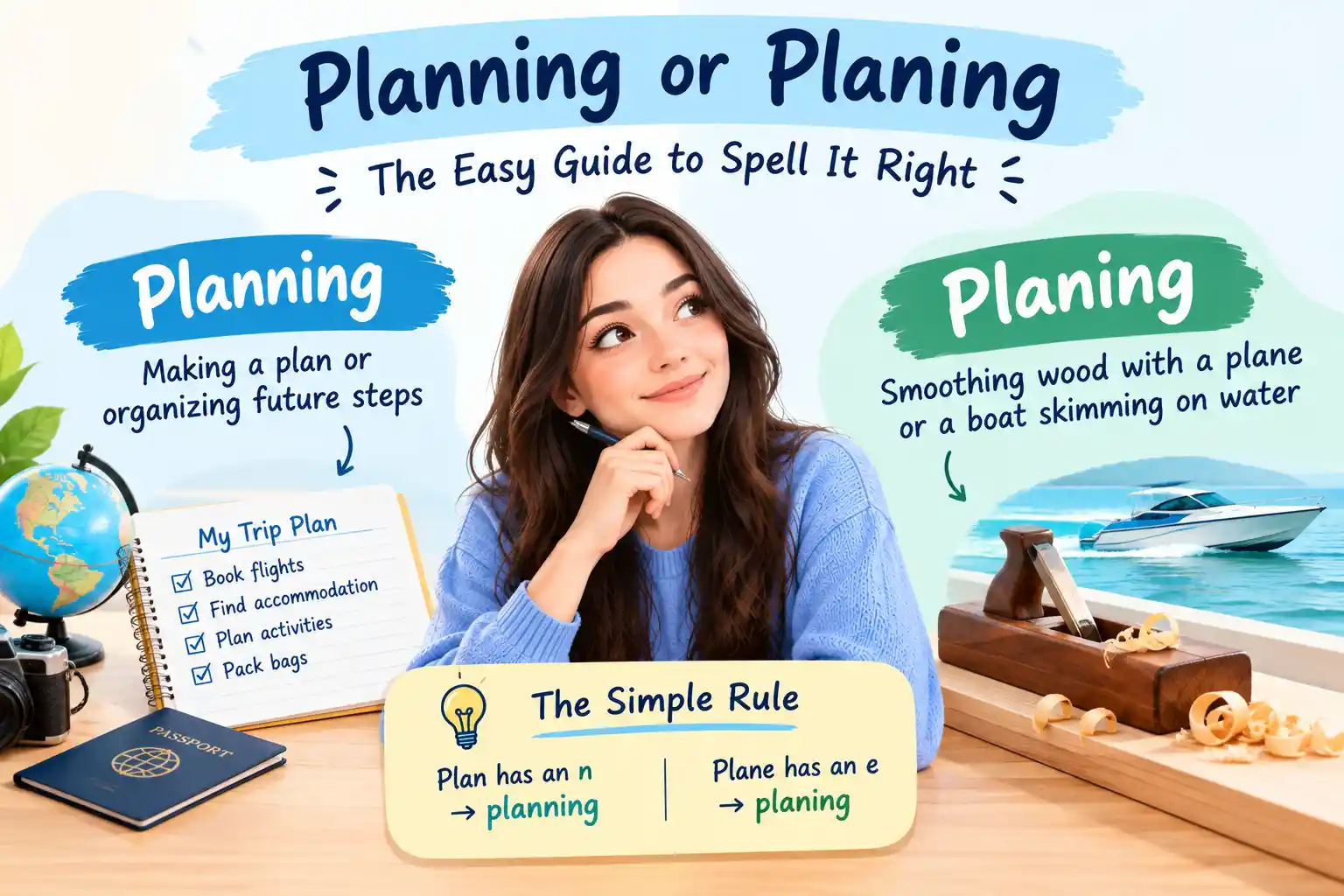
Planning or planing means two different words. Planning is the spelling for making a plan, as in planning a trip. Planing is a real word for smoothing wood with a plane, or for a boat skimming over water. Use planning for plans. Use planing for wood and boats.
Years ago, I walked through a busy timber market on a hot afternoon. A hand painted banner hung over one shop. It said “Wood Planning Done Here.”
I smiled. Then I stopped. Was the banner wrong, or was I?
I asked the carpenter. He laughed and said he cared about smooth boards, not spelling. But the question stayed with me.
Later, I saw the same doubt in student essays. One wrote “event planing” in a school report. A boating forum had a post about a “planning hull.” Two words, one letter apart, and both are real. That is exactly why so many people search for planning or planing.
This guide clears it up. You will learn what each word means, where each one comes from, and the simple rule that tells you which to write. You will also get three cheat sheets, real examples, and answers to common questions.
Ready to find out which “n” you need? Let us begin.
Planning or Planing: Quick Answer
Planning has a double n. It comes from the verb plan. It means thinking ahead and deciding how to do something.
Planing has a single n. It comes from the verb plane. It means making wood smooth with a plane tool, or a boat rising up and skimming across water.
Here are two quick examples:
- We are planning a family trip to the mountains.
- The carpenter spent the morning planing the edge of the door.
Both sentences are correct. The meaning decides the spelling.
The One Line Memory Trick
Plan has an n at the end. Add “ing” and you double it: planning.
Plane has an e at the end. Drop the e and add “ing”: planing.
The Origin and Background of Planning or Planing
Both words trace back to the Latin word planus, which means flat. That shared root explains why the two words look so alike.
The word plan came into English through French. In French, it meant a flat surface or a drawing of a flat layout, like the map of a house. Over time, English speakers used it for any scheme or idea about how to do something. So when you plan a trip, you are drawing a map of your future.
The tool called a plane got its name for a simple reason. It makes wood flat. A carpenter pushes the plane along a board and thin curls of wood fall away. The board ends up smooth and level.
Sailors later borrowed the idea. A fast boat can lift its front and skim over the surface of the water. People call that planing, because the boat glides on a flat layer of water, almost like a plane gliding over wood.
Why the Confusion Exists
There are three reasons.
First, English adds “ing” in different ways. Some words double the last letter. Some drop the silent e. Learners often mix up the two rules.
Second, both words are real. A spell checker will not flag “planing” when you meant “planning.” It sees a valid word and moves on.
Third, the sounds are close. They differ in only one vowel sound, and many people say them quickly.
How They Sound
Say them out loud and you will hear the difference.
- Planning sounds like “PLAN ing.” The a is short, like the a in “pan.” It rhymes with “scanning.”
- Planing sounds like “PLAY ning.” The a is long, like the a in “play.” It rhymes with “raining.”
If you can hear the long “ay” sound, you probably want planing.
Planning or Planing Explained: Key Differences or Variations
The two words belong to two different families. Here is the family tree in one table.
| Term | Meaning | When to Use | Region or Context |
| Planning | Making a plan or organizing future steps | Trips, events, projects, business, life | Used worldwide |
| Planing | Smoothing wood with a plane, or a boat skimming on water | Carpentry, woodworking, boating | Used worldwide |
| Planned | Past form of plan | “We planned the meeting last week.” | Used worldwide |
| Planed | Past form of plane | “He planed the board flat.” | Used worldwide |
| Planner | A person or tool that plans | Event planner, daily planner | Used worldwide |
| Planer | A tool or machine that planes wood | Workshops and joinery | Used worldwide |
Examples for Each Form
- Planning: Good planning saves time and money.
- Planing: Planing the table top took an hour.
- Planned: They planned a surprise party for her.
- Planed: The joiner planed the oak beams until they were perfectly smooth.
- Planner: My sister works as a wedding planner.
- Planer: He bought an electric planer for the workshop.
Cheat Sheet 1: The Doubling Rule
Here is the rule behind the whole puzzle. It is worth saving.
| Base Word | Ending | Rule | Result |
| Plan | Ends in one vowel plus one consonant | Double the consonant, then add ing | Planning |
| Plane | Ends in a silent e | Drop the e, then add ing | Planing |
| Hop | Ends in one vowel plus one consonant | Double the consonant | Hopping |
| Hope | Ends in a silent e | Drop the e | Hoping |
| Tap | Ends in one vowel plus one consonant | Double the consonant | Tapping |
| Tape | Ends in a silent e | Drop the e | Taping |
Notice the pattern. A double consonant keeps the vowel short. A single consonant with a dropped e keeps the vowel long. The same logic separates “hopping” from “hoping” and “tapping” from “taping.”
Cheat Sheet 2: Word Pairs to Remember
| Plan Family (Short a) | Plane Family (Long a) |
| plan | plane |
| planning | planing |
| planned | planed |
| planner | planer |
If the word is about ideas, schedules, or goals, pick the left column. If it is about wood, tools, or water, pick the right column.
Which Version or Approach Should You Use?
Here is direct advice for each kind of reader.
- For students and general writers, use planning because most essays, emails, and reports are about plans.
- For business and office writing, use planning because project planning, financial planning, and strategic planning all take the double n.
- For carpenters, joiners, and woodworkers, use planing because you smooth boards with a plane. The machine is a planer, and a factory that does this work is a planing mill.
- For boat owners and sailors, use planing because a boat that rises and skims over the water is planing. The shape that allows it is a planing hull.
- For global or neutral use, choose planning unless your topic is wood or boats. It is far more common, and your readers will expect it.
Cheat Sheet 3: The Fast Decision Guide
Ask yourself two questions:
- Am I talking about a plan, a schedule, or a goal? Use planning.
- Am I talking about smooth wood or a fast boat? Use planing.
If neither fits, you probably want planning.
Common Mistakes with Planning or Planing
Even careful writers slip here. Let us look at the five most common errors.
Mistake 1: Dropping an n in a plan word
- Wrong: We are planing our summer holiday.
- Right: We are planning our summer holiday.
Why it happens: The writer thinks “plane” and drops the e out of habit. The word for a holiday plan keeps the double n.
Mistake 2: Doubling the n in a wood word
- Wrong: The carpenter is planning the board.
- Right: The carpenter is planing the board.
Why it happens: The writer remembers “plan” and doubles the n. But smoothing wood belongs to the plane family.
Mistake 3: Mixing up the past forms
- Wrong: She planed the meeting for Monday.
- Right: She planned the meeting for Monday.
Why it happens: Single n looks tidy, so people use it. But a meeting is a plan, so it needs the double n.
Mistake 4: Confusing planner and planer
- Wrong: He hired a wedding planer.
- Right: He hired a wedding planner.
Why it happens: The two words differ by one letter, and a spell checker accepts both. A planer is a wood tool. A planner organizes events.
Mistake 5: Writing the wrong word for boats
- Wrong: The boat reached planning speed.
- Right: The boat reached planing speed.
Why it happens: Boating is a technical topic, and writers fall back on the more familiar word.
Planning or Planing in Real World Examples
Let us see both words at work in different settings.
In a Professional Email
“Hi Maria, our planning meeting is set for Tuesday. Please bring the budget notes. Thanks, Ahmed.”
“Hi Tariq, the planing of the oak panels will finish on Friday. We can start fitting them on Monday.”
In a News Headline
“City Council Approves New Urban Planning Rules”
“Fast Ferry Credited to New Planing Hull Design”
In a Social Media Post
“Spent the whole weekend planning our dream kitchen. So excited!”
“Nothing beats the smell of fresh wood shavings while planing a board by hand.”
In a Formal Report
“The committee recommends stronger long term planning for water supply.”
“The mill’s planing department produces smooth timber for the furniture industry.”
In Common Phrases
- Family planning
- Financial planning
- Planning permission (a common British phrase for official approval to build)
- Planning ahead
- Planing mill
- Planing hull
- Planed timber
Planning or Planing: Data, Trends, and Usage
Why do people search for this pair? The answer is simple. Both words are real, so no spell checker can rescue you.
Who searches for it? Students, teachers, bloggers, office workers, and learners of English. Woodworkers and boat owners may also search, because they often meet the less common spelling in their own field.
Where does it come up? Anywhere English is written or taught. The question appears in classrooms, in content writing, and in online forums about wood and boats. The double n spelling is far more common in everyday life, which is why the single n version surprises people.
What is the search intent? It is informational. The reader wants a fast, clear answer to a spelling doubt. Many also want to know whether “planing” is a typo or a real word.
Why does it matter now? More people write for the public than ever before. Business pages, social posts, and blogs all go live in seconds. A wrong spelling in a headline like “Event Planing Tips” can make a brand look careless. A small fix protects trust.
Here is one useful insight. Spelling mistakes in pairs like this one are not random. They follow the doubling rule. Learn the rule once and you fix dozens of words, not just this one.
Planning or Planing Comparison Table
Keep this table close for quick checks.
| Term or Variant | Meaning | Region or Context | Best Used When |
| Planning | Making a plan | Worldwide, all fields | Writing about schedules, goals, projects, trips |
| Planing | Smoothing wood, or a boat skimming on water | Worldwide, trade and technical fields | Writing about carpentry or boating |
| Planned | Past form of plan | Worldwide | Something was arranged in advance |
| Planed | Past form of plane | Worldwide | Wood was smoothed with a plane |
| Planner | Person or tool that plans | Worldwide | Event planner, daily planner |
| Planer | Wood smoothing tool or machine | Workshops and joinery | Woodworking tools |
| Planning permission | Official approval to build | Mainly British usage | Construction and property writing |
| Planing hull | Boat shape that lifts and skims | Marine and boating | Boat design and speed |
Frequently Asked Questions About Planning or Planing
Q: What does planning mean? A: Planning means deciding in advance what to do and how to do it. It is the “ing” form of the verb plan. It can also work as a noun, as in “good planning.”
Q: What does planing mean? A: Planing means smoothing wood with a plane tool or machine. It also describes a boat that rises and skims over the water. It comes from the verb plane.
Q: Planning or planing: which one is correct? A: Both are correct, but for different jobs. Use planning for plans and schedules. Use planing for woodwork and boats.
Q: Is planing a misspelling of planning? A: No. Planing is a real word with its own meaning. It becomes a mistake only when you use it to mean making a plan.
Q: How do you use planning correctly? A: Use it for any activity that involves organizing the future. Examples include “wedding planning,” “project planning,” and “planning ahead.”
Q: Where do planning and planing come from? A: Both trace back to the Latin word planus, meaning flat. Plan came through French as a flat drawing or layout. The tool called a plane got its name because it makes wood flat.
Q: Is planning acceptable in formal writing? A: Yes. Planning is the standard spelling in formal writing, in every English speaking country. Planing is formal too, but only in woodwork and marine contexts.
Conclusion: Planning or Planing Made Simple
Let us pull it together.
First, planning is for plans, schedules, and goals. Second, planing is for smoothing wood and for boats skimming on water. Third, the rule is simple: double the n for plan, drop the e for plane. Fourth, a spell checker will not rescue you, because both words are real.
My final advice is clear. If your sentence is about ideas or the future, write planning. If it is about boards, tools, or a boat gliding on water, write planing. When you are unsure, planning is almost always the right pick.
That banner in the timber market taught me something. A single letter can change a whole message, even when the work behind it is perfect.
Bookmark this guide so you never second guess planning or planing again. Share it with someone who is still confused about it.
Read More: Honor or Honour: The Easy Guide to Pick the Right One

I’m Zain. Through Wordiums.com, I write clear, accurate word comparison guides that show the difference between similar words, spellings, and phrases, so readers can choose the right word in seconds.