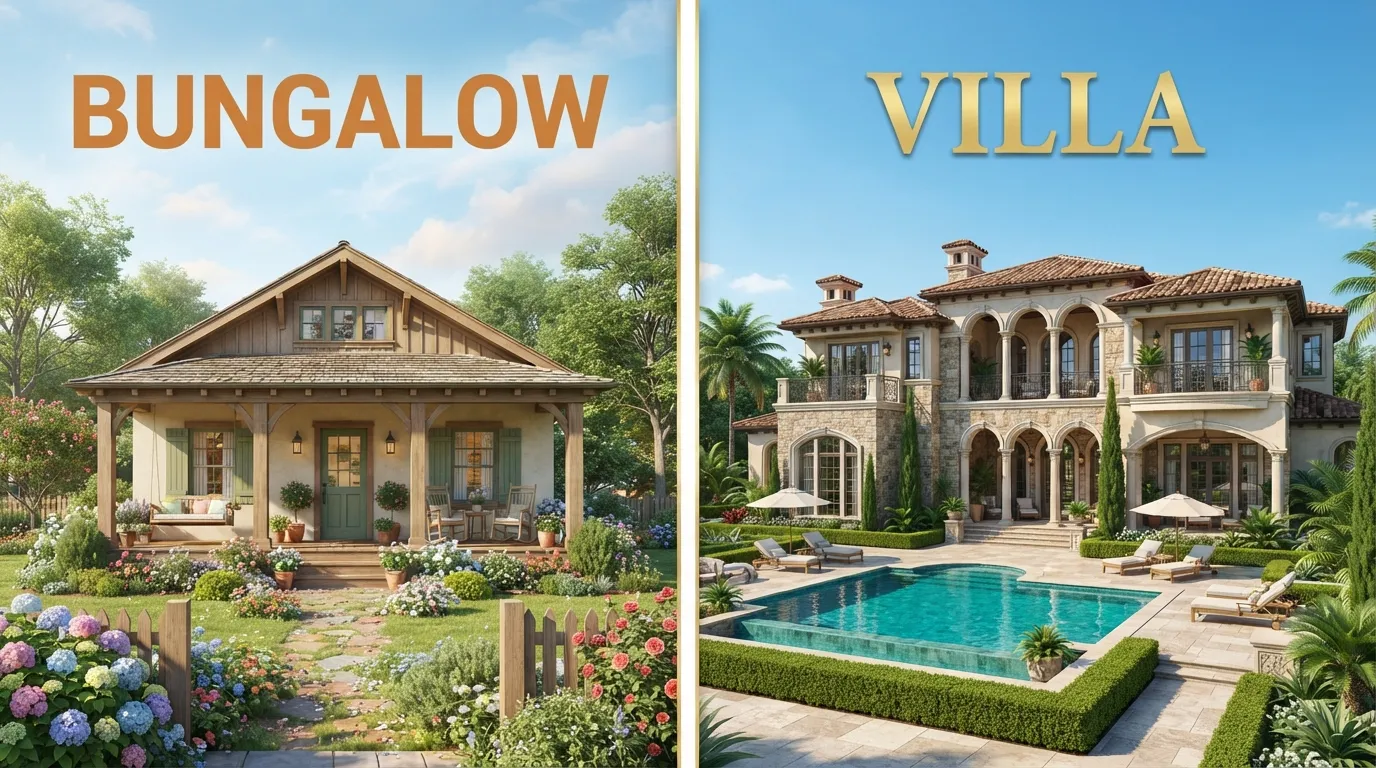
A bungalow is a small, single story home built for simple, practical living. A villa, on the other hand, is a larger, often luxurious house associated with comfort, space, and status.
When my parents started house hunting years ago, the agent kept switching between “bungalow” and “villa” like they were the same thing. My dad finally asked, “Wait, which one are we actually looking at?”
The agent laughed and admitted most buyers ask that exact question. So it turns out these two words get blended together constantly, especially in real estate listings.
If you plan to buy, rent, or simply understand property ads better, this mix up can genuinely cost you time and money.
This guide breaks the two terms apart clearly, so you always know exactly what you are looking at.
Bungalow vs Villa – Quick Answer
A bungalow is a compact, single story house, usually simple and practical. A villa, though, is typically larger and more luxurious, and it often includes outdoor space like a garden or pool.
For example, a retired couple might downsize into a cozy bungalow. A wealthy family, meanwhile, might build a spacious villa with multiple bedrooms and a private garden.
The Origin and Background of Bungalow and Villa
Bungalow comes from the Hindi word bangla, meaning “house in the Bengal style.” British colonists in India adopted the term for low, single story homes with wide verandas, and it spread to English speaking countries from there.
Villa, however, comes from Latin, originally describing a country estate or farmhouse owned by wealthy Romans. Over centuries, it evolved into a term for spacious, elegant homes, often built for leisure or vacation living.
Both words traveled across cultures and centuries, picking up slightly different meanings depending on the region. That history is exactly why confusion still exists today.
Bungalow and Villa Explained – Key Differences
| Term | Meaning | When to Use | Region/Context |
| Bungalow | Small, single story home | Describing compact, practical housing | Common in the US, UK, India, Australia |
| Villa | Larger, luxurious home, often with outdoor space | Describing upscale or vacation style homes | Common in Europe, Mediterranean, tropical regions |
A bungalow focuses on simplicity and easy living, often popular with retirees or small families. A villa, by contrast, focuses on space, comfort, and often a touch of luxury, popular in vacation destinations and upscale neighborhoods.
Which One Should You Choose?
- For simple, low maintenance living → choose a bungalow, because single story homes are easier to manage and move around in.
- For luxury or vacation style living → choose a villa, since it typically offers more space, privacy, and outdoor amenities.
- For families needing extra space → a villa usually fits better, thanks to multiple bedrooms and larger layouts.
If budget and simplicity matter most, a bungalow is often the smarter, more affordable choice. If comfort, space, and status matter more, though, a villa tends to deliver that lifestyle.
Common Mistakes with Bungalow and Villa
Mistake 1: Assuming all single story homes are bungalows.
- Wrong: Calling any one floor house a bungalow, even a large luxury one.
- Correct: A large, upscale single story home may actually be closer to a villa in style and size.
- Why it happens: People focus only on the number of floors, ignoring size and luxury level.
Mistake 2: Assuming all villas are enormous mansions.
- Wrong: “A villa must have ten bedrooms to count as a villa.”
- Correct: Villas can vary widely in size. The key factor is style, comfort, and often outdoor living space.
- Why it happens: Vacation marketing often shows only the most extravagant villas, skewing expectations.
Mistake 3: Using the terms interchangeably in real estate listings.
- Wrong: Advertising a small, basic home as a “villa” to sound fancy.
- Correct: Use “villa” only when the property genuinely matches that style and scale.
- Why it happens: Marketers know “villa” sounds more attractive than “bungalow,” so the term gets stretched.
Mistake 4: Ignoring regional differences in meaning.
- Wrong: Assuming “bungalow” means the exact same thing in every country.
- Correct: Research local real estate terms, since definitions shift slightly by region.
- Why it happens: Housing terminology evolved differently across colonized and non colonized regions.
Bungalow and Villa in Real World Examples
Professional email: “The client is interested in a two bedroom bungalow close to the city center, within their stated budget.”
News headline: “Luxury Villa Sales Surge in Coastal Regions This Summer”
Social media post: “Just booked the dreamiest villa for our vacation, complete with a private pool. 🏝️”
Formal document: “The property listed as a bungalow includes one floor, two bedrooms, and a small private garden.”
Bungalow and Villa – Data, Trends, and Usage
“Villa” sees heavy search volume from travelers and vacation renters, especially around booking sites and holiday planning seasons. “Bungalow,” meanwhile, gets searched more by home buyers, retirees, and people interested in smaller, practical housing.
Villa searches spike in tropical and Mediterranean travel seasons. Bungalow searches, by contrast, stay steadier year round, tied more to permanent housing decisions than vacations.
Search intent for both terms is largely commercial, tied closely to real estate listings, rentals, and vacation bookings. General curiosity about the meaning, though, also drives steady informational searches.
This distinction matters now because global real estate marketing increasingly blurs housing terms to sound more appealing. So it becomes more important than ever for buyers and renters to know exactly what they are choosing.
Bungalow vs Villa – Comparison Table
| Term/Variant | Meaning | Region/Context | Best Used When |
| Bungalow | Small, single story house | Global, especially US, UK, India | Describing simple, practical homes |
| Villa | Larger, luxurious home with outdoor space | Global, especially Europe, tropical areas | Describing upscale or vacation homes |
| Cottage | Small, cozy home, often rural | UK, countryside regions | Describing charming, rustic housing |
Frequently Asked Questions
Q: What does bungalow mean? A: A bungalow is a small, usually single story house designed for simple, practical living, often popular with small families or retirees.
Q: What does villa mean? A: A villa is a larger, often luxurious home, frequently associated with vacation living, private outdoor space, and upscale design.
Q: Bungalow vs villa, what’s the real difference? A: The main difference is size and style. Bungalows are compact and practical, while villas are larger, more luxurious, and often include outdoor amenities.
Q: Is villa acceptable to describe a small house? A: Not really. Calling a small, basic home a villa can mislead buyers or renters who expect a larger, more upscale property.
Q: Which is better, a bungalow or a villa? A: It depends on your needs. Choose a bungalow for simplicity and affordability, or choose a villa for space, comfort, and luxury.
Q: Where does the word bungalow come from? A: It comes from the Hindi word “bangla,” describing houses built in the Bengal region of India, later adopted by British colonists.
Q: Can a bungalow ever be considered luxurious? A: Yes. High end bungalows exist, especially in upscale neighborhoods, though they still typically remain single story and smaller than most villas.
Final Thoughts
Bungalows and villas both offer wonderful living options, just for different lifestyles. Bungalows deliver simplicity, ease, and practicality. Villas, meanwhile, deliver space, luxury, and often a vacation style feel.
Think about your budget, your space needs, and your lifestyle before you choose between the two.
Now you know exactly how to tell a bungalow from a villa. Go house hunting with confidence.
Read More: Highway or Expressway: The Real Difference Explained

Hey, I’m Ayeza. I started wordiums.com because I kept freezing over words that look almost the same, unsure which one was right. Now I explain every word comparison in plain language, so you can pick the right word with confidence and move on.