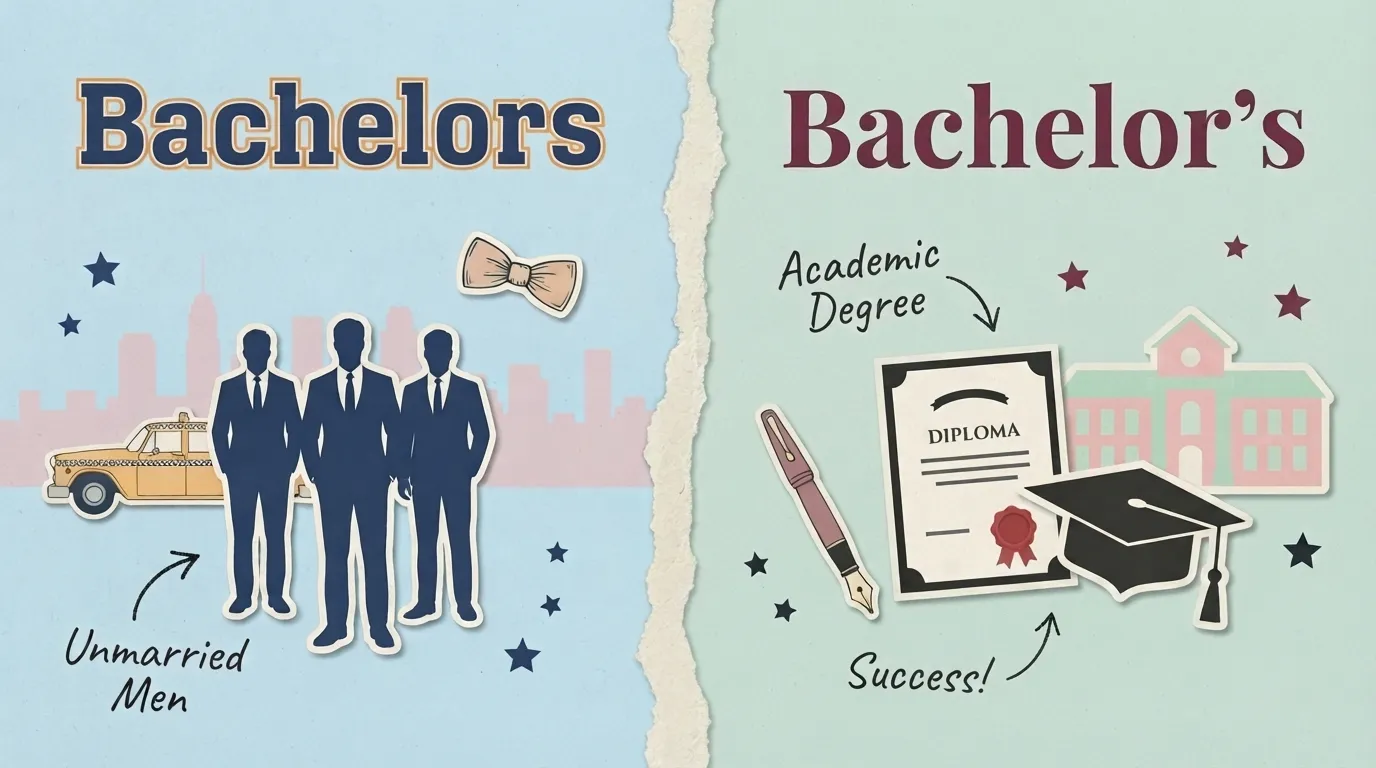
Bachelor’s is correct when describing the degree itself, as in “bachelor’s degree,” while bachelors without an apostrophe refers to multiple unmarried men or is used in a few fixed phrases like “Bachelors Day.”
I once submitted a resume with “Bachelors Degree” printed at the top, no apostrophe in sight. A recruiter mentioned it later, gently, and I have never made that mistake again.
This tiny apostrophe trips up college graduates, resume writers, and students constantly. It looks so small that most people assume it does not matter. It does.
Bachelor’s degree is one of the most searched education terms online, and the apostrophe question comes up every single time someone writes it down.
This guide settles the confusion for good. You will learn exactly where the apostrophe belongs, why it exists, and how to avoid the mistake that shows up on resumes and school papers everywhere.
By the end, you will spell bachelor’s degree correctly without a second thought.
Bachelors or Bachelor’s: Quick Answer
Bachelor’s with an apostrophe is correct when referring to the degree, as in “bachelor’s degree” or “a bachelor’s in biology.”
Bachelors without an apostrophe refers to multiple unmarried men, or appears in specific phrases that do not describe a degree.
Example: “She earned her bachelor’s degree in 2023.” (the degree) Example: “The party was full of bachelors.” (unmarried men)
The Origin of Bachelor’s and Bachelors
The word “bachelor” comes from Old French bacheler, originally meaning a young knight or a person who had not yet earned full status in a profession. Over time, it came to describe unmarried men and also academic degrees earned at the first level of higher education.
The apostrophe in “bachelor’s degree” works like any possessive apostrophe in English. The degree technically belongs to a category once called the “bachelor,” much like “a doctor’s appointment” or “a driver’s license.” That possessive structure locked the apostrophe into place.
The confusion exists because plural nouns and possessive nouns both often end in “s,” and it is easy to lose track of which rule applies. Add in the fact that “bachelor’s degree” gets typed quickly and casually online, and the apostrophe often disappears by accident.
Universities themselves have not always helped the situation. Some diplomas and official transcripts print “Bachelor of Science” or “Bachelor of Arts” without any apostrophe at all, since those are formal titles rather than possessive phrases. That inconsistency across official documents adds another layer of confusion for anyone trying to learn the rule by example alone.
Bachelors vs Bachelor’s: Key Differences
Here is a clear breakdown of when to use each form, with real examples.
| Term | Meaning | When to Use | Region/Context |
| Bachelor’s | Possessive form referring to the degree | Academic writing, resumes, school documents | Used consistently in US and UK English |
| Bachelors | Plural form referring to unmarried men | General writing about multiple single men | Used equally in US and UK English |
More examples:
- “He completed his bachelor’s in computer science.” (degree)
- “Three bachelors moved into the apartment next door.” (unmarried men)
- “Her bachelor’s degree took four years to finish.” (degree)
- “The show followed several bachelors looking for love.” (unmarried men)
A simple trick: if you can replace the phrase with “the degree of a bachelor,” the apostrophe belongs. If you are simply counting unmarried men, drop the apostrophe entirely.
Which Version Should You Use?
Your choice depends entirely on what you are describing, not on personal preference or style.
- For resumes and job applications, always use bachelor’s degree with the apostrophe. This is the standard, expected format employers look for.
- For academic transcripts and school paperwork, use bachelor’s consistently, since the degree is always treated as a possessive noun.
- For general writing about unmarried men, use bachelors with no apostrophe, since you are describing a plural group, not a possession.
- For casual writing about dating shows or single life, bachelors without the apostrophe is almost always correct.
Common Mistakes with Bachelors or Bachelor’s
Mistake 1: “I have a Bachelors Degree in Marketing.” Correction: “I have a Bachelor’s Degree in Marketing.” Why it happens: writers treat the phrase as a simple plural instead of a possessive noun.
Mistake 2: “She is one of the bachelor’s at the reunion.” Correction: “She is one of the bachelors at the reunion.” Why it happens: people add an apostrophe automatically whenever a word ends in “s,” even when no possession is involved.
Mistake 3: “Bachelors’ degree programs are competitive this year.” Correction: “Bachelor’s degree programs are competitive this year.” Why it happens: writers confuse singular possessive with plural possessive, placing the apostrophe after the s instead of before it.
Mistake 4: Leaving the apostrophe out entirely on resumes. Correction: Always include the apostrophe in “bachelor’s degree” on professional documents. Why it happens: fast typing and autocorrect settings sometimes strip apostrophes without the writer noticing.
Mistake 5: Capitalizing “Bachelor’s” mid sentence unnecessarily. Correction: Keep it lowercase unless it starts a sentence or is part of an official degree title, like “Bachelor of Science.” Why it happens: writers borrow capitalization habits from official degree titles and apply them everywhere.
Mistake 6: Writing “bachelors degree” with no apostrophe at all on a LinkedIn profile. Correction: Add the apostrophe, since LinkedIn profiles are scanned by recruiters just as closely as resumes. Why it happens: quick typing on mobile devices often skips punctuation that feels optional in the moment.
Bachelors or Bachelor’s in Real-World Examples
Professional email: “I completed my bachelor’s degree in finance last spring.”
News headline: “More Students Choose Online Bachelor’s Programs This Year”
Social media post: “Just walked the stage for my bachelor’s degree! 🎓”
Formal document: “Applicants must hold a bachelor’s degree from an accredited university.”
Notice how bachelor’s with the apostrophe always points to the degree, while bachelors without one always points to unmarried men or a plural group.
Bachelors or Bachelor’s: Data, Trends, and Usage
People search for this comparison constantly, especially students preparing resumes, applications, and LinkedIn profiles.
Search interest spikes heavily around graduation season and college application deadlines, when students and job seekers proofread their documents closely.
The intent behind this search is almost always informational, though it carries a strong commercial undertone too, since many searchers are actively applying for jobs or degree programs.
This matters now because online applications and resume builders often auto format text, sometimes stripping apostrophes or adding them incorrectly. Writers need to double check this detail manually, since software cannot always be trusted to get it right.
Hiring managers and admissions officers often notice small punctuation errors like this one, even if they never mention it out loud. A missing apostrophe will not disqualify a strong application, but it can quietly chip away at the polished impression you are trying to create.
Career coaches and resume writing services frequently list this exact mistake as one of the most common errors they catch during edits, right alongside spacing issues and inconsistent formatting.
Quick Decision Cheat Sheet
Use this fast checklist whenever you are unsure which form to use:
- Talking about the degree itself? Use bachelor’s with an apostrophe.
- Talking about more than one unmarried man? Use bachelors with no apostrophe.
- Writing “Bachelor of Science” or “Bachelor of Arts” as an official title? No apostrophe needed there either.
- Writing a resume or cover letter? Double check every instance of “bachelor’s degree” for the apostrophe.
- Still unsure? Try the swap test: “the degree of a bachelor” confirms the apostrophe belongs.
Keep this list open while editing resumes, transcripts, or any document listing your education.
Bachelors and Bachelor’s in Everyday Language
Beyond resumes and academic writing, these words show up in a few familiar phrases worth knowing.
“Bachelor party” describes a celebration for a groom before his wedding, and it never takes an apostrophe, since it functions as a descriptive phrase rather than a possessive one.
“Bachelor pad” describes a stereotypically single man’s apartment, also written without an apostrophe.
“The Bachelor” as a television show title uses no apostrophe either, since it refers to one specific unmarried man as the show’s central figure.
These phrases show how the word bachelor shifts meaning slightly depending on context, while the apostrophe rule for degrees stays fixed and predictable.
Bachelors or Bachelor’s: Full Comparison Table
| Term/Variant | Meaning | Region/Context | Best Used When |
| Bachelor’s | Possessive form tied to the academic degree | US and UK academic and professional writing | Referring to a bachelor’s degree or program |
| Bachelors | Plural form referring to unmarried men | General English worldwide | Referring to multiple single men or fixed phrases without possession |
Frequently Asked Questions
Q: What does bachelor’s mean?
A: Bachelor’s is the possessive form used specifically when referring to a bachelor’s degree, the first level of a college or university degree.
Q: How do you use bachelors correctly?
A: Use bachelors, without an apostrophe, when referring to more than one unmarried man or when using fixed phrases like “bachelor party” that do not involve possession.
Q: Bachelors vs bachelor’s, what’s the real difference?
A: Bachelor’s refers to the degree and always includes an apostrophe. Bachelors refers to unmarried men and never includes an apostrophe.
Q: Is bachelor’s acceptable in formal writing?
A: Yes. Bachelor’s is not just acceptable but required in formal writing whenever you are referring to the academic degree.
Q: Which version is correct, bachelors or bachelor’s, on a resume?
A: Bachelor’s is correct on a resume, since you are naming your degree, not describing a group of unmarried men.
Q: Where does this confusion come from?
A: The confusion comes from plural and possessive nouns both ending in “s,” which makes it easy to misplace or drop the apostrophe by accident.
Q: Can bachelors ever refer to a degree without an apostrophe?
A: No. Any reference to the academic degree always requires the apostrophe. Dropping it is considered a spelling and grammar error.
Q: What about plural degrees, like someone with two bachelor’s degrees?
A: Keep the apostrophe before the s in each instance, as in “two bachelor’s degrees,” since each individual degree still follows the same possessive rule.
Q: Does “Bachelor of Science” need an apostrophe?
A: No. Official degree titles like “Bachelor of Science” or “Bachelor of Arts” never take an apostrophe, since they function as formal titles, not possessive phrases.
Final Thoughts
Bachelor’s and bachelors split along one clear rule. Bachelor’s belongs to the degree. Bachelors belongs to unmarried men.
The fastest test is simple. Ask yourself if you mean “the degree of a bachelor.” If yes, keep the apostrophe. If you are just counting single men, drop it completely.
Getting this right matters most on resumes, transcripts, and job applications, where a missing apostrophe can look careless to someone reviewing your work closely.
Now you know exactly how to use bachelors or bachelor’s, go try it in your next piece of writing. Bookmark this guide so you never second guess it again.
Read More: Disk or Disc: The Real Difference, Finally Clear

Hi, I’m Zara. Words that look almost identical but mean completely different things have always fascinated me, that’s what pulled me toward writing about spelling and usage. I focus on digging into where these mix-ups actually come from, whether it’s a British-American split or just a rule English never bothered to make consistent. My goal with every guide is simple: give you the answer fast, then explain it well enough that you never have to look it up again.