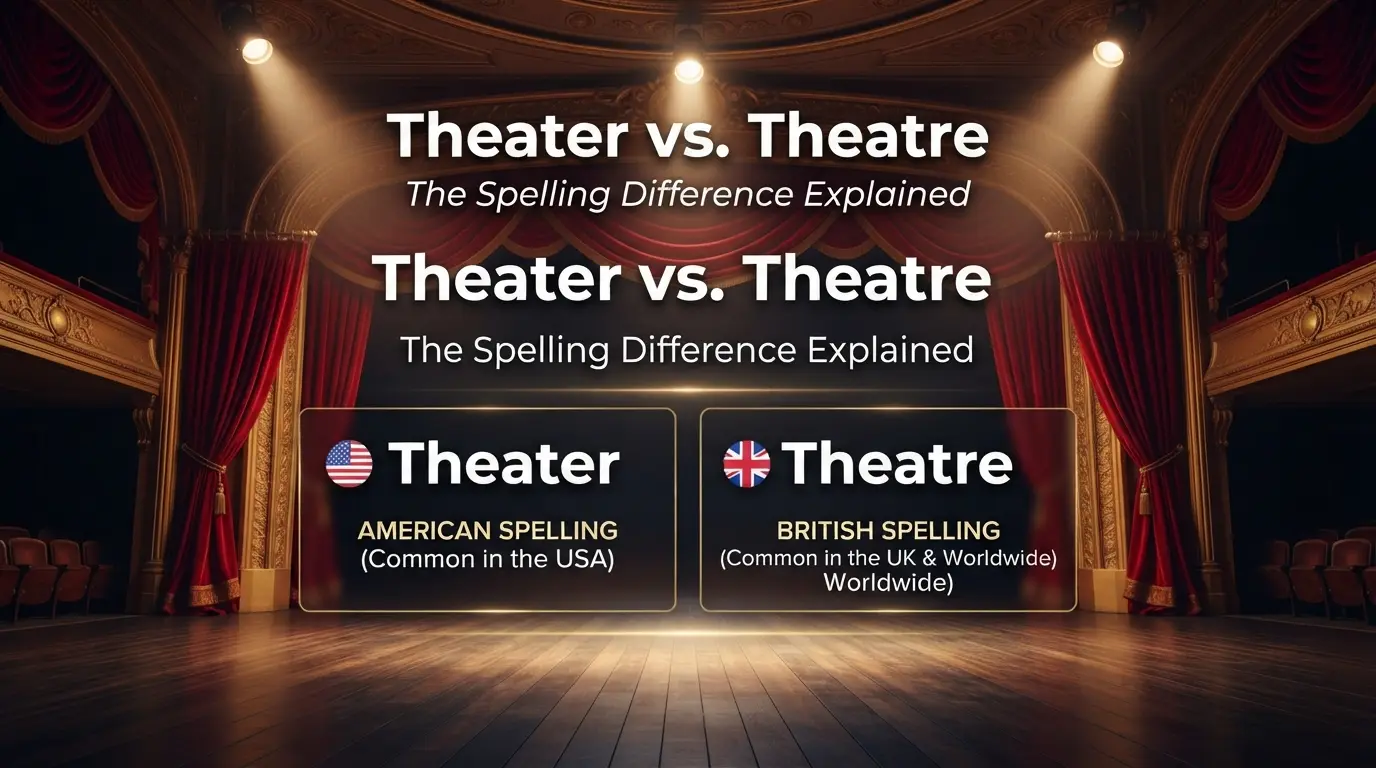
Theater is the standard American spelling. Theatre is the standard British spelling. Both refer to the same thing, a building for performances or the art form of drama itself.
I spent an entire summer working box office at a small performance space in college, and the marquee outside spelled it “Theatre.” Every single piece of paperwork inside, from payroll forms to fire safety notices, spelled it “Theater.” Nobody on staff could tell me why. They just shrugged and said that’s how it had always been.
That contradiction is actually more common than most people realize, and it points to something deeper than a simple regional quirk. Theater and theatre are not always predictable by country alone. Plenty of American venues proudly keep the British spelling in their official name, purely for the elegant, artistic feel it carries.
This guide untangles the whole thing. You will learn which spelling belongs to which region, why American venues sometimes break their own rule, and how to choose confidently no matter what you are writing.
Theater or Theatre, Quick Answer
Theater is the standard spelling throughout the United States, used for both the building and the art form, as in “we watched the play at the local theater.”
Theatre is the standard spelling throughout the United Kingdom, Australia, Canada, and most other English speaking countries outside the United States, as in “the West End is famous for its historic theatres.”
Even within American English, some venues and companies deliberately choose theatre in their official names, which adds a small but genuine exception to an otherwise simple regional rule.
The Origin of Theater and Theatre
Both spellings trace back to the Greek word “theatron,” meaning a place for viewing, which described the outdoor seating areas used for ancient Greek drama and public spectacle. Latin later adopted the word as “theatrum,” and it passed into French as “theatre” before entering English.
For centuries, English writers used various spellings inconsistently, including theater, theatre, and even theatar in some historical documents. The modern split largely traces back to Noah Webster, the American lexicographer who pushed for simplified, more phonetic American spellings in the early nineteenth century.
Webster favored theater because it more closely matched how English speakers actually pronounced the word, moving the “re” ending to a more familiar “er” pattern already common in American English. British English, by contrast, kept the older French influenced ending, theatre, consistent with other words like centre and metre.
This single historical decision explains most of the split we still see today, though it never became a perfectly clean divide, especially once proper names entered the picture.
Theater and Theatre Explained, Key Differences and Variations
Understanding this pair means separating the general spelling rule from the exceptions that show up constantly in real world names and branding.
Theater is the standard spelling in American English for both the physical building where performances happen and the broader art form of drama. Example: “She studied theater at university and now works at a regional theater downtown.”
Theatre is the standard spelling in British, Australian, Canadian, and most Commonwealth English for the same two meanings. Example: “The National Theatre in London hosts world class productions.”
Movie theater is the standard American phrase for a cinema, and it never switches to theatre, even in casual conversation. Cinema is the more common British term for the same building, though theatre can also describe a performance venue for film screenings in specific contexts.
Proper names frequently break the regional rule entirely. Many American performance venues, especially older or more prestigious ones, use theatre in their official branding, such as the Apollo Theatre or the Shubert Theatre, regardless of the fact that American English generally prefers theater elsewhere.
| Term | Meaning | When to Use | Region or Context |
| Theater | Building or art form | General writing | United States |
| Theatre | Building or art form | General writing | United Kingdom, Australia, Canada, most Commonwealth countries |
| Movie theater | Cinema building | American English | United States |
| Theatre (proper name) | Official venue branding | Specific to that venue | Can appear anywhere, including the United States |
Which Version Should You Use?
For American writers producing general content, news, business writing, or everyday communication, use theater consistently, since that matches standard American style guides such as the Associated Press and Chicago Manual of Style.
And For British, Australian, and Canadian writers, use theatre consistently, following the same logic that applies to centre, metre, and litre in those regions.
For anyone referring to a specific venue by its official name, always match that venue’s own spelling choice, regardless of your regional preference elsewhere in the piece. If a Broadway venue calls itself a theatre in its own branding, respect that spelling when naming it directly.
For academic and artistic writing about drama as a discipline, theatre sometimes appears even in American academic settings, since many university departments and professional organizations use theatre to signal a more formal, artistic connection to the craft, separate from the everyday building.
Common Mistakes with Theater or Theatre
Mistake: Mixing both spellings inconsistently within the same American document. Correction: Pick theater and use it consistently throughout, unless quoting a specific proper name that officially uses theatre.
Mistake: Assuming every American venue uses theater in its name. Correction: Many prominent American venues deliberately use theatre for branding, so always check the venue’s own official spelling before writing about it by name.
Mistake: Writing “cinema theater” as a redundant phrase in American English. Correction: Use simply “movie theater” or “cinema,” since combining both words is repetitive and unnecessary.
Mistake: Assuming theatre is somehow more correct or more formal in all contexts. Correction: Neither spelling is more correct overall. Correctness depends entirely on regional standard and, occasionally, proper name branding.
Mistake: Changing the spelling of a direct quotation to match your own regional preference. Correction: Always preserve the original spelling when quoting a source directly, even if it differs from your document’s general style.
Cheat Sheet: Theater or Theatre
Use this quick cheat sheet whenever you are unsure.
- American English, general use: theater
- British, Australian, Canadian English, general use: theatre
- Movie building in American English: always theater, never theatre
- Proper venue names: always match the venue’s own official spelling
- Academic or artistic discipline in American writing: theatre sometimes appears intentionally, especially in university department names
- Quick memory trick: American English tends to simplify French influenced endings, so theater, like center and meter, drops the “re” for a more phonetic “er.”
Theater or Theatre in Real World Examples
Professional email (American English): “Tickets for the theater are on sale now, and I’d love to grab a group of us to see the new production downtown.”
News headline (British English): “Historic London Theatre Announces Major Renovation Ahead of Next Season”
Social media post (American English): “Saw the most incredible show at the community theater last night, still thinking about it.”
Formal document (British English): “The council has approved funding for essential repairs to the regional theatre building.”
Notice how each example stays consistent with its own regional standard, which is the safest and most professional approach in almost every case.
Theater or Theatre, Data, Trends and Usage
Searches for “theater or theatre” increase noticeably around award season, major Broadway and West End openings, and back to school periods when students choose university programs in drama or performing arts.
This search intent is almost entirely informational, driven by writers, students, marketers, and venue owners who want spelling confirmation before publishing content, signage, or official branding materials where consistency really matters.
Marketing teams for performance venues search this term especially often, since choosing the wrong regional spelling on a website or printed program can look inconsistent with a venue’s audience or location, even when both spellings are technically valid English.
Comparison Table
| Term or Variant | Meaning | Region or Context | Best Used When |
| Theater | Performance building or art form | American English | Any general American writing |
| Theatre | Performance building or art form | British and Commonwealth English | Any general writing outside the United States |
| Movie theater | Cinema building | American English | Referring to film screening venues |
| Theatre (as branding) | Official venue or company name | Global, including the United States | Naming a specific venue by its exact title |
Frequently Asked Questions
Q: What does theater mean? A: Theater refers to a building where performances take place, or more broadly to the art form of drama itself, including acting, staging, and production.
Q: How do you use theater and theatre correctly? A: Use theater consistently in American English writing, and theatre consistently in British, Australian, and Canadian English, matching your target audience and region.
Q: Theater vs theatre, what is the real difference? A: The difference is regional spelling, not meaning. Both words describe the same building and the same art form, with the choice depending on American or British English conventions.
Q: Is theatre acceptable in American formal writing? A: It can appear intentionally, especially in proper venue names or academic department titles, but general American formal writing typically prefers theater.
Q: Which version is correct, theater or theatre? A: Both are correct English words. The right choice depends on your region and, when naming a specific venue, that venue’s own official spelling.
Q: Where does theater come from? A: Both spellings trace back to the Greek word theatron, meaning a place for viewing, through Latin and French before entering English.
Q: Can theater be used to describe a movie venue? A: Yes, movie theater is the standard American English phrase for a cinema building, and it always uses the theater spelling rather than theatre.
Conclusion
Theater and theatre describe the exact same thing, a place for performance and the art of drama itself, split apart only by regional spelling convention. American English simplified the ending to theater, while British and Commonwealth English kept the older theatre form, consistent with words like centre and metre. The one real complication comes from proper names, since many American venues proudly keep theatre in their official branding regardless of the general rule.
Now you know exactly how to use theater and theatre correctly. Bookmark this guide so you never second guess this word again, and share it with anyone who has ever wondered why that one theatre down the street spells it differently than everywhere else.
Read More: Drier or Dryer: What’s the Difference?

My name is Ayesha Sadiqah, the writer behind this website. I write in-depth articles on English spelling, word comparisons, grammar, and vocabulary to help learners make better language choices. Every guide is carefully researched and designed to provide accurate, practical, and easy-to-understand information.