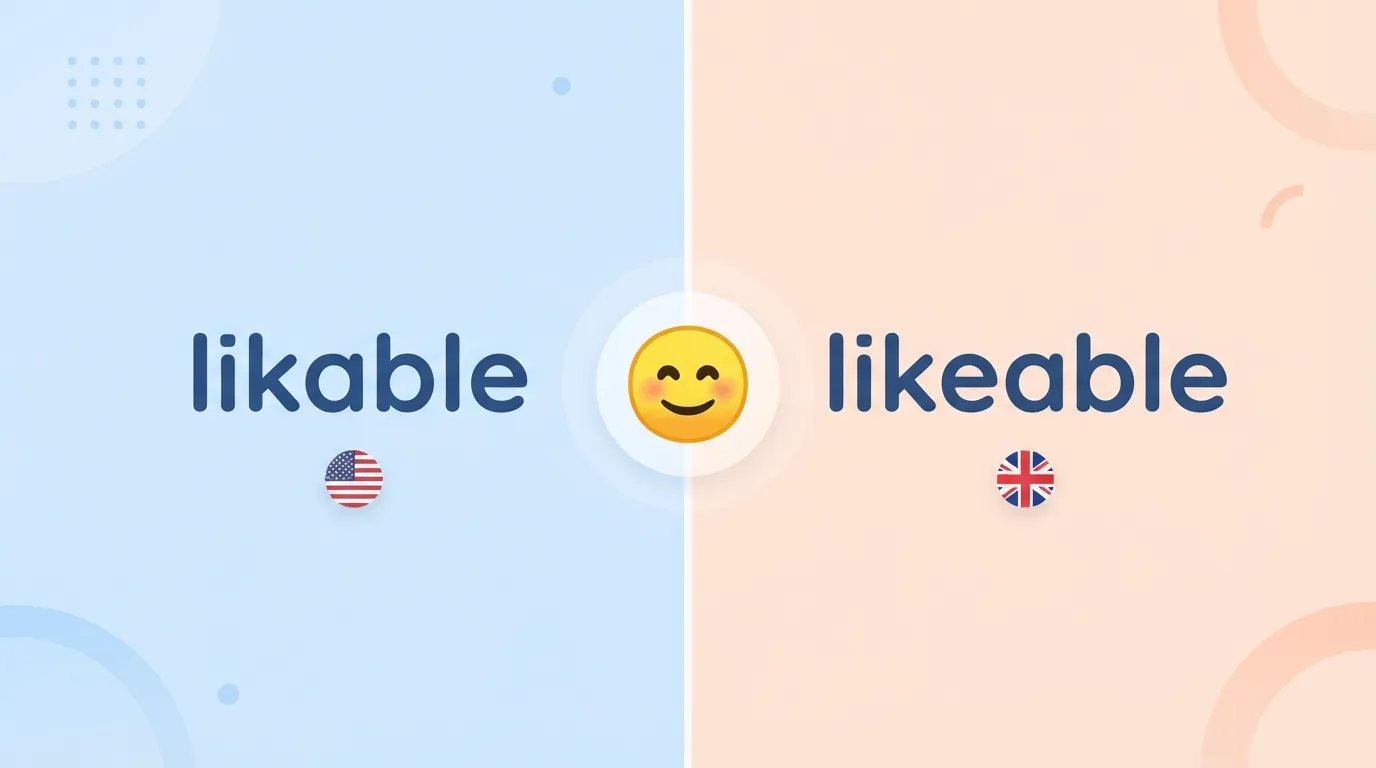
Both spellings are correct. Likable is the preferred spelling in American English, while likeable is the preferred spelling in British English, Canadian English, and most other English speaking countries outside the United States.
I once wrote a character description for a short story and used likeable throughout the entire draft. My writing group, made up mostly of American readers, kept circling the word and asking if I had misspelled it.
Nothing was wrong at all. I had simply been reading a lot of British fiction that month, and the spelling naturally carried over into my own writing without me noticing.
This kind of mix up happens constantly with certain adjectives, especially ones formed by adding a suffix to a base word. Readers assume one spelling has to be wrong, when the real answer depends entirely on which regional English you are writing in.
This guide clears up the confusion completely. You will learn exactly which spelling fits which audience, why the difference exists, and how to stay consistent no matter which version you choose.
Likeable or Likable: Quick Answer
Likable is the preferred spelling across the United States, appearing consistently in American publishing, business writing, and everyday communication.
Likeable is the preferred spelling in the United Kingdom, Canada, Australia, and most Commonwealth countries, following the more traditional spelling pattern.
Example: An American article might describe a politician as “genuinely likable,” while a British review might describe a character as “wonderfully likeable.”
The Origin and Background of Likable and Likeable
Both spellings come from the same source, the verb like combined with the suffix able, meaning capable of being liked. In its earliest written form, the word almost always kept the silent e from like before adding able, producing likeable.
Language historians have traced actual uses of likable back to the mid eighteenth century, appearing in both British and early American writing at the time. For many decades, the two spellings existed side by side without any strong regional preference at all.
The clearer split developed later, largely tied to broader spelling simplification trends in American English. This same pattern shaped other well known word pairs, including color versus colour and canceled versus cancelled, where American English gradually dropped extra or silent letters that British English chose to keep.
Likable followed that same simplification path, becoming the dominant American spelling by the twentieth century, while likeable remained the standard choice throughout British English and most Commonwealth writing.
Likable vs Likeable Explained: Key Differences and Variations
| Term | Meaning | When to Use | Region/Context |
|---|---|---|---|
| Likable | Easy to like, pleasant or appealing | American writing, business, and media | United States |
| Likeable | Same meaning, traditional spelling | British, Canadian, and Commonwealth writing | United Kingdom, Canada, Australia, and beyond |
| Unlikable or Unlikeable | The opposite meaning, difficult to like | Follows the same regional spelling pattern | Matches whichever base spelling you are using |
The meaning stays exactly the same between both versions. The only real difference is regional expectation, similar to the well known split between favor and favour, or center and centre.
Which Spelling Should You Use?
American Writers and Publications
Use likable. It matches most American style guides and publishers, including widely used dictionaries that list likable as the primary American spelling.
British, Canadian, and Australian Writers
Use likeable. It matches Oxford style, most Commonwealth style guides, and reader expectations across these regions.
Business and Marketing Writing
Match your spelling to your target audience’s country, since brand voice and copywriting often benefit from sounding naturally local rather than slightly foreign.
Global or Mixed Audience Writing
Pick one spelling and remain consistent throughout the entire piece. Consistency carries more weight than which specific version you personally prefer.
Academic and Formal Writing
Follow whichever style guide your institution or publication requires, since formal writing often defers to one specific regional standard regardless of the writer’s personal background.
If you remember only one rule, remember this: likable stays American, likeable stays everywhere else, and neither spelling is ever actually incorrect.
Common Mistakes with Likable and Likeable
Mistake 1: Mixing Both Spellings Within the Same Document
Correction: Choose one spelling at the start of your project and review your writing carefully to catch any accidental inconsistencies before publishing.
Mistake 2: Assuming One Spelling Is More Grammatically Correct
Correction: Neither spelling is more correct in an absolute sense. Correctness depends entirely on which regional English standard applies to your audience.
Mistake 3: Forgetting That the Negative Form Follows the Same Pattern
Correction: Unlikable pairs with likable in American English, while unlikeable pairs with likeable in British English, so keep the negative form consistent too.
Mistake 4: Letting Autocorrect Choose the Wrong Regional Spelling
Correction: Many spellcheck tools default to American English unless manually changed, which can quietly convert likeable to likable without you noticing during editing.
Mistake 5: Assuming British Readers Will Find Likable Incorrect
Correction: Likable is understood clearly by British readers too, even though likeable remains their more common and expected spelling choice.
Each of these mistakes happens because writers rarely pause to confirm their target audience clearly before locking in a regional spelling choice.
Likable and Likeable in Real World Examples
Professional Email
“Our American marketing team confirmed the campaign copy will use the likable spelling throughout all United States materials.”
News Headline
“Survey Finds Voters Consider Candidate Genuinely Likeable Ahead of Local Elections”
Social Media Post
“Just finished the book. Such a likable main character, I was rooting for her the whole way through.”
Formal Document
“This performance review notes the employee’s likeable demeanor and consistent collaboration with team members.”
Notice how the correct spelling shifts based on audience and context, not because one version holds more authority than the other.
Likable and Likeable: Data, Trends, and Usage
Searches comparing likable and likeable happen consistently, driven largely by writers, students, and marketers preparing content for specific regional audiences.
American audiences overwhelmingly search and use likable, while searches for likeable concentrate heavily in the United Kingdom, Canada, Australia, and other Commonwealth regions.
This search falls almost entirely into the informational category, though it occasionally overlaps with content creation needs, especially among copywriters and character focused writers such as novelists and screenwriters.
Growing global content creation continues to keep this spelling question relevant, since more writers now create material for international audiences rather than a single regional market.
Standalone Comparison Table
| Term/Variant | Meaning | Region/Context | Best Used When |
|---|---|---|---|
| Likable | Easy to like, pleasant or appealing | United States | Writing for an American audience |
| Likeable | Same meaning, traditional spelling | United Kingdom, Canada, Australia | Writing for a Commonwealth audience |
Frequently Asked Questions
What does likable mean?
Likable means easy to like, pleasant, or appealing, often used to describe a person’s personality, a character in a story, or a brand’s overall impression.
How do you use likeable correctly in a sentence?
Use likeable as an adjective describing something pleasant or appealing, such as “he has a likeable personality,” matching your chosen regional spelling throughout the sentence.
Likeable vs likable, what is the actual difference?
There is no difference in meaning at all. Likable is the American spelling, and likeable is the British and Commonwealth spelling, both describing the exact same quality.
Is likeable acceptable in American formal writing?
Generally, American style guides and publishers expect likable, so likeable may read as slightly inconsistent within strictly American formal writing.
Which version is correct, likable or likeable?
Both are correct, depending entirely on your audience. Likable is standard in the United States, while likeable is standard nearly everywhere else in the English speaking world.
Where does the word likable come from?
Likable comes from the verb like combined with the suffix able, meaning capable of being liked, with written examples dating back to the mid eighteenth century.
Can likable and likeable be used interchangeably in casual writing?
Yes, in casual writing, most readers understand both spellings without confusion, though staying consistent throughout a single piece still looks more polished and intentional.
Final Thoughts
Likable and likeable describe the exact same quality, someone or something that is easy to like and enjoyable to be around. The real difference comes down to geography, not correctness.
Remember the core takeaway here. Choose likable for American audiences, likeable for British and Commonwealth audiences, and stay consistent once you pick a side.
Bookmark this guide so you never second guess this spelling again, and share it with any writer who has ever paused mid sentence, unsure which version looked right.
Read More: Coliseum or Colosseum: The Correct Spelling Explained

I’m Zain. Through Wordiums.com, I write clear, accurate word comparison guides that show the difference between similar words, spellings, and phrases, so readers can choose the right word in seconds.