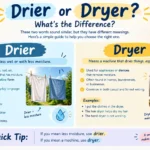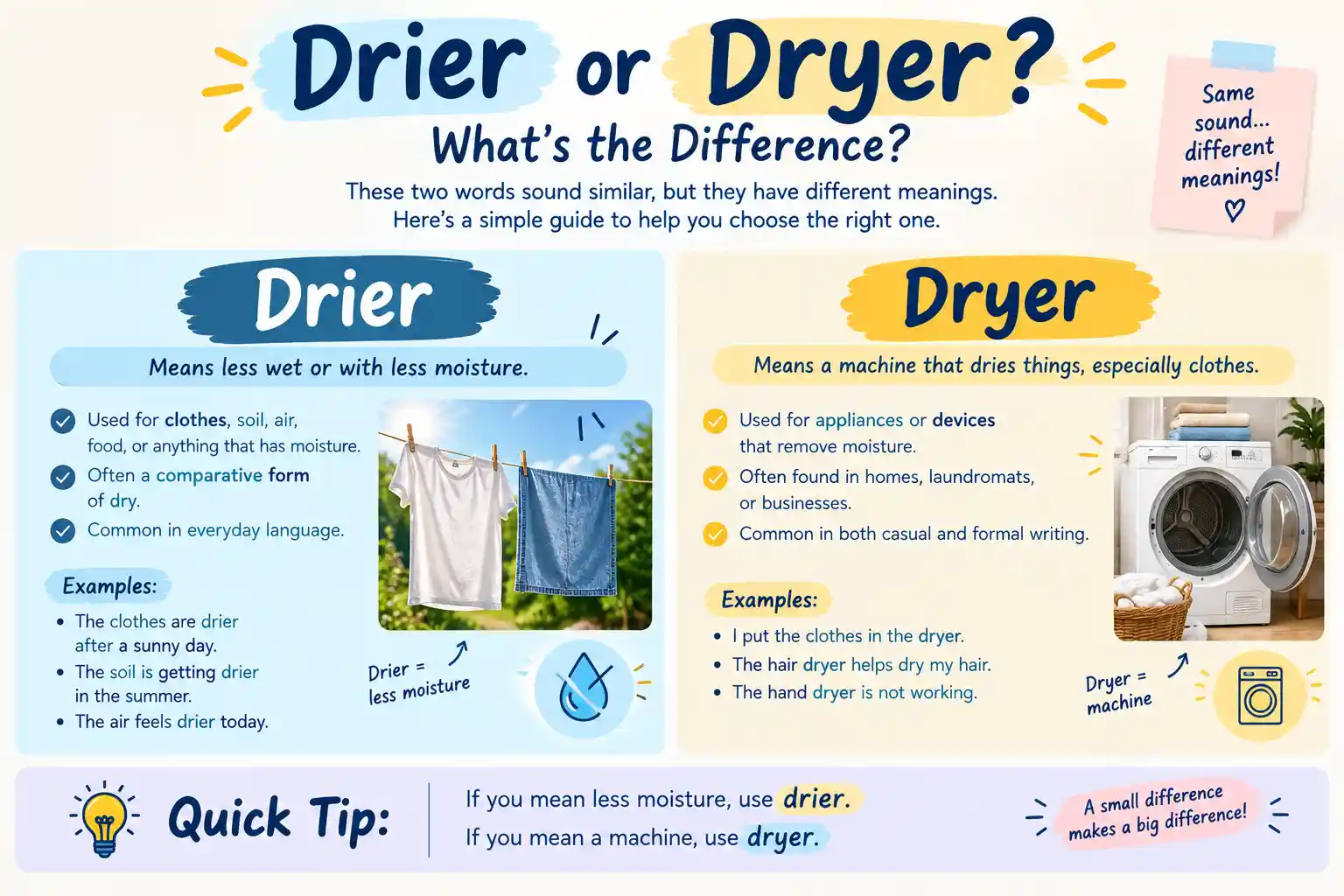
Drier is usually the comparative form of dry, meaning something is less wet. Dryer is usually a noun for a machine that dries things, such as a clothes dryer. For example, “The towel is drier now” and “I put the clothes in the dryer.”
If you often confuse drier and dryer, you are not alone. Both words come from dry, and they sound almost the same.
The easiest way to remember them is simple: drier usually describes something that has become less wet, while dryer usually names a machine that makes something dry.
Drier Meaning
Drier is the comparative form of the adjective dry.
It means something has less moisture than something else or than it had before.
Examples of Drier
1• The clothes are drier after an hour in the sun.
2• This towel is drier than that one.
3• The weather is drier today.
4• The soil becomes drier during summer.
Here, drier describes a condition or state.
Drier as a Comparative Adjective
The word dry becomes drier when you compare two things or two conditions.
| Basic Form | Comparative Form | Meaning |
| dry | drier | less wet |
| warm | warmer | more warm |
| cold | colder | more cold |
| clean | cleaner | more clean |
For example:
This shirt is dry.
This shirt is drier than the other one.
The second sentence compares the moisture levels of two shirts.
Dryer Meaning
Dryer is most commonly a noun that refers to a machine or device used to remove moisture.
A clothes dryer dries clothes after they have been washed.
Examples of Dryer
1• I put my clothes in the dryer.
2• The dryer stopped working this morning.
3• We need a new hair dryer.
4• Please take the clothes out of the dryer.
In these sentences, dryer refers to a device.
A hair dryer is another common example. It uses warm air to dry hair.
Drier vs Dryer
The main difference is their usual grammatical function and meaning.
| Word | Common Meaning | Example |
| Drier | Less wet | This towel is drier. |
| Dryer | A machine that dries something | The dryer is running. |
A quick trick can help:
Drier = more dry
Dryer = a device that dries
So, if you are talking about how dry something is, use drier.
If you are talking about a machine, use dryer.
Drier Examples in Sentences
Here are some natural examples of drier:
- My clothes are drier now.
- This part of the garden is drier than the other side.
- The air feels drier today.
- The towel became drier in the sunlight.
- The desert climate is much drier than the coastal climate.
- Leave the paper somewhere drier.
- My skin feels drier during winter.
In each example, drier describes something with less moisture.
Dryer Examples in Sentences
Here are some examples of dryer:
- The clothes are in the dryer.
- Our dryer makes a strange noise.
- I bought a new hair dryer.
- The dryer takes about thirty minutes to finish.
- Please clean the dryer filter.
- The washing machine works, but the dryer does not.
- She used a hair dryer to dry her hair.
In these examples, dryer refers to a device.
Why Are Drier and Dryer Confusing?
The confusion comes from the way English forms words from dry.
When dry is used as an adjective and you want to compare two things, it becomes drier.
Dry + er = drier
When you add er to create the name of something that performs an action, you get dryer.
Dry + er = dryer
The spelling looks very similar, but the words normally serve different purposes.
Drier or Dryer for Clothes?
Both words can appear when talking about clothes, but they mean different things.
Use drier when describing the clothes.
The clothes are drier now.
Use dryer when talking about the machine.
The clothes are in the dryer.
You can even use both in the same sentence:
The clothes are drier after being in the dryer.
This sentence clearly shows the difference.
Drier or Dryer for Hair?
The same rule applies to hair.
Use drier when describing the condition of hair.
My hair is drier than usual.
Use dryer when referring to the device.
I need to buy a new hair dryer.
So:
Drier hair means hair with less moisture.
Hair dryer means a device used to dry hair.
Drier or Dryer in American and British English
The word dryer is widely used in both American and British English when referring to a machine.
For example:
clothes dryer
hair dryer
The spelling drier is also common when it means the comparative form of dry.
Some dictionaries may also recognize drier as a noun for a drying device, but dryer is the much more familiar spelling for machines in everyday English.
For learners, the safest rule is to use drier for the comparative adjective and dryer for a drying machine.
Common Mistakes
Mistake 1: Using Dryer to Describe Something
Incorrect:
This towel is dryer than that one.
Better:
This towel is drier than that one.
Here, you are comparing how dry the towels are, so drier is the right choice.
Mistake 2: Calling the Machine a Drier
You may sometimes see drier used for a drying device, but dryer is the standard everyday choice for machines such as clothes dryers and hair dryers.
Better:
I put the clothes in the dryer.
Mistake 3: Confusing Drier With Drier Conditions
Remember that drier can describe weather, soil, air, skin, clothes, and many other things.
For example:
The climate is becoming drier.
This does not refer to a machine. It describes a change in moisture.
Easy Trick to Remember Drier vs Dryer
Think about what you are talking about.
If you can replace the word with more dry or less wet, choose drier.
The towel is drier.
This means:
The towel is more dry or less wet.
If you can replace the word with drying machine, choose dryer.
The clothes are in the dryer.
This means:
The clothes are in the drying machine.
This simple test works in most everyday situations.
Drier vs Dryer: Quick Comparison
| Feature | Drier | Dryer |
| Common use | Comparative adjective | Noun |
| Basic word | Dry | Dry |
| Meaning | Less wet or more dry | A device that dries |
| Example | The air is drier. | The dryer is broken. |
| Talks about a machine | Usually no | Yes |
| Talks about moisture | Yes | Usually no |
FAQs About Drier and Dryer
Is drier or dryer correct?
Both are correct, but they usually have different meanings. Drier normally means less wet or more dry. Dryer usually refers to a machine that dries something.
Is it drier or dryer clothes?
Use drier when comparing the condition of clothes.
These clothes are drier than those clothes.
Use dryer when talking about the machine.
Put the clothes in the dryer.
Is it hair drier or hair dryer?
Hair dryer is the standard spelling for the device used to dry hair.
For example:
I bought a new hair dryer.
Is drier a word?
Yes. Drier is the comparative form of dry and means less wet or more dry.
For example:
The towel is drier now.
Is dryer a word?
Yes. Dryer is commonly used as a noun for a device that dries things, such as a clothes dryer or hair dryer.
How do you remember the difference between drier and dryer?
Remember drier as a comparison and dryer as a machine.
Drier = more dry
Dryer = drying machine
Conclusion
The difference between drier and dryer is simple once you know what each word does.
Use drier when you mean less wet or more dry. For example, “The towel is drier now.”
Use dryer when you mean a machine that dries something. For example, “The clothes are in the dryer.”
When you are unsure, ask yourself whether you are describing how dry something is or naming a machine. If you are describing moisture, choose drier. If you mean a device, choose dryer.
Read More: Councilor or Counselor: The Complete, Proven Guide

I’m Zain. I got interested in commonly confused words while helping non-native English speakers prep for writing exams, where a single misused word could cost real marks. That experience shaped how I write now: I try to explain not just which spelling is correct, but why the confusion exists in the first place, since understanding the reason is what actually makes it stick.