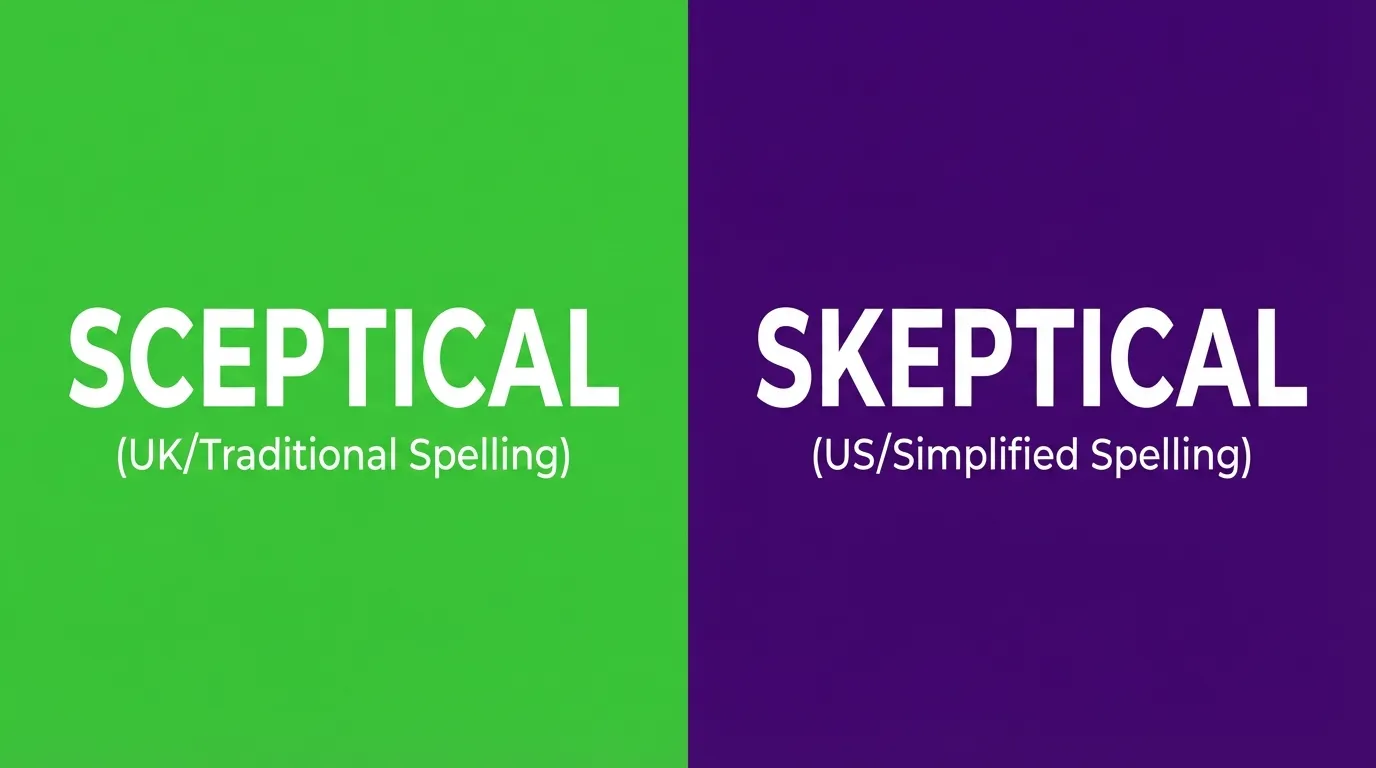
Sceptical and skeptical mean exactly the same thing, describing doubt or a questioning attitude toward a claim. Skeptical is the American spelling, while sceptical is the British spelling used across the UK and most Commonwealth countries.
A colleague once sent me a document with track changes flagging “skeptical” as a spelling error and replacing it with “sceptical,” insisting the original was simply wrong. I pushed back, pulled up an American dictionary, and we both realized neither of us was actually mistaken.
That small disagreement is incredibly common. Sceptical and skeptical look strange next to each other, especially with that unusual letter swap in the middle, and many writers assume one version must be a typo.
It is not. This is another case where English split into two regional camps centuries ago, leaving behind two equally valid spellings that confuse writers, students, and editors around the world every single day.
This guide explains exactly why the c and k swap exists, when to use each spelling, and how to avoid embarrassing inconsistency in your own writing. By the end, you will handle this word with complete confidence no matter which audience you are writing for.
Let us dive in.
Sceptical or Skeptical: Quick Answer
Skeptical is the standard spelling in American English, describing an attitude of doubt or questioning toward claims, ideas, or evidence.
Sceptical is the standard spelling in British English, Canadian English, and Australian English, carrying the exact same meaning.
For example, an American scientist might write “I remain skeptical of these results,” while a British scientist writing about the same doubt would write “I remain sceptical of these results.”
The Origin of Sceptical and Skeptical
The word traces back to the ancient Greek term skeptikos, meaning thoughtful or inquiring, itself rooted in the verb skeptesthai, meaning to consider or examine carefully. This connects directly to the ancient Greek school of Skepticism, a philosophical tradition built around questioning claims and suspending judgment until sufficient evidence appears.
When the word entered Latin and later French, the spelling shifted toward using a c instead of a k, following the conventions common in those languages at the time. English initially adopted this French influenced spelling with the c.
Just as with many other c versus k spelling pairs in English, American lexicographer Noah Webster later pushed for a spelling reform that favored the k, arguing it better reflected the word’s Greek origin and pronunciation. This is the same reformer responsible for splitting fiber from fibre and color from colour.
British English resisted this change, continuing to favor the French influenced c spelling that had already become standard practice by the time Webster proposed his reforms. That resistance preserved sceptical as the accepted British form, while skeptical became firmly rooted in American writing and education.
Interestingly, some etymologists note that the k spelling actually existed in English even before Webster’s reforms, appearing occasionally in earlier texts before the French influenced c version took over as the dominant standard. Webster essentially revived an older form rather than inventing something entirely new, framing his choice as a return to the word’s true Greek character rather than a radical departure.
This detail often surprises people who assume American spelling reforms were purely about simplification. In this particular case, the reform leaned instead toward historical accuracy, favoring the letter that better matched the original Greek pronunciation over the French influenced version that had crept into common British use centuries earlier.
Dictionaries on both sides of the Atlantic eventually codified their respective versions, and by the twentieth century, the split was fully entrenched in printed materials, classrooms, newspapers, and eventually digital spell checkers, cementing the divide that writers still navigate today.
Skeptical Explained: Key Differences and Variations
Beyond the base word, several related forms follow the exact same regional spelling pattern.
| Term | Meaning | When to Use | Region or Context |
| Skeptical | Doubtful, questioning | American writing and speech | United States |
| Sceptical | Doubtful, questioning | British writing and speech | UK, Canada, Australia, most Commonwealth nations |
| Skepticism | The philosophy or attitude of doubt | American writing | United States |
| Scepticism | The philosophy or attitude of doubt | British writing | UK and Commonwealth nations |
| Skeptic | A person who doubts or questions claims | American writing | United States |
| Sceptic | A person who doubts or questions claims | British writing | UK and Commonwealth nations |
Every related form of the word follows the same consistent pattern, so once you know your target audience, the entire family of words falls into place automatically.
Which Version Should You Use?
As with most American versus British spelling pairs, audience determines the correct choice here.
For American readers, always choose skeptical, skepticism, and skeptic. This includes US publications, American academic writing, and content targeting Google searches from within the United States.
For British, Canadian, Australian, or other Commonwealth readers, choose sceptical, scepticism, and sceptic instead, since these spellings feel natural and expected to that audience.
For scientific and philosophical writing specifically, check the publication’s style guide first, since academic journals often enforce strict regional spelling consistency regardless of where individual authors are based.
If you are writing for a truly global blended audience, pick one spelling system and apply it consistently across every related word in your piece, rather than switching between skeptic in one paragraph and sceptical in another.
Common Mistakes With Sceptical and Skeptical
Even careful writers stumble over this particular pair. Here are the errors that show up most often.
Mistake 1: Mixing spelling systems within the same document Wrong: “As a skeptic, she remained deeply sceptical of the entire proposal.” Correct: “As a skeptic, she remained deeply skeptical of the entire proposal.” Why it happens: Writers pull references from both British and American sources during research without noticing the inconsistency.
Mistake 2: Assuming skeptical is always correct because it looks more common online Wrong belief: “Sceptical must be a typo since skeptical shows up more in search results.” Correct understanding: Sceptical is fully standard and correct in British English, simply less common globally due to population size differences online.
Mistake 3: Forgetting to update related word forms Wrong: “The British report described widespread skepticism among voters.” Correct: “The British report described widespread scepticism among voters,” matching the rest of the British spelling used throughout that document.
Mistake 4: Autocorrect silently changing the spelling Many word processors default to American English, quietly converting sceptical to skeptical without the writer noticing until after publishing, especially in emails and quick documents.
Mistake 5: Using the wrong spelling in academic citations Wrong: Citing a British scholar’s exact skepticism when the original text used scepticism. Correct: Preserve the original spelling exactly as published when quoting or citing academic sources, even if it does not match your own regional spelling elsewhere in your paper.
Sceptical and Skeptical in Real World Examples
Context makes the regional pattern easy to spot once you know what to look for.
Professional email, American English: “Our team remains skeptical about the projected timeline for this rollout.”
News headline, British English: “Economists Remain Sceptical Despite Government’s Optimistic Growth Forecast”
Social media post, American English: “Honestly pretty skeptical about this new diet trend everyone keeps talking about.”
Formal document, British English: “The panel expressed considerable scepticism regarding the proposed funding allocation.”
Each example demonstrates how the surrounding writing style stays neutral, while the single spelling choice instantly signals the intended regional audience.
Sceptical and Skeptical: Data, Trends and Usage
Search data consistently shows skeptical earning significantly higher global search volume, primarily due to the size of the American English speaking population online. Sceptical still maintains strong, steady search volume specifically within the UK, Australia, Canada, and Ireland.
This word appears heavily in science communication, news commentary, and philosophy content, almost always tied to informational search intent, since people typically search to understand doubt, evidence, or critical thinking rather than to purchase anything.
Content around scientific skepticism, healthy skepticism, and skeptical thinking has grown steadily as media literacy and misinformation awareness have become more prominent topics worldwide, making this word increasingly relevant across news, education, and social commentary.
Publishers producing content for multiple English speaking markets increasingly localize this spelling choice deliberately, recognizing that small details like this can meaningfully affect how professional and regionally appropriate a piece of writing feels to its readers.
News organizations with both American and British editions often maintain entirely separate style guides just to manage words like this one, ensuring that every article published under a UK edition consistently uses sceptical while the American edition of the same story uses skeptical throughout. This level of attention shows just how seriously professional publishers take regional spelling accuracy, even for a single letter difference that most casual readers might never consciously notice.
Comparison Table: Sceptical vs Skeptical
| Term or Variant | Meaning | Region or Context | Best Used When |
| Skeptical | Doubtful or questioning | United States | Writing for American audiences |
| Sceptical | Doubtful or questioning | UK, Canada, Australia | Writing for Commonwealth audiences |
| Skepticism | Philosophy or attitude of doubt | United States | American academic or general writing |
| Scepticism | Philosophy or attitude of doubt | UK and Commonwealth nations | British academic or general writing |
Frequently Asked Questions
Q: What does sceptical or skeptical mean? A: Both words describe an attitude of doubt or questioning toward a claim, idea, or piece of evidence, requiring more proof before accepting it as true.
Q: How do you use sceptical or skeptical correctly? A: Match the spelling to your audience, using skeptical for American readers and sceptical for British or Commonwealth readers, staying consistent throughout your writing.
Q: Sceptical vs skeptical, what is the real difference? A: There is no difference in meaning whatsoever. The only distinction is regional spelling convention, with skeptical used in America and sceptical used across most other English speaking countries.
Q: Is sceptical acceptable in formal academic writing? A: Yes, sceptical is completely standard and expected in formal British, Canadian, and Australian academic writing, including peer reviewed journals following those regional style guides.
Q: Which spelling is correct, sceptical or skeptical? A: Both are correct. The right choice depends entirely on which regional English standard your writing follows, not on any inherent error in either spelling.
Q: Where does the word skeptical come from? A: It comes from the ancient Greek word skeptikos, meaning thoughtful or inquiring, connected to the philosophical tradition of questioning claims before accepting them.
Q: Can sceptical and skeptical be used interchangeably online? A: Yes for meaning, but consistency still matters. Search engines and readers respond best when a single spelling system is used throughout an entire piece of content.
Final Thoughts
Sceptical and skeptical share the exact same Greek roots and the exact same meaning, split apart only by a spelling reform movement that happened over a century ago. Neither version is more accurate or more intelligent than the other.
Remember these key takeaways. Skeptical belongs to American English. Sceptical belongs to British and Commonwealth English. Both describe the same healthy habit of questioning claims before accepting them. Consistency throughout your writing matters more than which specific spelling you choose.
Next time you write about doubt, evidence, or critical thinking, you will know exactly which spelling fits your audience without a moment of hesitation, and you can move on to the actual substance of your argument instead of worrying over a single letter.
Bookmark this guide so you never second guess sceptical or skeptical again, and share it with anyone who has ever accused you of a spelling mistake that was not actually a mistake at all.
Read More: Coliseum or Colosseum: The Correct Spelling Explained

Hi, I’m Zara. Words that look almost identical but mean different things have always fascinated me, and that is what pulled me into writing about spelling and usage. Every guide gives you the answer first, then explains it clearly enough that you won’t need to look it up again.