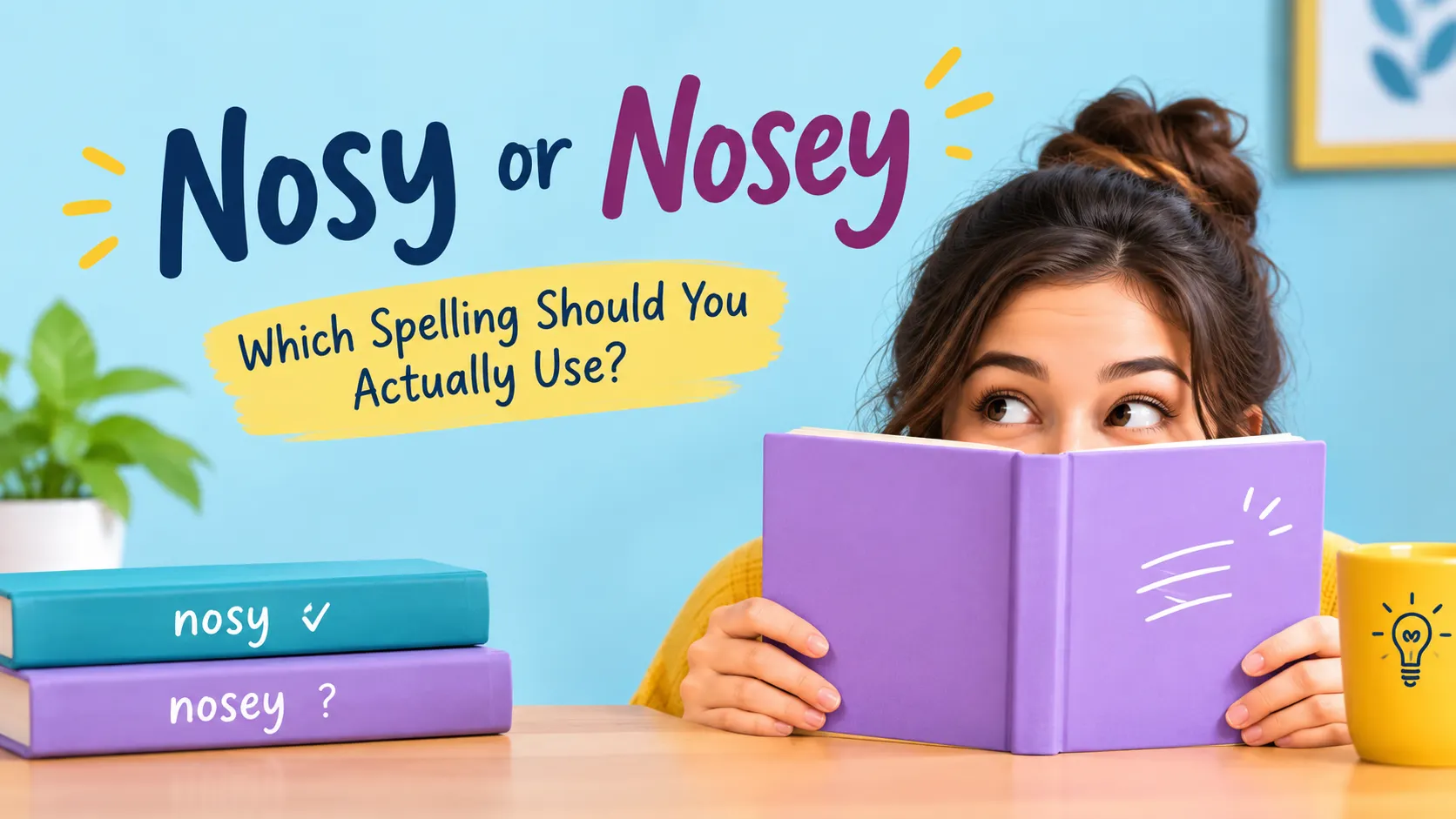
Nosy is the standard, most common spelling in both American and British English. Nosey is a recognized variant spelling, seen more often in British English, but it still stays less common than nosy almost everywhere.
I once wrote nosey in a work email without thinking twice. A colleague circled it and wrote nosy in the margin. That small moment sent me straight to the dictionary.
Turns out we were both right. Sort of.
This is one of those spelling questions where two forms genuinely exist side by side. That rarely happens in English. Most spelling debates have one clear winner and one clear mistake.
Nosy and nosey do not work that way. Both spellings show up in real dictionaries. But they are not used equally, and knowing the difference will help you pick the version that looks most natural, wherever you are writing for.
By the end of this guide, you will know exactly which spelling to reach for, and why English ended up with two versions of such a simple, everyday word.
Nosy or Nosey: Quick Answer
Nosy describes someone who shows too much curiosity about other people’s private business. It works as an adjective, and both spellings share the exact same meaning.
For example, “My neighbor is so nosy, she always asks about our weekend plans.” That sentence uses the more common spelling. Swap in nosey, and the meaning stays exactly the same.
Nosy remains the dominant, expected spelling almost everywhere. Nosey exists as a secondary variant, more common in British English than American English, but never the primary choice in either.
The Origin of Nosy and Nosey
Nosy comes directly from the word nose, plus the suffix y, which turns a noun into an adjective. The image behind the word is simple and visual. Someone nosy sticks their nose into situations that do not concern them, much like a dog sniffing around uninvited.
The word entered English in the eighteenth century, already carrying this same playful, slightly disapproving tone it still has today.
The variant spelling nosey likely developed the same way many English spelling variants do. Writers sometimes add an extra e before a suffix, following patterns seen in other words, even when the base word, in this case nose, does not strictly require it. Over time, both spellings settled into common use, though nosy became the more established, standard form.
Nosy or Nosey Explained: Key Differences
Neither spelling is factually wrong. But they are not treated the same way by dictionaries, editors, or style guides.
| Term | Meaning | When to Use | Region or Context |
| Nosy | Excessively curious about others’ private matters | Nearly all writing, everywhere | Standard spelling across American and British English |
| Nosey | Same meaning as nosy | Casual or informal British writing | Occasionally seen in British English, rare in American English |
Major American dictionaries almost always list nosy as the primary spelling, with nosey noted only as a variant. British dictionaries do the same, though nosey shows up slightly more often in everyday British writing than it does in American writing.
Which Version Should You Use?
For formal writing, business communication, and academic work, always choose nosy. It remains the expected, standard spelling, and using nosey in this context can look like a simple typo rather than an intentional variant.
For British casual writing, nosey does appear occasionally, especially in informal blog posts, personal emails, and everyday conversation. It will not confuse anyone, but it still remains the less common choice.
For American writing of any kind, nosy is overwhelmingly preferred. Nosey will look unusual to most American readers, even in casual contexts.
For global or neutral use, nosy is the safer, more universally recognized spelling. It works cleanly across every English speaking audience, without raising any eyebrows.
The simple rule of thumb here mirrors many other English spelling questions. When in doubt, choose the shorter, more standard form, which in this case is nosy.
Common Mistakes with Nosy or Nosey
Mistake: “Don’t be so noisy about my personal life.” Correction: “Don’t be so nosy about my personal life.” Why it happens: Nosy and noisy look and sound similar enough that autocorrect and quick typing sometimes swap them, even though they mean completely different things.
Mistake: Assuming nosey is always incorrect. Correction: Nosey is a recognized, dictionary listed variant, especially common in British English, even though nosy remains the more standard choice. Why it happens: Many writers only ever encounter the more common spelling, so the variant can look like a straightforward error rather than an accepted alternative form.
Mistake: Mixing both spellings within the same document. Correction: Pick one spelling, nosy or nosey, and stay consistent throughout the entire piece of writing. Why it happens: Writers sometimes switch spellings unconsciously, especially when copying text from different sources that each used a different version.
Mistake: Using nosey in formal American business writing. Correction: Use nosy instead, since American formal writing strongly favors the standard spelling. Why it happens: Writers exposed to British content online sometimes absorb the less common spelling without realizing it reads as unusual in an American professional context.
Nosy or Nosey in Real World Examples
Professional email: “Please remind the team that client financial details are confidential. We do not want anyone appearing nosy during vendor negotiations.”
News headline: “Nosy Neighbors App Sees Surge in Downloads Amid Rising Package Theft Concerns”
Social media post: “My nosey coworker just asked how much I make. Some people have no boundaries.”
Formal document or report: “Survey respondents cited nosy coworkers as one of the top three sources of workplace discomfort.”
Notice how nosy appears in the more formal, professional, and widely distributed examples, while nosey shows up specifically in the casual, personal social media post, which lines up closely with how the two spellings actually get used in everyday writing.
Nosy or Nosey: Data, Trends, and Usage
Search interest in “nosy or nosey” stays fairly steady year round, since curiosity about neighbors, coworkers, and family members is not tied to any particular season or event.
This search is almost entirely informational. People typing this phrase want to confirm correct spelling, not purchase anything or take any specific action.
English learners search this pair often, since irregular or optional spelling variants like this one rarely follow a predictable rule, which makes them especially tricky for anyone studying English as a second language.
One relevant insight here involves regional content trends. As British media and entertainment content continues spreading globally through streaming platforms and social media, nosey may become slightly more visible to American audiences over time, even though nosy will likely remain the dominant, standard spelling for the foreseeable future.
Comparison Table: Nosy vs Nosey
| Term or Variant | Meaning | Region or Context | Best Used When |
| Nosy | Excessively curious about others’ private matters | Standard across American and British English | Formal writing, business communication, and any general or professional context |
| Nosey | Same meaning as nosy | More common in British English, rare in American English | Casual, informal writing where the variant spelling feels acceptable |
Frequently Asked Questions
Q: What does nosy mean? A: Nosy describes someone who shows too much interest in other people’s private business or personal matters, often in a way others find intrusive.
Q: How do you use nosy correctly in a sentence? A: Use nosy as an adjective before or after a noun, as in “She gave her nosy coworker a vague answer on purpose.”
Q: Nosy versus nosey, what is the actual difference? A: There is no difference in meaning. Nosy is simply the more standard, widely accepted spelling, while nosey remains a recognized but less common variant.
Q: Is nosey acceptable in formal writing? A: It is technically acceptable, but nosy is strongly preferred in formal and professional writing, so it remains the safer, more polished choice.
Q: Which version is correct, nosy or nosey? A: Both are considered correct by major dictionaries, though nosy is used far more often and remains the recommended default spelling.
Q: Where does the word nosy come from? A: Nosy comes from the word nose, combined with the suffix y, creating a vivid image of someone metaphorically sticking their nose into other people’s business.
Q: Can nosy be used to describe an animal? A: Yes, informally. People sometimes describe a curious dog or cat as nosy, though the word applies far more often to people and their behavior toward others.
Conclusion
Nosy is the spelling you should reach for by default, especially in formal, professional, and American writing, where it remains the clear standard. Nosey is not incorrect, but it stays firmly in the minority, appearing mostly in casual British writing.
Remember these key points. Nosy is the primary, most widely accepted spelling everywhere. Nosey is a recognized but secondary variant, more common in British English than American English. Both words share the exact same meaning, so accuracy is never the issue, only consistency and audience expectation. And once you pick a spelling for a given piece of writing, stick with it all the way through.
Now you know exactly how to choose between nosy and nosey. Bookmark this guide so you never second guess this spelling again, and share it with anyone who has ever paused mid sentence wondering which version to type.
Read More: Drier or Dryer: What’s the Difference?

My name is Ayesha Sadiqah, the writer behind this website. I write in-depth articles on English spelling, word comparisons, grammar, and vocabulary to help learners make better language choices. Every guide is carefully researched and designed to provide accurate, practical, and easy-to-understand information.