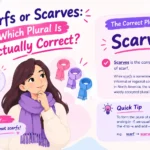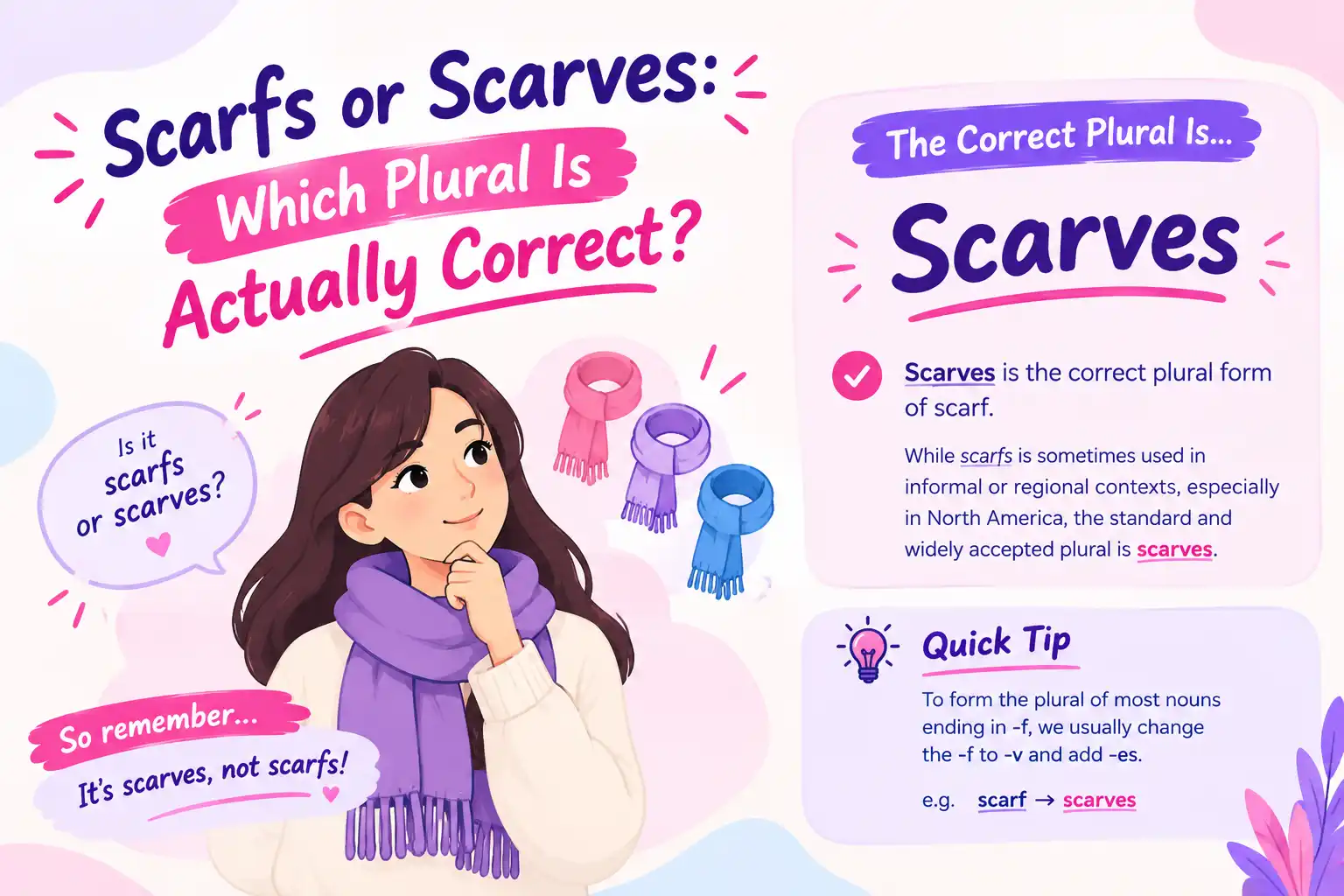
Scarves is the more common and widely preferred plural of scarf, but scarfs is also considered grammatically acceptable by major dictionaries. Both forms exist because scarf follows an irregular pattern shared with other words ending in f, similar to hoof and dwarf.
I used to think there was only one right answer here, until I looked it up properly and realized both forms show up in respected dictionaries.
That surprised me. Most spelling questions have one clean answer, and this one does not.
You have probably seen scarves in books and clothing store signs your whole life. But you may have also seen scarfs somewhere, maybe on a product tag or in a casual social post, and wondered if it was simply a mistake.
It is not always a mistake. English has a small, stubborn group of words ending in f that can form their plural in more than one way, and scarf happens to be one of them.
By the end of this guide, you will know exactly which plural to reach for depending on your writing situation, and why this confusion exists in the first place.
Scarfs or Scarves: Quick Answer
Scarves is the traditional, more widely used plural form, and it remains the safer choice in formal writing, retail contexts, and most everyday communication.
Scarfs is also listed as an acceptable plural in dictionaries like Merriam Webster, though it appears far less often in actual usage.
For example, “She packed three warm scarves for the trip” uses the more common form, while “He owns more scarfs than any of his friends” uses the less common, but still valid, alternative.
The Origin of Scarf and Its Plural
Scarf entered English in the sixteenth century, originally referring to a sash or band worn across the body, likely derived from Old North French escarpe, related to a traveler’s satchel or sash. Its meaning gradually shifted toward the long strip of fabric worn around the neck that we recognize today.
The plural confusion comes from a pattern found in a small set of English nouns ending in f or fe, where the f sound shifts to a v sound in the plural, following rules inherited from Old English. Words like knife, becoming knives, and wife, becoming wives, follow this pattern strictly. Other words, like roof and hoof, allow both the regular s ending and the shifted v ending, and scarf falls into this second, more flexible category.
This is exactly why scarf never fully settled into one single plural form the way most English nouns do.
Scarfs or Scarves Explained: Key Differences
Neither form is technically incorrect, but they are not used equally, and understanding the difference helps you sound natural rather than uncertain.
| Term | Meaning | When to Use | Region or Context |
| Scarves | Standard, traditional plural of scarf | Formal writing, retail, general everyday use | Preferred across American and British English |
| Scarfs | Accepted but less common plural of scarf | Casual writing, informal speech | Occasionally seen in both American and British English, though rare |
There is an important side note here. Scarfs is also the correct third person singular verb form of the informal verb to scarf, meaning to eat something quickly, as in “he scarfs his lunch in under five minutes.” This verb use of scarfs has nothing to do with the plural noun, but it does explain why the spelling scarfs already feels somewhat familiar to many English speakers, even if they have never used it as a plural for the clothing item.
Which Version Should You Use?
For formal writing, business communication, and academic work, use scarves. It remains the expected, standard choice and will never raise a reader’s eyebrow.
For retail, fashion, and product listings, scarves is overwhelmingly the industry standard. Shoppers expect to see this spelling on tags, websites, and advertisements.
For casual writing or conversation, scarfs will usually be understood without confusion, but it may still read as slightly unusual to some readers, since it remains the less common option.
For global or neutral use, scarves is the safer, universally recognized choice across both American and British English, making it the best default whenever you are unsure which audience you are writing for.
The simple rule of thumb: when in doubt, choose scarves. It carries no risk of sounding unusual and works in every context where the plural of scarf is required.
Common Mistakes with Scarfs or Scarves
Mistake: “I bought too much scarfs on sale.” Correction: “I bought too many scarves on sale.” Why it happens: This mixes up the plural spelling issue with a separate quantifier error, since scarves is countable and should pair with many, not much.
Mistake: Assuming scarfs is always wrong. Correction: Scarfs is a recognized, dictionary listed alternative plural, even though it is far less common. Why it happens: Many English learners are taught only the more common form, so the alternative spelling can look like an outright error rather than a rarely used, accepted variant.
Mistake: Confusing the verb scarfs with the plural noun scarfs. Correction: “He scarfs his breakfast every morning” uses the verb, unrelated to the clothing item, while “He owns five scarfs” uses the noun plural. Why it happens: The identical spelling in both cases makes it easy to blend two completely different meanings together without realizing it.
Mistake: Writing scarve as a singular form. Correction: The singular form is always scarf, never scarve, regardless of which plural form you choose. Why it happens: Once a writer sees scarves regularly, the false singular scarve can start to feel plausible, even though it does not exist.
Scarfs or Scarves in Real World Examples
Professional email: “Our new collection of scarves arrives in stores this Friday, with limited quantities available online.”
News headline: “Winter Sales Surge as Shoppers Stock Up on Scarves and Gloves”
Social media post: “Just added five new scarfs to my collection this week, can’t wait for the cold weather!”
Formal document or report: “The inventory report lists four hundred units of scarves currently available across all retail locations.”
Notice how scarves dominates the more formal, professional, and retail examples, while scarfs shows up only in the casual, personal social media post, which lines up closely with how each spelling actually gets used in real writing.
Scarfs or Scarves: Data, Trends, and Usage
Search interest in “scarfs or scarves” spikes seasonally, rising sharply every year as autumn and winter approach, when scarves become a common topic in fashion and shopping content.
This search is almost entirely informational, since people typing this phrase are checking correct spelling rather than looking to buy anything, even though the topic itself is tightly connected to a commercial product category.
English learners search this pair frequently, since irregular plural patterns like this one are a well known source of confusion for anyone studying English as a second language, particularly because most English plurals simply add an s without any spelling shift.
One relevant insight here: as global fashion retailers increasingly localize product listings, scarves remains the dominant spelling worldwide, which likely reinforces its position as the expected, default plural over time, even as scarfs continues to exist as a recognized but secondary option.
Comparison Table: Scarfs vs Scarves
| Term or Variant | Meaning | Region or Context | Best Used When |
| Scarves | Standard, most common plural of scarf | Universal across American and British English | Formal writing, retail, and any general or professional context |
| Scarfs | Accepted, less common plural of scarf | Rare, casual usage in both American and British English | Informal writing where a less traditional plural feels acceptable |
Frequently Asked Questions
Q: What does the plural of scarf mean? A: The plural of scarf refers to more than one scarf, the long piece of fabric worn around the neck or head. Both scarves and scarfs describe this same plural concept.
Q: How do you use scarves correctly in a sentence? A: Use scarves as the plural noun for multiple scarves, as in “She keeps her scarves organized by color in a drawer.”
Q: Scarfs versus scarves, what is the actual difference? A: There is no difference in meaning. Scarves is simply the far more common and widely accepted plural, while scarfs remains a valid but rarely used alternative.
Q: Is scarfs acceptable in formal writing? A: It is technically acceptable, but scarves is strongly preferred in formal, academic, and professional writing, so it remains the safer choice.
Q: Which version is correct, scarfs or scarves? A: Both are considered correct according to major dictionaries, though scarves is used far more often and is generally the recommended choice.
Q: Where does the word scarf come from? A: Scarf likely comes from Old North French escarpe, originally referring to a sash or satchel worn across the body, before evolving into its modern meaning of a strip of fabric worn around the neck.
Q: Can scarfs be used as a verb? A: Yes. As a verb, to scarf means to eat something quickly, and scarfs is the correct third person singular form, as in “she scarfs her lunch between meetings,” which is entirely separate from the plural noun.
Conclusion
Scarves is the plural you should reach for by default, especially in formal, professional, and retail writing, where it remains the clear industry standard. Scarfs is not incorrect, but it stays firmly in the minority, showing up mostly in casual or conversational contexts.
Remember these key points. Scarves is the traditional, most widely accepted plural. Scarfs is a recognized but far less common alternative. The identical spelling scarfs also functions as a completely unrelated verb form meaning to eat quickly. And when you are unsure which audience you are writing for, scarves is always the safer, more universally understood choice.
Now you know exactly how to choose between scarfs and scarves. Bookmark this guide so you never second guess this spelling again, and share it with anyone who has ever paused over a clothing tag wondering which one was right.
Read More: Councilor or Counselor: The Complete, Proven Guide

I’m Zain. I got interested in commonly confused words while helping non-native English speakers prep for writing exams, where a single misused word could cost real marks. That experience shaped how I write now: I try to explain not just which spelling is correct, but why the confusion exists in the first place, since understanding the reason is what actually makes it stick.