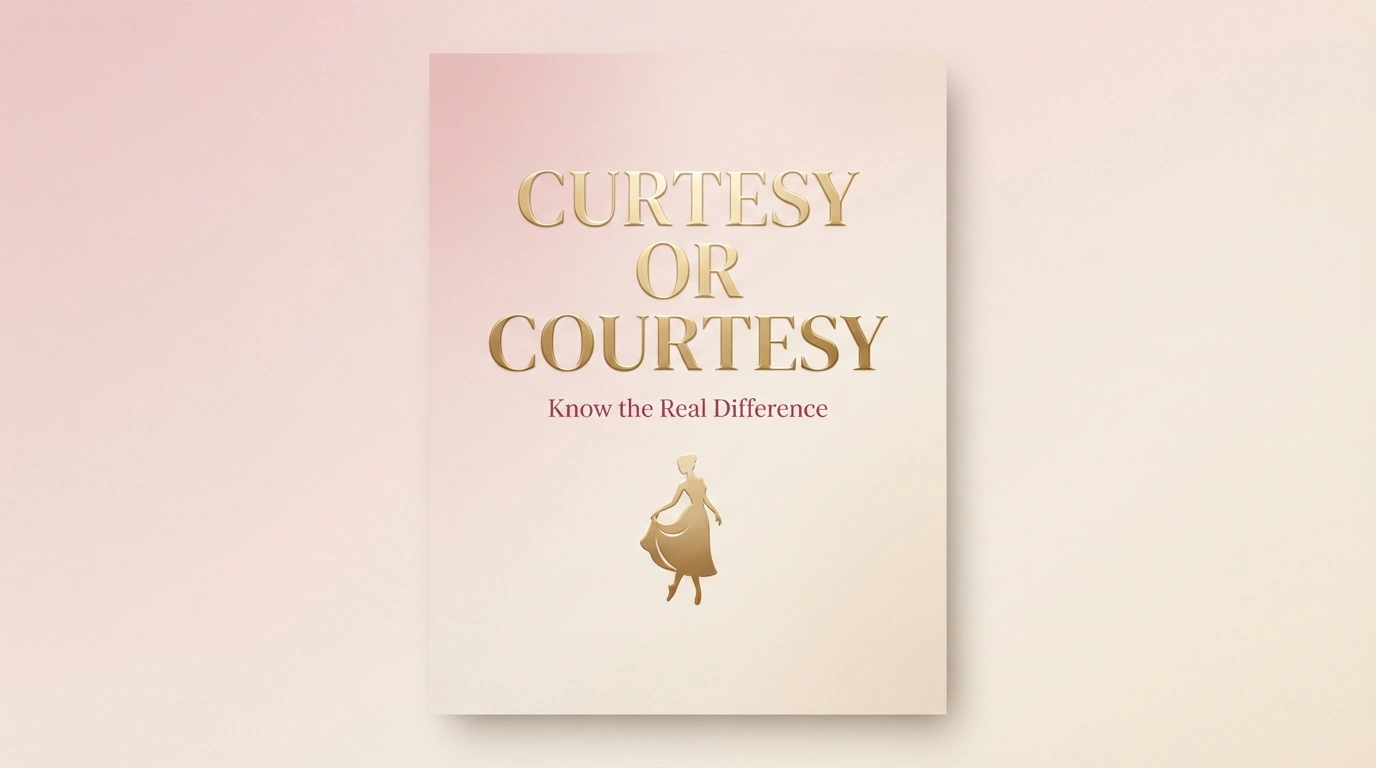
Curtesy or courtesy usually comes down to a typo. Courtesy means polite, respectful behavior. Curtesy is a rare legal word about a husband’s property rights. Most people who type “curtesy” actually mean either courtesy or curtsy, the small bow of respect.
A student once handed me an essay with this line. “She greeted the guests with great curtesy.” I read it twice. Then I smiled and picked up my red pen.
She meant courtesy. But her spelling landed on a real word, just the wrong one. That single missing letter sent her sentence somewhere strange.
This mix up happens more than you think. Three words are tangled together here. Courtesy, curtsy, and curtesy. They sound close. They look close. Only one of them means what most people are trying to say.
You have probably typed one of these words and paused. Did I spell that right? Is there even a difference? Spellcheck often stays quiet, since all three are real words in the dictionary.
This guide untangles the mess for good. You will learn exactly what each word means, You will see clear examples from real writing. You will also get a simple cheat sheet you can save and check anytime doubt creeps in.
Let us clear this up, one word at a time.
Curtesy or Courtesy: Quick Answer
Courtesy means polite, respectful behavior toward others. It is the word you want almost every time.
Curtsy (also spelled curtsey) is the small bow women make by bending their knees, usually as a sign of respect.
Curtesy is a legal term. It refers to an old common law right that let a husband keep an interest in his late wife’s property after her death, under certain conditions.
Here are two quick examples.
- Courtesy: He held the door open out of courtesy.
- Curtsy: She gave a small curtsy before the queen.
Notice how different these meanings are, even though the spellings look almost identical.
The Origin of Courtesy, Curtsy, and Curtesy
All three words share a common ancestor. That ancestor is the Old French word curteisie, which meant behavior fit for a royal court. It came from cort, meaning court, the kind with kings and nobles, not the kind with judges.
Courtesy kept this meaning closely. It grew into the modern word for polite, considerate behavior, the kind once expected in a royal court.
Curtsy developed as a shortened, altered form of courtesy. Over time, the word narrowed to describe one specific act, the physical bow of respect. Language often works this way. A broad word splinters into a narrow one tied to a single gesture.
Curtesy, the legal term, followed a separate path. It comes through old English and French legal tradition, referring to a husband’s right by “courtesy of the realm” or the customs of the land. This use survives mainly in law textbooks and historical property cases.
So why the confusion today?
- All three words trace back to the same French root.
- Curtsy and curtesy differ by only one letter.
- Curtesy, the legal term, is rare, so most people never learned it and assume any “curtesy” spelling must be a typo for courtesy or curtsy.
- Autocorrect sometimes flips one spelling into another, since all three exist in dictionaries.
Once you see how these words split apart over time, the confusion makes a lot more sense.
Curtesy or Courtesy Explained: Key Differences
Let us compare all three words clearly, side by side.
| Term | Meaning | When to Use | Region or Context |
| Courtesy | Polite, respectful behavior | Everyday manners, formal writing, kindness | All English |
| Curtsy or Curtsey | A bow made by bending the knees | Royal greetings, formal ceremonies, dance | All English, common in British royal contexts |
| Curtesy | A husband’s legal right to his late wife’s property | Legal history, property law, old case studies | Mostly historical and legal English |
How Courtesy Works
Courtesy describes kindness, manners, and respect shown to others. You will see it constantly in daily language.
- Please extend the same courtesy to every customer.
- He answered the tough question with courtesy.
- The hotel offers a courtesy shuttle to the airport.
Notice how flexible this word is. It fits emails, speeches, business writing, and casual conversation.
How Curtsy Works
Curtsy describes one specific physical action. A person, usually a woman or girl, bends her knees slightly while lowering her body as a sign of respect.
- The dancer curtsied at the end of the performance.
- Young girls learn to curtsy before meeting royalty.
- She gave a quick curtsy and left the stage.
The verb form is “curtsy” or “curtsey.” The past tense is “curtsied” or “curtseyed.” Both spellings are accepted, though “curtsy” is more common in American English.
How Curtesy Works
Curtesy is the rarest word of the three. It belongs to legal history, specifically old English common law.
Historically, curtesy gave a widower certain rights to property that belonged to his deceased wife, if the couple had a child together during the marriage. Modern property law has replaced or removed this right in most places, but the term still appears in legal textbooks, exams, and historical case studies.
- The court explained the old doctrine of curtesy in its ruling.
- Curtesy no longer applies under modern inheritance law in most states.
Unless you are studying property law or reading legal history, you will rarely need this word.
Which Word Should You Use?
Here is direct advice, based on your situation.
- For everyday writing: Use courtesy. It almost always fits, whether you mean politeness, kindness, or a free service like a courtesy call.
- For describing a bow or curtsy movement: Use curtsy or curtsey. Pick one spelling and stay consistent throughout your writing.
- For law students and legal writers: Use curtesy only when referring to the specific historical property right. Double check your context before using this word anywhere else.
- For non native English speakers: If you are unsure, courtesy is almost always the safe choice. It is by far the most common of the three words.
- For global or neutral use: Courtesy works everywhere and fits nearly every situation. Curtsy fits ceremonial or royal contexts. Curtesy should stay inside legal writing.
Cheat Sheets You Can Save
Cheat Sheet 1: The One Second Test
Ask yourself, am I talking about being polite? Use courtesy.
Am I talking about a physical bow? Use curtsy.
Am I writing about an old legal property right? Use curtesy.
Cheat Sheet 2: Spelling Reminder
Courtesy has an extra “our” in the middle, just like the word “our” tucked inside it. Think “our courtesy,” meaning shared respect.
Curtsy is short and simple, matching the quick, simple action it describes.
Curtesy looks like curtsy with an added “e,” but it means something completely different. This is the word to double check every time.
Cheat Sheet 3: Quick Rules at a Glance
- Use courtesy for politeness, manners, and free services.
- Use curtsy or curtsey for the physical bow.
- Use curtesy only for the legal property right, and only in that context.
- When in doubt, courtesy is almost always the safest choice.
- Never use curtesy casually, since readers may not understand the legal meaning.
Cheat Sheet 4: Memory Trick
Picture a royal court. Everyone there shows courtesy, meaning good manners. A young girl performs a curtsy, a small bow, before the queen. A judge somewhere reads about curtesy, an old legal right involving property. Same court, three very different words.
Save these cheat sheets. They will settle almost every doubt you have.
Common Mistakes with Curtesy or Courtesy
Here are the most frequent errors, along with clear corrections.
Mistake 1: Writing curtesy instead of courtesy
- Wrong: She treated every guest with great curtesy.
- Right: She treated every guest with great courtesy.
Why it happens: The missing letter is easy to overlook, especially while typing quickly.
Mistake 2: Writing courtesy instead of curtsy
- Wrong: The dancer gave a small courtesy at the end.
- Right: The dancer gave a small curtsy at the end.
Why it happens: Writers know the word “courtesy” well, so they default to it even when describing a physical bow.
Mistake 3: Using curtesy in casual writing
- Wrong: Thanks for your curtesy during the meeting.
- Right: Thanks for your courtesy during the meeting.
Why it happens: People assume curtesy is simply a fancier spelling of courtesy, when it is actually a completely different, unrelated legal term.
Mistake 4: Mixing up curtsy and curtsey spelling inconsistently
- Wrong: She curtsied to the king, then gave another curtsey moments later.
- Right: She curtsied to the king, then gave another curtsy moments later.
Why it happens: Both spellings are correct individually, but switching between them in the same piece of writing looks inconsistent and careless.
Mistake 5: Using curtesy in a legal context incorrectly
- Wrong: The company showed curtesy by refunding the customer.
- Right: The company showed courtesy by refunding the customer.
Why it happens: Writers sometimes remember seeing “curtesy” somewhere formal, like a legal document, and assume it fits any formal sentence, even when the meaning does not match at all.
Curtesy or Courtesy in Real World Examples
Seeing these words in real writing helps the meaning stick permanently.
In a professional email
Hi Mr. Ahmed,
Thank you for your continued courtesy during our recent negotiations. As a courtesy, we are extending your contract review deadline by one week.
In a news headline
- Royal Family Greets Crowds as Young Fans Practice Their Curtsy
In a social media post
- Loved watching the ballet tonight. Every dancer ended with the most graceful curtsy I have ever seen.
And In a formal document or report
- Under the historical doctrine of curtesy, a surviving husband could claim a life interest in his wife’s real property, provided a child had been born of the marriage. Modern statutes have since abolished curtesy in most jurisdictions, replacing it with equal inheritance rights for both spouses.
Each example shows the correct word fitting naturally into its own specific context.
Curtesy or Courtesy: Data, Trends and Usage
Most people who search this exact phrase are typing quickly, often in an email, an essay, or a formal letter. They pause, unsure of the spelling, and search for clarity. This makes the search intent clearly informational. Readers want a fast answer, not a long history lesson.
Who searches for this most often?
- English learners building vocabulary and confidence
- Students writing essays or formal letters
- Law students encountering the legal term curtesy for the first time
- Writers and editors double checking spelling before publishing
- Etiquette and wedding content creators writing about curtsies and formal manners
Here is one insight worth remembering. Courtesy appears constantly in daily English, while curtesy almost never does outside legal study. That imbalance is exactly why the confusion happens. Most people have simply never encountered curtesy as a legal word, so when they see it anywhere, they assume it must be a misspelling. Understanding all three words protects your writing from looking careless, especially in professional or academic settings.
Standalone Comparison Table
| Term or Variant | Meaning | Region or Context | Best Used When |
| Courtesy | Polite, respectful behavior | All English | Everyday manners, emails, and formal writing |
| Curtsy | A bow made by bending the knees | All English, common in royal or ceremonial settings | Describing a physical gesture of respect |
| Curtsey | Alternate spelling of curtsy | All English, slightly more common in British writing | Same as curtsy, based on personal or regional preference |
| Curtesy | A husband’s historical legal right to his wife’s property | Legal history and property law | Academic legal writing or historical case discussion |
| Etiquette | The general rules of polite behavior | All English | Broader discussions of manners and social conduct |
FAQ
Q: What does curtesy or courtesy mean? A: Courtesy means polite, respectful behavior. Curtesy is a rare legal term about a husband’s property rights after his wife’s death. Most people meaning politeness should use courtesy, not curtesy.
Q: How do you use curtesy or courtesy correctly? A: Use courtesy for kindness, manners, or free services like a courtesy call. Use curtesy only when discussing the specific historical legal right, almost always in a legal or academic setting.
Q: Curtsy vs courtesy, what is the real difference? A: Curtsy is a physical bow made by bending the knees, often shown to royalty. Courtesy is polite behavior in general. They sound alike but describe completely different things.
Q: Is curtesy acceptable in formal writing? A: Only within legal writing, historical analysis, or academic property law discussions. In every other formal context, courtesy is the correct and expected word.
Q: Which spelling is correct, curtsy or curtsey? A: Both spellings are correct and accepted. Curtsy is more common in American English, while curtsey appears more often in British English. Choose one and stay consistent.
Q: Where does the word courtesy come from? A: Courtesy comes from the Old French word curteisie, meaning behavior fit for a royal court. Curtsy and curtesy share this same root but developed separate, narrower meanings over time.
Q: Can curtesy ever mean the same thing as courtesy? A: No. Despite the similar spelling, curtesy refers only to an old legal property right. It never means politeness, even though the two words look almost identical on the page.
Conclusion
Let us review what actually matters here.
- Courtesy means politeness and respect. It is the word you need almost every time.
- Curtsy or curtsey describes the physical bow, often seen in royal or formal settings.
- Curtesy is a rare legal term tied to old property law, not everyday manners.
- When unsure, courtesy is almost always your safest and most natural choice.
My honest advice is simple. If your sentence involves being polite, reach for courtesy every single time. Save curtsy for describing an actual bow, and leave curtesy alone unless you are deep in legal study.
Now you know exactly how to use curtesy or courtesy correctly, go try it in your next piece of writing. Bookmark this guide so you never second guess it again. Share it with someone who has mixed up these tricky words before.
Read More: Cloths or Clothes: Easy Difference and Correct Use

My name is Ayesha Sadiqah, the writer behind this website. I write in-depth articles on English spelling, word comparisons, grammar, and vocabulary to help learners make better language choices. Every guide is designed to provide accurate, practical, and easy-to-understand information.