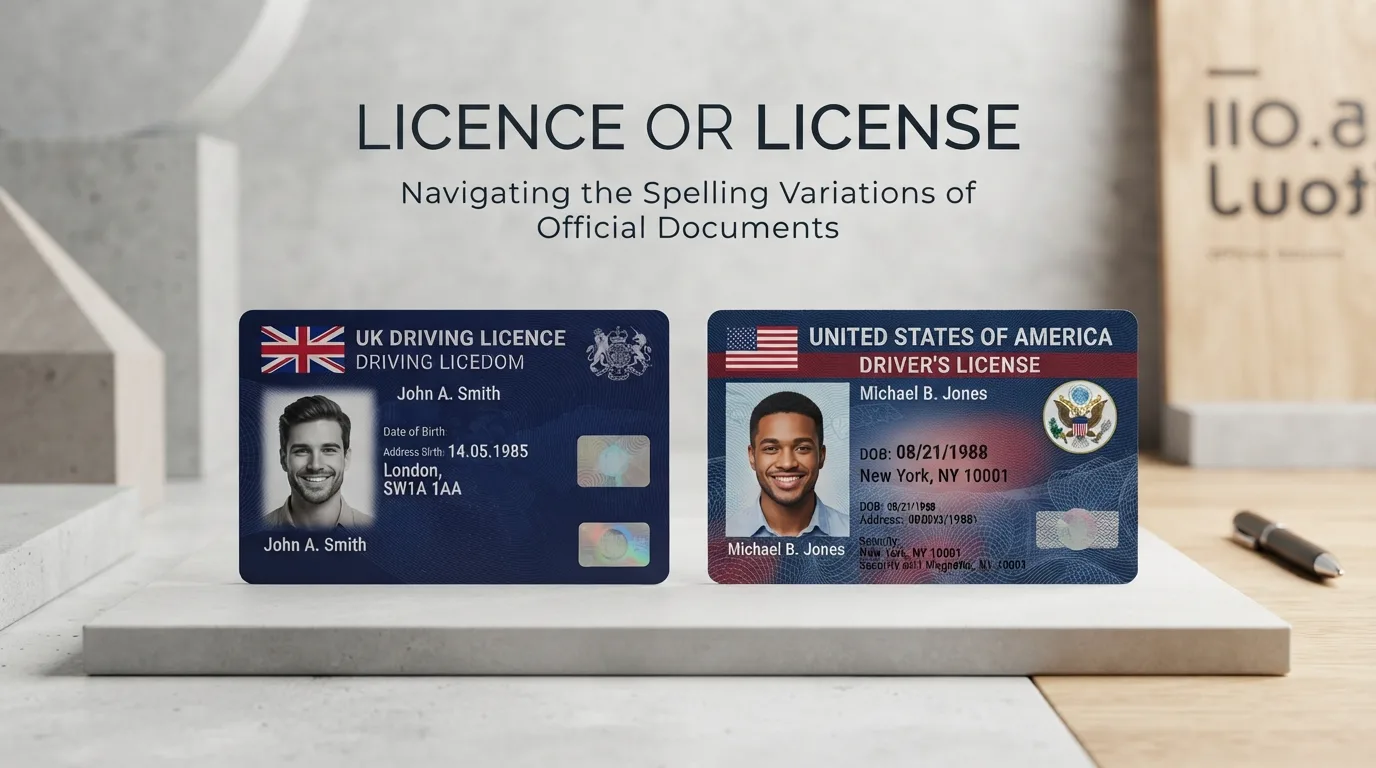
Licence is the noun and license is the verb in British English. In American English, license is used for both, and licence is not used at all.
I once watched a British colleague correct a printed sign that read “Driving Licence Renewal Centre” and then, five minutes later, correct her own email that read “you must licence this software before use.” She fixed the sign. She missed her own mistake. That contradiction stuck with me, because it shows how tricky this pair really is, even for people who grew up with the correct spelling right in front of them their whole lives.
This is one of those word pairs that quietly trips up careful writers, editors, and students everywhere. It looks like a simple typo, but it is not. It is a genuine grammar rule tied to region and part of speech, and getting it wrong in the wrong country can make a document look sloppy or even legally imprecise.
By the end of this guide, you will know exactly when to use licence, when to use license, and why American English simplified the whole system in the first place. No more pausing mid sentence to second guess yourself.
Licence or License, Quick Answer
In British English, licence is the noun, describing a document or official permission, as in “he lost his driving licence.” License is the verb, describing the act of granting that permission, as in “the company was licensed to sell alcohol.”
In American English, this split does not exist. License covers both jobs, so you would write “his driving license” and “the company was licensed to sell alcohol,” using the exact same spelling both times.
The Origin of Licence and License
Both words trace back to the Latin word “licentia,” meaning freedom or liberty, which passed into English through Old French. For centuries, English writers used license as both a noun and a verb, without much consistency.
British English eventually settled on a pattern that already existed for similar word pairs, splitting the spelling by grammatical function. This is the same pattern behind practice and practise, and advice and advise. The noun takes a “c,” and the verb takes an “s.”
American English simplified this system during the process of American spelling reform in the nineteenth century, largely influenced by Noah Webster, who favored consistency over historical distinction. As a result, American English dropped licence entirely and kept license for every use.
This explains why the confusion feels so persistent today. British writers are managing an active grammar rule, while American writers only ever need to remember one spelling, and international online content constantly mixes both systems together.
Licence and License Explained, Key Differences and Variations
Understanding this pair means separating two different questions. First, are you in British or American English. Second, are you using a noun or a verb.
Licence functions only as a noun in British English, referring to an official document, permit, or formal permission. Example: “You need a licence to fish in this river.”
License functions as a verb in British English, describing the act of authorizing or permitting something. Example: “The council licensed three new food trucks this year.”
License in American English covers both the noun and verb roles, with no separate spelling for either function. Example: “She renewed her license” and “The state licenses new drivers every day” both use the identical spelling.
Licenced or licensed as the past tense follows the same regional pattern. British English generally prefers “licensed” as the adjective form too, since the adjective grew out of the verb, as in “a licensed pharmacist,” which means British English actually uses the s spelling more often than many people expect.
| Term | Meaning | When to Use | Region or Context |
| Licence | Noun, official permission or document | British English nouns only | United Kingdom, Australia, most Commonwealth countries |
| License | Verb, to grant permission | British English verbs only | United Kingdom, Australia, most Commonwealth countries |
| License | Both noun and verb | All uses | United States, and generally Canada |
| Licensed | Adjective, past tense form | Both regions | Global, since the adjective follows the verb spelling |
Which Version Should You Use?
For British, Australian, and most Commonwealth writers, remember the simple rule. Licence is a thing you hold. License is an action you take. If you can replace the word with “permit” as a noun, use licence. If you can replace it with “permit” as a verb, use license.
For American writers, this entire distinction disappears. Always use license, whether you are naming a document or describing the act of granting one.
For global businesses and international websites, pick one regional standard and apply it consistently across the entire site or document. Mixing British and American spelling in the same piece of writing looks careless, even if each individual instance is technically correct somewhere in the world.
For students studying in British institutions, examiners will expect the noun and verb split, and losing marks over this distinction is entirely avoidable once the pattern clicks.
Common Mistakes with Licence or License
Mistake: “You must license before driving.” (British English, referring to the document) Correction: “You must have a licence before driving.” This happens because the verb form looks so similar that writers forget they actually need the noun here.
Mistake: “The government will licence the new pharmacy.” (British English, describing an action) Correction: “The government will license the new pharmacy.” Writers often default to the noun spelling out of habit, especially since licence appears more often in everyday signage and paperwork.
Mistake: Using licence anywhere in American English writing. Correction: Always use license in American English, regardless of whether it functions as a noun or a verb.
Mistake: Writing “licenced” instead of “licensed” as the adjective, even in British English. Correction: The adjective form consistently uses the s spelling, as in “a licensed contractor,” even in regions that use licence as a noun.
Mistake: Assuming this is simply a typo rather than an actual grammar rule. Correction: This is a real, intentional spelling distinction in British English, not a mistake to casually overlook or autocorrect away.
Cheat Sheet: Licence or License
Use this quick cheat sheet whenever you are unsure.
- British English noun: licence (a licence, my licence, the driving licence)
- British English verb: license (to license, we license, they licensed)
- American English, both: license (a license, to license, licensed drivers)
- Quick memory trick: “c” comes before “s” in the alphabet, just like “noun” comes before “verb” in a typical sentence, so licence with a c is the noun.
Licence or License in Real World Examples
Professional email (British English): “Please attach a copy of your business licence so we can process the license renewal request.”
News headline (American English): “State Announces New Online System for Driver License Renewals”
Social media post (British English): “Finally got my driving licence today, three years after starting lessons.”
Formal document (American English): “Applicants must hold a valid professional license before submitting this form.”
Notice how the British email example uses both spellings correctly within a single sentence, once for the document and once for the action, which shows exactly how the rule works in real writing.
Licence or License, Data, Trends and Usage
Searches for “licence or license” spike heavily among writers working across international teams, particularly in publishing, legal writing, and software localization, where a single document might need review by both British and American editors.
This search intent is almost entirely informational, driven by professionals who want spelling confirmation before publishing official content, contracts, or public facing text where a mistake could look unprofessional or legally imprecise.
Businesses expanding into new English speaking markets search this term often, since choosing the wrong regional spelling across an entire website can quietly signal to customers that the content was not carefully localized for their region.
Comparison Table
| Term or Variant | Meaning | Region or Context | Best Used When |
| Licence | Noun, official document or permission | British and Commonwealth English | Referring to the physical document or formal permission |
| License | Verb, to grant permission | British and Commonwealth English | Describing the act of authorizing something |
| License | Both noun and verb | American English | Any use, noun or verb, in American writing |
| Licensed | Adjective, describing authorized status | Global | Describing someone or something officially permitted |
Frequently Asked Questions
Q: What does licence mean? A: In British English, licence is a noun referring to an official document or formal permission, such as a driving licence or a business licence.
Q: How do you use licence and license correctly? A: In British English, use licence for the document and license for the action. In American English, use license for both.
Q: Licence vs license, what is the difference? A: The difference is regional and grammatical. British English splits the spelling by noun and verb, while American English uses license for everything.
Q: Is licence acceptable in formal writing? A: Yes, in British English formal writing, licence is not just acceptable but expected for the noun form, while license handles the verb.
Q: Which version is correct, licence or license? A: Both are correct, depending entirely on your target region and, in British English, whether you need a noun or a verb.
Q: Where does licence come from? A: Both spellings trace back to the Latin word licentia, meaning freedom or permission, which entered English through Old French.
Q: Can license be used in British English? A: Yes, but only as a verb or in the adjective form licensed, never as the standalone noun, which requires licence instead.
Conclusion
Licence and license are not simply two spellings of the same word waiting for you to guess correctly. They represent a real grammar rule in British English, splitting noun from verb, while American English quietly flattened that distinction into a single, simpler spelling. Once you remember that licence is a thing and license is an action, the British rule becomes almost automatic. American writers can skip the whole debate entirely and simply use license every time.
Now you know exactly how to use licence and license correctly. Bookmark this guide so you never second guess this word again, and share it with a colleague who keeps mixing up the noun and the verb.
Read More: Councilor or Counselor: The Complete, Proven Guide

My name is Ayesha Sadiqah, the writer behind this website. I write in-depth articles on English spelling, word comparisons, grammar, and vocabulary to help learners make better language choices. Every guide is carefully researched and designed to provide accurate, practical, and easy-to-understand information.