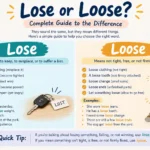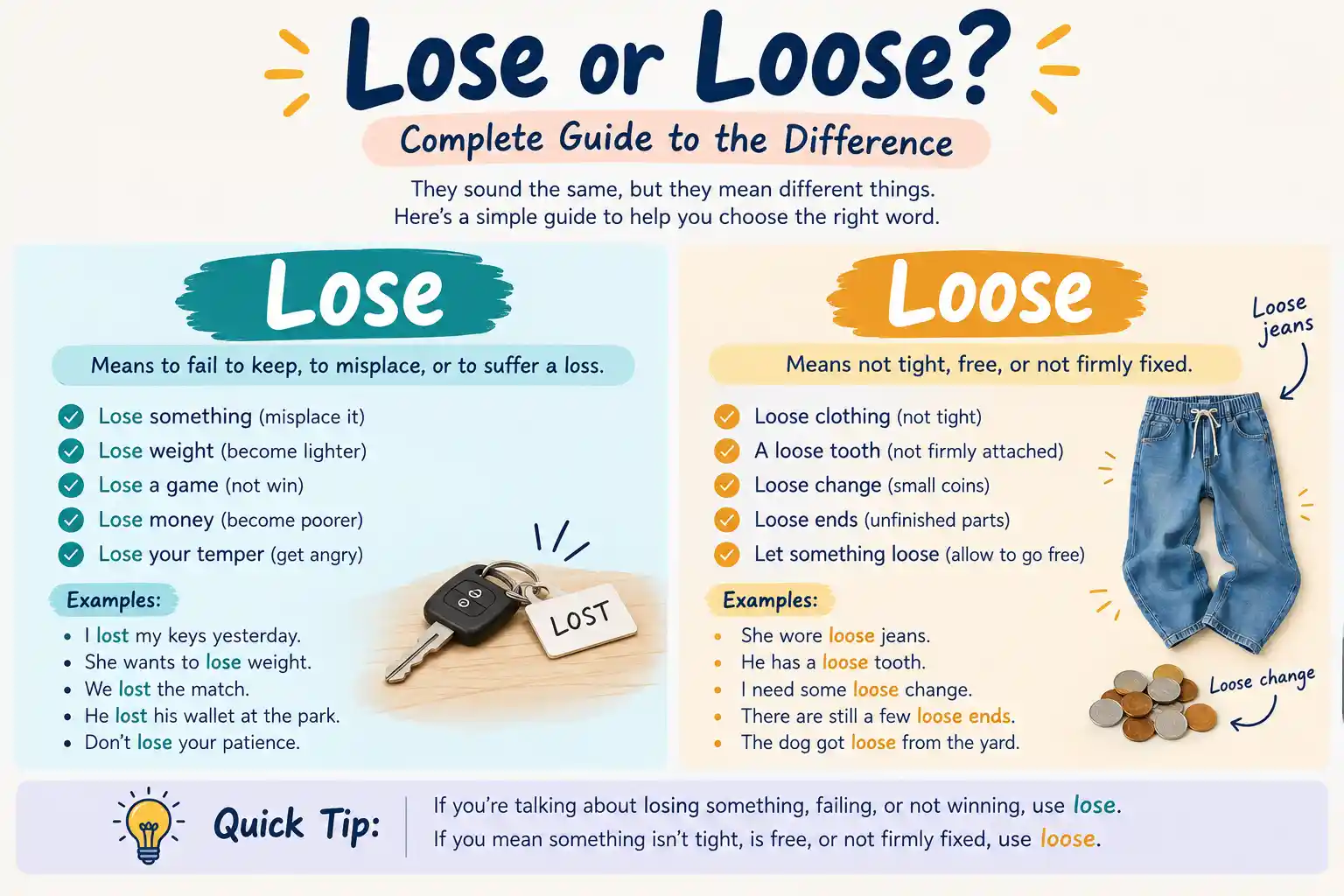
Lose means to misplace something, fail to win, or no longer have something, while loose means not tight, not firmly fixed, or free from restraint. The easiest way to remember the difference is that lose is usually a verb, while loose is usually an adjective.
Have you ever typed a sentence and suddenly stopped because you were not sure whether to write lose or loose?
You are not alone.These two words cause problems for many English learners and even native speakers. They look and sound similar, but their meanings are very different. A single extra letter can completely change your sentence.
For example, if you write, “Do not loose your keys,” you are using the wrong word. The correct sentence is, “Do not lose your keys.”
But if you write, “My shoes are lose,” that is also incorrect. The correct word is loose.
This small difference matters in school assignments, emails, websites, social media posts, professional documents, and everyday conversations.
I have seen this mistake many times in ordinary writing. People often know what they want to say, but the similar spelling makes them hesitate. The good news is that you do not need to memorize a long grammar rule.
In this guide, you will learn the meaning of lose and loose, their pronunciation, their word history, their differences, common mistakes, easy examples, and simple memory tricks.
By the end, you should be able to choose the right word without second guessing yourself.
Lose or Loose: Quick Answer
The both words, Lose and loose are different words with different meanings.
Lose is mainly a verb. It means to no longer have something, fail to win, or become unable to find something.
Examples:
“I do not want to lose my phone.”
“Our team may lose the match.”
“She does not want to lose her job.”
Loose is mainly an adjective. It means not tight, not firmly attached, or free.
Examples:
“My shirt is loose.”
“The door handle is loose.”
“The dog broke loose from the chain.”
Easy Rule
Think of it this way:
Lose = something is gone or you fail to win.
Loose = something is not tight or is free.
This simple rule can help you remember the difference quickly.
What Does Lose Mean?
Lose is a verb that describes the act of no longer having something, failing to keep something, failing to win, or being unable to find something.
It can describe physical objects, opportunities, competitions, relationships, money, time, or even feelings.
For example:
“I might lose my wallet.”
Here, lose means you may no longer have your wallet because you cannot find it.
You can also use lose when talking about competitions.
“Our team could lose the game.”
Here, lose means the team may not win.
The word also appears in situations involving time.
“Do not lose time.”
In this sentence, lose means to waste or fail to use time.
Another common meaning relates to weight.
“She wants to lose weight.”
Here, lose means to reduce weight.
Common Uses of Lose
You can use lose when talking about:
• Losing an object
• Losing a competition
• Losing money
• Losing time
• Losing an opportunity
• Losing a job
• Losing a relationship
• Losing weight
• Losing concentration
• Losing control
Examples of Lose
“I always worry that I will lose my keys.”
“Do not lose hope.”
“We cannot afford to lose this opportunity.”
“He may lose the competition.”
“She wants to lose five kilograms.”
“I do not want to lose contact with my friends.”
“The company could lose customers.”
Notice that lose usually describes something that is no longer kept, found, won, or controlled.
What Does Loose Mean?
Loose is usually an adjective. It describes something that is not tight, not firmly attached, or free.
For example:
“This dress is loose.”
The dress is not tight against the body.
You can also use loose to describe something that is not securely attached.
“The screw is loose.”
The screw is not firmly fixed in place.
Loose can also describe freedom.
“The horse got loose.”
This means the horse escaped from something that was holding it.
Common Uses of Loose
You can use loose when describing:
• Loose clothing
• Loose hair
• Loose screws
• Loose teeth
• Loose ropes
• Loose connections
• Loose objects
• Animals that escape
• Something that is not firmly attached
Examples of Loose
“My trousers are too loose.”
“One of the buttons is loose.”
“The dog is loose in the garden.”
“The wire became loose.”
“She wore a loose dress.”
“The tooth feels loose.”
In each example, loose describes something that is not tight, secure, or firmly held.
Lose or Loose: Key Difference
The biggest difference is simple.
Lose is generally about not having something, failing to win, or being unable to find something.
Loose is generally about not being tight, secure, or fixed.
Compare these sentences:
“I do not want to lose my ring.”
“My ring is loose.”
The first sentence means you do not want your ring to go missing.
The second sentence means the ring does not fit tightly.
Here is another example:
“I might lose my shoe.”
This means you might no longer have your shoe.
“My shoe is loose.”
This means your shoe does not fit tightly.
The meaning changes completely.
Lose vs Loose Comparison Table
| Word | Part of Speech | Main Meaning | Example |
| Lose | Verb | To no longer have something | I do not want to lose my phone. |
| Lose | Verb | To fail to win | Our team may lose the match. |
| Lose | Verb | To reduce weight | She wants to lose weight. |
| Loose | Adjective | Not tight | My shirt is loose. |
| Loose | Adjective | Not firmly attached | The screw is loose. |
| Loose | Adjective | Free from restraint | The dog is loose. |
How to Pronounce Lose and Loose
Pronunciation is another useful way to tell these words apart.
Lose is pronounced like looz.
Loose is pronounced like looss.
The vowel sound is similar, but the ending sound is different.
Lose ends with a z sound.
Loose ends with an s sound.
Try saying these pairs aloud:
Lose
Loose
Choose
Shoes
Use
Juice
The pronunciation can help you remember the difference.
Why Do People Confuse Lose and Loose?
The main reason is their similar spelling.
Both words begin with loo, and both contain similar letters. Their pronunciation is also close.
English has many words that look similar but have different meanings. Lose and loose are among the most common examples.
Another reason is that English learners may assume that adding an extra letter does not change the meaning much.
In this case, it does.
Compare:
“I do not want to lose my bag.”
“I do not want to loose my bag.”
The first sentence is correct.
The second sentence is incorrect because loose does not normally mean to misplace something.
A useful habit is to stop thinking about the spelling for a moment and ask yourself what you mean.
Are you talking about something disappearing or not winning?
Use lose.
Are you talking about something being not tight or not firmly attached?
Use loose.
The Easiest Memory Trick for Lose or Loose
Here is a simple trick.
Think about the extra o in loose.
The two o letters can remind you of something having more room.
A loose shirt has more room.
A loose shoe has more room.
A loose rope is not pulled tightly.
For lose, remember that it has only one o.
You can also remember:
Lose has one O because something is gone.
Loose has two Os because something has extra room.
This is not a grammar rule. It is simply a memory trick.
Another helpful method is to remember that loose is connected to the idea of being free.
A dog can break loose.
A knot can come loose.
A shirt can be loose.
A screw can be loose.
Meanwhile, lose is connected to the idea of something no longer being yours, being unable to find something, or failing to win.
Common Mistakes With Lose and Loose
Mistake 1: Loose Your Keys
Incorrect:
“Do not loose your keys.”
Correct:
“Do not lose your keys.”
Why?
You are talking about misplacing your keys. Therefore, the correct word is lose.
Mistake 2: Lose Clothing
Incorrect:
“She prefers lose clothing.”
Correct:
“She prefers loose clothing.”
Why?
You are describing clothing that is not tight. Therefore, use loose.
Mistake 3: Lose Weight
Correct:
“I want to lose weight.”
Incorrect:
“I want to loose weight.”
Why?
Lose is used when talking about reducing weight.
Mistake 4: Loose the Game
Incorrect:
“We might loose the game.”
Correct:
“We might lose the game.”
Why?
You are talking about failing to win. Use lose.
Mistake 5: Lose Screw
Incorrect:
“The screw is lose.”
Correct:
“The screw is loose.”
Why?
The screw is not firmly attached. Therefore, use loose.
Lose or Loose in Real World Examples
Understanding words becomes much easier when you see them in natural situations.
In a Professional Email
“I do not want to lose this important opportunity.”
Here, lose means fail to keep or benefit from the opportunity.
In a News Article
“The team could lose its position at the top of the table.”
The meaning is that the team may no longer keep its position.
In a Social Media Post
“Do not lose hope. Better days are coming.”
Here, lose means stop having hope.
In a Fashion Article
“Why Loose Clothing Is Becoming More Popular”
Here, loose describes clothing that is not tight.
In a Workplace Conversation
“The connection between the two devices is loose.”
Loose means the connection is not secure.
In Everyday Conversation
“I think I might lose my wallet.”
This means the speaker may misplace the wallet.
“My wallet feels loose in this pocket.”
Here, loose means the wallet is not held tightly.
Lose or Loose in Formal Writing
Both words are completely acceptable in formal writing when they are used correctly.
You can use lose in business reports, academic assignments, professional emails, articles, and formal documents.
Examples:
“The company may lose customers because of poor service.”
“Students can lose marks because of spelling errors.”
You can also use loose in formal writing.
Examples:
“The machine contains a loose component.”
“The report uses a loose definition of the term.”
The important point is not whether the word is formal or informal.
The important point is whether the word matches the intended meaning.
Lose and Loose Word Family
Understanding related words can make the difference easier to remember.
Words Related to Lose
Lose
“I may lose my phone.”
Lost
“I lost my phone yesterday.”
Losing
“I am losing my patience.”
Loser
The person or team that fails to win.
Notice that lose changes form depending on the sentence.
Words Related to Loose
Loose
“The shirt is loose.”
Loosen
“Please loosen the rope.”
Loosely
“The box was loosely covered.”
Loosened
“She loosened the knot.”
These words are connected to the idea of something becoming less tight or less firmly held.
Lose or Loose Cheat Sheet
If you need a quick answer, save this section.
| If You Mean | Use |
| Misplace something | Lose |
| Fail to win | Lose |
| Reduce weight | Lose |
| Waste time | Lose |
| Stop having something | Lose |
| Not tight | Loose |
| Not firmly attached | Loose |
| Free from restraint | Loose |
| Clothing with extra room | Loose |
| A screw that is not secure | Loose |
One Second Test
Ask yourself:
Does something disappear, get missed, or fail?
Use lose.
Is something not tight or not secure?
Use loose.
That is usually all you need.
Lose or Loose Examples You Can Memorize
Here are some simple sentences worth remembering.
Lose
“I do not want to lose my phone.”
“Do not lose your keys.”
“Our team might lose.”
“She wants to lose weight.”
“Do not lose hope.”
“I could lose my job.”
Loose
“My shirt is loose.”
“The screw is loose.”
“The rope is loose.”
“Her hair is loose.”
“The dog got loose.”
“These shoes are too loose.”
If you remember these examples, many future situations will become easier.
Is Loose Ever a Verb?
Yes.
Although loose is most commonly an adjective, it can also be used as a verb.
As a verb, loose means to release something or set something free.
For example:
“The soldiers loosed the dogs.”
However, this use is less common in everyday modern English.
A much more common verb is loosen.
For example:
“Please loosen the knot.”
“Loosen the screw.”
“She loosened her scarf.”
This is another reason learners sometimes become confused.
Loose and loosen are related, but they are not exactly the same.
Loose usually describes the condition.
Loosen describes the action of making something less tight.
Compare:
“The rope is loose.”
“The worker loosened the rope.”
Is Lose a Verb?
Yes.
Lose is a verb.
It has several common meanings.
You can lose an object.
You can lose a competition.
You can lose money.
You can lose time.
You can lose weight.
You can lose an opportunity.
You can lose control.
You can lose confidence.
You can lose interest.
Because lose is a verb, it normally describes an action, event, or change.
For example:
“I lost my wallet.”
“She lost the match.”
“He is losing interest.”
These sentences describe something happening.
Lose or Loose in Questions
These words can also appear naturally in questions.
“Did you lose your phone?”
“Did our team lose the game?”
“Are these trousers too loose?”
“Is this screw loose?”
“Why did you lose your keys?”
“Why is this button loose?”
Notice how the meaning makes the correct word obvious.
Lose or Loose: Which One Should You Use?
Your choice depends entirely on the meaning.
Use lose when you mean:
• Misplace
• Fail to win
• No longer have
• Reduce
• Waste
• Fail to keep
Use loose when you mean:
• Not tight
• Not secure
• Not firmly attached
• Free
• Having extra space
There is no situation where you should choose between these words simply because one looks more familiar.
Always check the meaning first.
Frequently Asked Questions About Lose or Loose
Q: What is the difference between lose and loose?
A: Lose is mainly a verb meaning to misplace something, fail to win, or no longer have something. Loose is mainly an adjective meaning not tight, not secure, or free.
Q: Is it lose weight or loose weight?
A: The correct phrase is lose weight. Lose means to reduce something, so “I want to lose weight” is correct.
Q: Is it lose your keys or loose your keys?
A: The correct phrase is lose your keys. If you cannot find your keys, you have lost them.
Q: Is it loose clothing or lose clothing?
A: The correct phrase is loose clothing. Loose means the clothing is not tight.
Q: Is it lose the game or loose the game?
A: The correct phrase is lose the game. Lose means fail to win.
Q: Is loose a verb?
A: Yes, loose can be used as a verb meaning to release or set free. However, this use is less common than its use as an adjective. The verb loosen is much more common in everyday English.
Q: How can I remember lose and loose?
A: Remember that lose means something is gone or you fail to win. Loose means something is not tight or secure. You can also use the memory trick that loose has two Os and can describe something with extra room.
Q: Which is correct, lose or loose?
A: Both are correct words, but they have different meanings. Use lose for misplacing something, failing to win, or no longer having something. Use loose for something that is not tight or firmly attached.
Q: Is “loose your mind” correct?
A: No. The common expression is lose your mind. It means to become extremely upset, excited, or unable to think calmly.
Q: Is “loose interest” correct?
A: No. The correct phrase is lose interest. It means you stop being interested in something.
Final Thoughts on Lose or Loose
The difference between lose and loose may look small, but the meanings are very different.
Use lose when something is gone, misplaced, reduced, or not won. You can lose your keys, lose a game, lose money, lose weight, or lose an opportunity.
Use loose when something is not tight, secure, or firmly attached. You can wear loose clothing, find a loose screw, have a loose rope, or see an animal running loose.
The fastest way to remember the difference is to focus on the meaning rather than the spelling.
If something is gone or not won, choose lose.
If something is not tight or not secure, choose loose.
Keep this simple rule in mind whenever you write. It can help you avoid one of the most common spelling mistakes in English.
Bookmark this guide so you never have to second guess lose or loose again.

My name is Ayesha Sadiqah, the writer behind this website. I write in-depth articles on English spelling, word comparisons, grammar, and vocabulary to help learners make better language choices. Every guide is carefully researched and designed to provide accurate, practical, and easy-to-understand information.