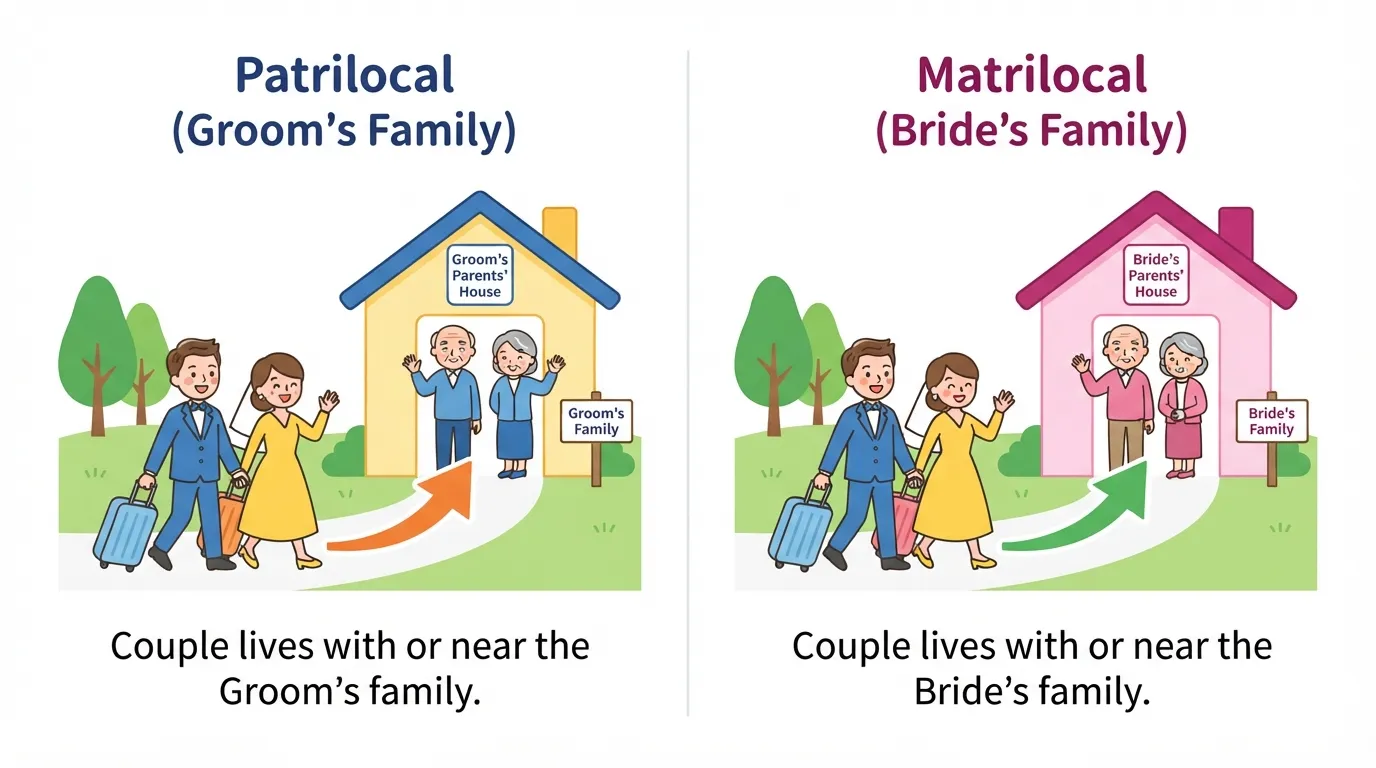
Patrilocal means a married couple lives with or near the husband’s family. Matrilocal means a married couple lives with or near the wife’s family. They describe opposite residence patterns after marriage, not two versions of the same word.
I remember flipping through an anthropology textbook late at night, completely stuck on a single practice question. It asked whether a specific community followed patrilocal or matrilocal residence, and I genuinely could not remember which word matched which family.
I ended up circling both answers, hoping partial credit existed. It did not, and that mistake stuck with me long enough to finally memorize the difference for good.
Students studying anthropology and sociology run into this exact confusion constantly. The two words share nearly identical structure, which makes it easy to blank on which term points toward the husband’s side and which points toward the wife’s side.
This guide clears up the confusion permanently. You will learn exactly what each term means, where the concepts come from, and how to use both correctly in academic work or everyday writing.
Patrilocal or Matrilocal: Quick Answer
Patrilocal describes a residence pattern where a married couple settles with or near the husband’s family and community after marriage.
Matrilocal describes a residence pattern where a married couple settles with or near the wife’s family and community after marriage.
Example: In a patrilocal society, a new bride typically moves into her husband’s family home. In a matrilocal society, the husband typically moves into his wife’s family home instead.
The Origin and Background of Patrilocal and Matrilocal
Both words combine Latin roots with the word locus, meaning place. Patri comes from pater, meaning father, giving patrilocal its meaning of settling near the father’s side of the family. Matri comes from mater, meaning mother, giving matrilocal its meaning of settling near the mother’s side.
Anthropologists developed these terms in the late nineteenth and early twentieth centuries while studying marriage and family structures across different societies worldwide. Researchers noticed that where a couple chose to live after marriage often reflected deeper patterns around inheritance, property, and family authority.
Patrilocal residence historically appeared in many agricultural societies, where land and property typically passed down through the father’s line, making it practical for a new couple to remain near his family. Matrilocal residence historically appeared in societies where property, farming responsibilities, or family authority passed through the mother’s line instead.
The confusion between these two words usually comes from their nearly matching structure. Both terms share the same ending and length, differing only in that small patri versus matri prefix, which makes them easy to mix up without close attention.
Patrilocal vs Matrilocal Explained: Key Differences and Variations
| Term | Meaning | When to Use | Region/Context |
|---|---|---|---|
| Patrilocal | Couple settles near the husband’s family | Describing father centered residence patterns | Common in many agricultural and historical societies |
| Matrilocal | Couple settles near the wife’s family | Describing mother centered residence patterns | Common in various indigenous and traditional societies |
| Neolocal | Couple establishes an entirely new, independent household | Describing modern, independent living arrangements | Common in many contemporary industrialized societies |
Patrilocal and matrilocal sit at opposite ends of the same spectrum, while neolocal describes a related but distinct modern pattern where couples avoid settling near either family.
Which Term Should You Use?
Sociology and Anthropology Students
Use both terms precisely, based on the specific residence pattern being described, since exam questions frequently test the ability to distinguish them accurately.
Writers Covering Cultural or Family Structures
Use patrilocal when describing communities where couples settle near the husband’s family, and matrilocal when describing communities where couples settle near the wife’s family.
Researchers Studying Family and Kinship Systems
Use the term that matches your actual data. Patrilocal applies to husband centered residence patterns, while matrilocal applies specifically to wife centered residence patterns.
General Readers and Casual Writers
Focus on the core distinction. Patrilocal points toward the husband’s side, while matrilocal points toward the wife’s side.
Global or Comparative Cultural Writing
Clarify which specific society or region you are discussing, since residence patterns vary widely and rarely follow one single universal rule across cultures.
If you remember only one rule, remember this: patrilocal follows the father’s side, and matrilocal follows the mother’s side.
Common Mistakes with Patrilocal and Matrilocal
Mistake 1: Confusing the Prefixes Patri and Matri
Correction: Remember that patri connects to pater, meaning father, similar to paternal, while matri connects to mater, meaning mother, similar to maternal.
Mistake 2: Assuming Both Terms Describe the Same Pattern
Correction: Patrilocal and matrilocal describe opposite residence patterns, not two versions of the same concept.
Mistake 3: Confusing Residence Patterns with Descent Patterns
Correction: Patrilocal and matrilocal describe where a couple lives, while separate terms like patrilineal and matrilineal describe how family lineage and inheritance are traced.
Mistake 4: Overlooking Regional and Cultural Variation
Correction: Different societies apply patrilocal and matrilocal residence differently, so avoid assuming one universal pattern applies across every culture.
Mistake 5: Forgetting That Modern Societies Often Shift Toward Neolocal Living
Correction: Many contemporary societies increasingly favor neolocal residence, where couples establish independent households rather than settling near either family.
Each of these mistakes happens because the two terms sound structurally similar, even though their actual meanings point toward opposite sides of a family.
Patrilocal and Matrilocal in Real World Examples
Professional Email
“Our research team is comparing patrilocal residence rates across three regions for the upcoming anthropology publication.”
News Headline
“Study Examines Shifting Matrilocal Traditions Among Younger Generations in Rural Communities”
Social Media Post
“Learned so much in class today about matrilocal societies and how family land often passes through the mother’s side.”
Formal Document
“This anthropological report examines both patrilocal and matrilocal residence practices across the surveyed communities.”
Notice how both terms appear naturally in academic, journalistic, and casual contexts, as long as the writer clearly signals which specific pattern is being discussed.
Patrilocal and Matrilocal: Data, Trends, and Usage
Searches comparing patrilocal and matrilocal happen consistently among sociology and anthropology students, particularly during exam seasons and research paper deadlines.
Researchers studying family structures, cultural anthropologists, and writers covering kinship systems also search these terms regularly, especially when comparing residence patterns across different societies.
This search falls almost entirely into the informational category. Readers want a clear, accurate explanation of two related but opposite concepts, not a lengthy academic lecture.
Growing academic interest in family structures, gender roles, and changing residence patterns continues to keep both terms relevant across sociology, anthropology, and cultural studies fields.
Standalone Comparison Table
| Term/Variant | Meaning | Region/Context | Best Used When |
|---|---|---|---|
| Patrilocal | Couple settles near the husband’s family | Global, especially traditional agricultural contexts | Describing father centered residence patterns |
| Matrilocal | Couple settles near the wife’s family | Global, especially certain indigenous and traditional contexts | Describing mother centered residence patterns |
Frequently Asked Questions
What does patrilocal mean?
Patrilocal means a married couple settles with or near the husband’s family after marriage, a pattern historically common in many agricultural and property based societies.
How do you use matrilocal correctly in a sentence?
Use matrilocal to describe residence near the wife’s family, such as “the community followed matrilocal traditions, with husbands moving into their wife’s family home.”
Matrilocal vs patrilocal, what is the actual difference?
Patrilocal residence centers around the husband’s family, while matrilocal residence centers around the wife’s family. They describe completely opposite living arrangements, not variations of the same concept.
Is matrilocal residence still practiced today?
Yes, though less commonly than in the past. Some communities around the world continue to follow matrilocal traditions, particularly where family property or authority passes through the mother’s line.
Which term applies to a bride moving into her husband’s family home?
Patrilocal applies here, since it specifically describes residence patterns that place a couple near the husband’s side of the family after marriage.
Where do the terms patrilocal and matrilocal come from?
Both terms combine Latin roots with locus, meaning place. Patri connects to father, and matri connects to mother, giving each word its opposite meaning.
Can a society shift between patrilocal, matrilocal, and neolocal patterns over time?
Yes. Many societies shift toward neolocal residence as they modernize, moving away from traditional patrilocal or matrilocal expectations toward independent household formation.
Final Thoughts
Patrilocal and matrilocal describe two opposite residence patterns after marriage, not two versions of the same word. Patrilocal centers on the husband’s family, while matrilocal centers on the wife’s family.
Keep the core distinction in mind. Patri connects to father, matri connects to mother, and both terms depend heavily on which specific family and community structure is being discussed.
Bookmark this guide so you never second guess these terms again, and share it with a classmate or colleague working through the same anthropology or sociology material.
Read More: Pannel or Panel: The Correct Spelling Explained

My name is Ayesha Sadiqah, the writer behind this website. I write in-depth articles on English spelling, word comparisons, grammar, and vocabulary to help learners make better language choices. Every guide is carefully researched and designed to provide accurate, practical, and easy-to-understand information.