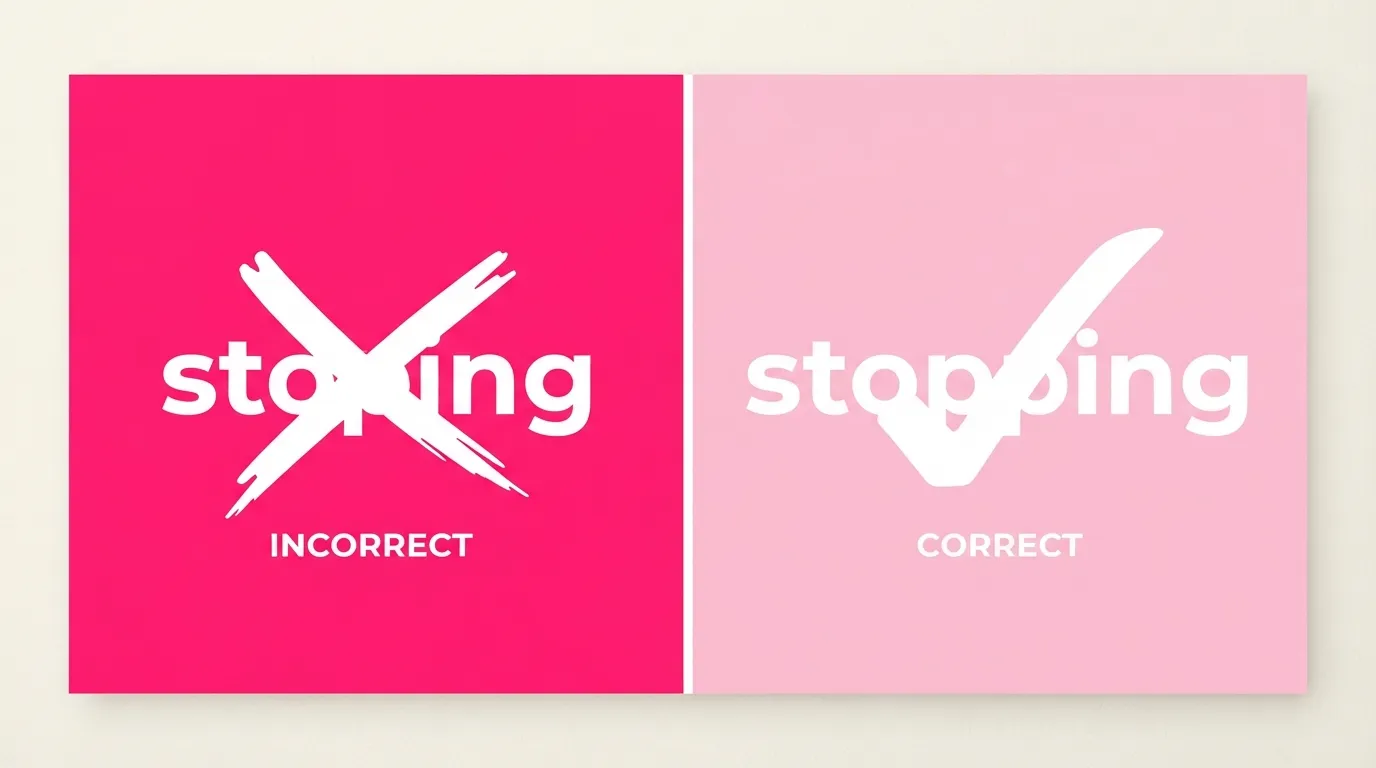
Stopping is the correct spelling for the everyday action of ceasing movement or activity. Stoping is a real but completely different word, used almost exclusively in underground mining to describe removing ore from a mine.
I once read a text from a friend who wrote that traffic kept “stoping and starting” on her drive home. I assumed it was a simple typo, until I actually looked up the word out of curiosity.
I was surprised to learn stoping is a genuine English word after all, just not the one she meant. It belongs to an entirely different world, one involving underground tunnels and mining engineers, not rush hour traffic.
This mix up happens because stopping requires doubling a consonant, a rule many writers forget under pressure. At the same time, stoping quietly exists as a specialized term, which makes this pair more interesting than a typical typo story.
This guide clears up both sides of the confusion. You will learn the correct everyday spelling, the surprising real meaning behind the other version, and exactly which one belongs in your writing.
Stoping or Stopping: Quick Answer
Stopping means ceasing movement, action, or an ongoing process, and it is the spelling almost every writer actually intends to use.
Stoping is a specialized mining term describing the process of extracting ore from an underground mine, leaving behind an open space called a stope.
Example: “The bus kept stopping every few blocks” uses the everyday meaning correctly. “The mining crew focused on stoping the lower tunnel section” uses the specialized mining meaning correctly, and neither word can replace the other.
The Origin and Background of Stopping and Stoping
Stopping comes from the verb stop, which traces back to Old English and Late Latin roots related to plugging or blocking something. When English speakers add ing to a short word ending in a single vowel and consonant, the rule requires doubling that final consonant, which is exactly why stop becomes stopping rather than stoping.
Stoping developed along a completely different path. It comes from the mining term stope, a word used since at least the eighteenth century to describe an excavated underground space created while removing ore. Miners eventually turned that noun into a verb, stoping, to describe the ongoing act of creating and working within those spaces.
The confusion between the two words happens for a simple reason. Most people have never encountered stoping in its real mining context, so when they see it, their brain assumes it must be a misspelled version of stopping instead.
Since both words are technically valid English, spellcheck tools often let stoping pass without flagging it, even when a writer clearly meant stopping. That silence from spellcheck allows the mistake to slip into casual writing, texts, and even some published content.
Stopping vs Stoping Explained: Key Differences and Variations
| Term | Meaning | When to Use | Region/Context |
|---|---|---|---|
| Stopping | Ceasing movement or an ongoing action | Everyday writing, all contexts | Standard across English speaking regions |
| Stoping | Extracting ore from an underground mine | Mining, geology, and engineering writing | Specialized industry term worldwide |
| Stop | The base verb meaning to cease | All writing, formal and casual | Standard across English speaking regions |
These two words share no real connection in meaning, despite looking nearly identical. Stopping belongs in essentially every type of writing, while stoping belongs almost entirely within mining and geology contexts.
Which Spelling Should You Use?
Everyday and General Writing
Use stopping for any sentence involving pausing, ceasing, or ending an action, since this covers the overwhelming majority of situations where this word appears.
Students and Academic Writing
Use stopping unless your assignment specifically involves mining engineering or geology, where stoping might appear as an accurate technical term.
Mining, Engineering, and Geology Writing
Use stoping when specifically referring to the extraction of ore and the creation of underground stopes, since this is the only context where the word applies correctly.
Business and Professional Writing
Use stopping for nearly all professional communication, reserving stoping strictly for industry specific documents related to mining operations.
Casual Writing and Messaging
Use stopping. Unless you work in mining, there is almost no situation in daily conversation where stoping would ever be the intended word.
If you remember only one rule, remember this: stopping is for everyday life, and stoping is for underground ore extraction.
Common Mistakes with Stopping and Stoping
Mistake 1: Forgetting to Double the Consonant
Correction: Remember that stop follows the standard doubling rule, so stopping needs two p letters, not one.
Mistake 2: Assuming Stoping Is Always a Typo
Correction: Stoping is a real word, just an extremely specialized one, so it is not automatically incorrect, only incorrect outside a mining context.
Mistake 3: Using Stoping in General Writing by Mistake
Correction: Double check your intended meaning. If you are describing pausing or ending an action, stopping is almost certainly the word you need.
Mistake 4: Trusting Spellcheck to Catch This Specific Error
Correction: Since stoping is a valid word, most spellcheck tools will not flag it, so you need to manually confirm you selected the correct spelling.
Mistake 5: Confusing Related Mining Terms Like Stope and Stoping
Correction: A stope is the physical space created underground, while stoping describes the ongoing process of creating and working that space.
Each of these mistakes happens because this particular word pair hides a real, valid second meaning, unlike most simple misspellings that have no accepted use at all.
Stopping in Real World Examples
Professional Email
“Please confirm the delivery schedule, since the driver reported stopping frequently due to road construction along the main route.”
News Headline
“City Council Approves New Traffic Measures Aimed at Reducing Unnecessary Stopping During Rush Hour”
Social Media Post
“My car keeps stopping randomly at red lights even when nothing is around. Time for a mechanic visit.”
Formal Document
“This safety protocol outlines proper procedures for stopping heavy machinery during scheduled maintenance periods.”
Mining Industry Example
“The engineering report recommended shrinkage stoping for this section of the ore body, based on the surrounding rock strength.”
Notice how stopping fits naturally into everyday professional and casual writing, while stoping only appears correctly within a specific technical mining context.
Stopping and Stoping: Data, Trends, and Usage
Searches comparing stopping and stoping happen consistently, mostly driven by everyday writers checking basic spelling before sending a message or publishing content.
A much smaller group of searches comes from mining students, engineers, and geology professionals confirming correct technical terminology for reports and academic papers.
This search falls almost entirely into the informational category for general users, though it shifts toward specialized technical intent among mining and engineering audiences.
Interest in mining terminology remains steady within that industry, while general confusion around the everyday spelling continues among writers unfamiliar with the mining definition entirely.
Standalone Comparison Table
| Term/Variant | Meaning | Region/Context | Best Used When |
|---|---|---|---|
| Stopping | Ceasing movement or an ongoing action | Global standard | Any everyday writing situation |
| Stoping | Extracting ore from an underground mine | Mining and geology industries | Technical or industry specific writing |
Frequently Asked Questions
What does stopping mean?
Stopping means ceasing movement, action, or an ongoing process. It applies to almost any situation involving pausing or ending something, from traffic to daily habits.
How do you use stopping correctly in a sentence?
Use stopping as the present participle of stop, such as “the train is stopping at every station,” making sure to include both p letters.
Stoping vs stopping, what is the actual difference?
Stopping describes ceasing an action in everyday language, while stoping describes a specific underground mining process involving ore extraction. The words share no real connection beyond their similar spelling.
Is stoping ever acceptable in general writing?
Only if you are specifically discussing mining or geology. In nearly every other context, stoping would be considered an error where stopping was intended.
Which version is correct, stopping or stoping?
Both are correct English words, but they mean completely different things. Stopping covers everyday use, while stoping applies only within mining and geology writing.
Where does the word stopping come from?
Stopping comes from the verb stop, rooted in Old English and Late Latin terms related to blocking or plugging something, following standard English doubling rules when adding ing.
Can stoping be used outside of mining contexts?
Rarely. Stoping is a highly specialized term almost entirely limited to mining engineering, geology, and related technical fields, making it an unlikely fit for general writing.
Final Thoughts
Stopping and stoping look nearly identical, but they belong to two completely different worlds. Stopping covers everyday pausing and ending actions, while stoping describes a specific mining process most people will never need to write about.
Keep the key takeaways in mind. Double the consonant for stopping in everyday writing, and reserve stoping strictly for mining and geology contexts where it actually applies.
Bookmark this guide so you never second guess this word pair again, and share it with anyone who has ever typed stoping by accident, wondering why it looked strangely correct.
Read More: Pannel or Panel: The Correct Spelling Explained

I’m Zain. I got interested in commonly confused words while helping non-native English speakers prep for writing exams, where a single misused word could cost real marks. That experience shaped how I write now: I try to explain not just which spelling is correct, but why the confusion exists in the first place, since understanding the reason is what actually makes it stick.