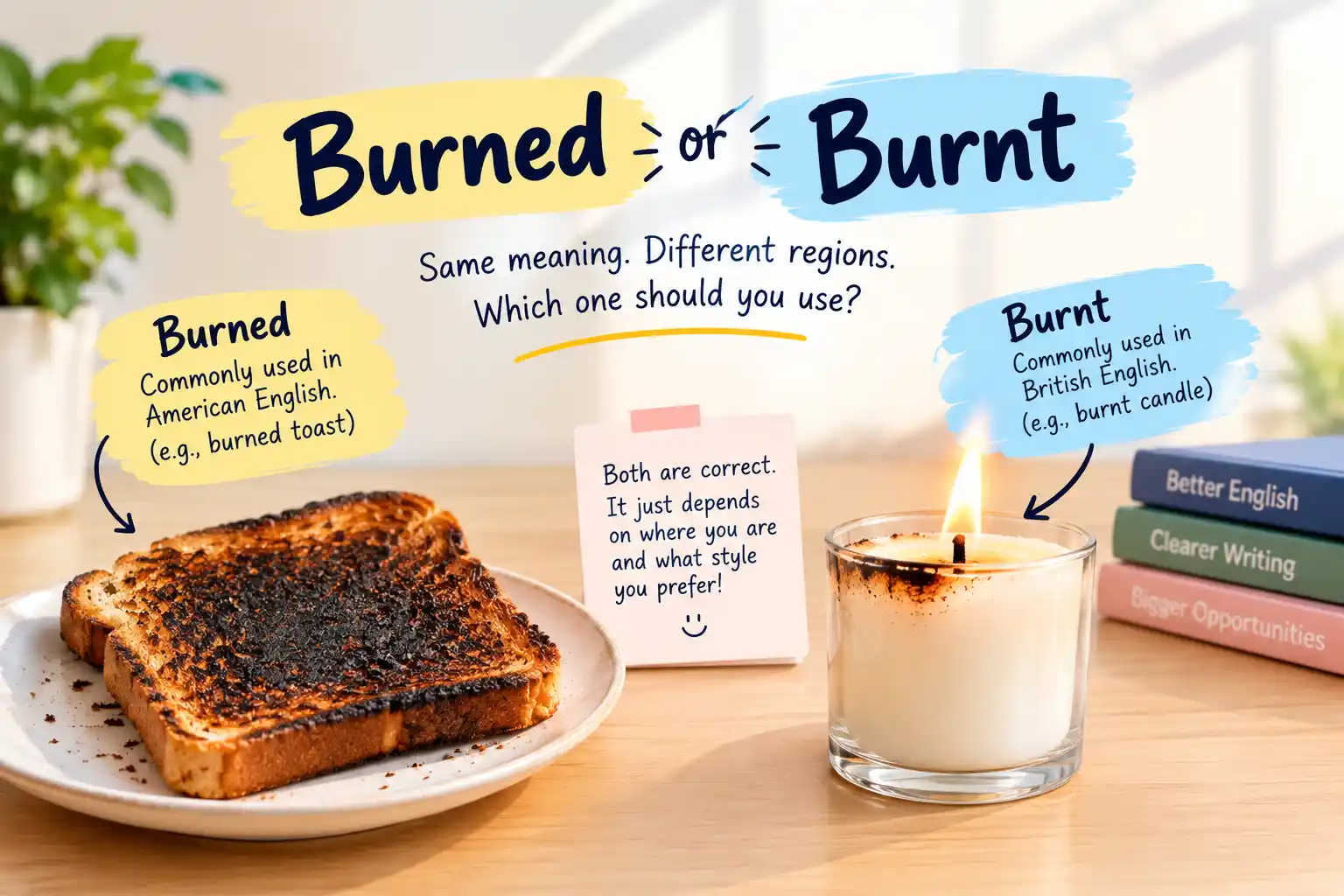
Burned and burnt are both correct forms of burn. Burned is more common in American English, while burnt is more common in British English.
Have you ever written the word burned and wondered if it should be burnt instead?
You are not alone.
Many English learners ask this question. Even native speakers sometimes stop to think about it. Both forms are common, so the difference can seem confusing.
The good news is that both burned and burnt are correct.
The main difference is regional. American English usually prefers burned. British English often prefers burnt. However, British speakers also use burned. American speakers can also use burnt in some expressions.
For example, you can say:
The toast burned in the oven.
You can also say:
The toast burnt in the oven.
Both sentences are correct.
There is also a useful difference in common expressions. The word burnt appears often in phrases such as burnt toast, burnt sugar, and burnt orange.
So, which form should you use?
The answer depends on your audience, your preferred style of English, and the context. This guide explains the difference in simple language. You will also find examples, common mistakes, a comparison table, and a useful cheat sheet.
Burned or Burnt: Quick Answer
Burned and burnt are two accepted forms of the verb burn.
Both can describe something affected by fire or heat.
For example:
She burned the cake.
She burnt the cake.
The meaning is the same.
However, usage can change by region.
American English often uses burned.
British English often uses burnt.
Still, these are preferences rather than strict rules. You may find both forms in American and British writing.
Quick Cheat Sheet
| Word | Common Use | Example |
| Burned | Common in American English | She burned the toast. |
| Burnt | Common in British English | She burnt the toast. |
| Burned | Past tense | The paper burned quickly. |
| Burnt | Past tense | The paper burnt quickly. |
| Burned | Past participle | The wood has burned. |
| Burnt | Past participle | The wood has burnt. |
The easiest rule is simple.
Use burned if you mainly write American English.
Use burnt if you mainly write British English.
Most importantly, keep your style consistent.
What Does Burned Mean?
Burned is the past tense and past participle of burn.
The verb burn means to damage something with fire or heat. It can also mean to catch fire or produce heat.
For example:
The paper burned quickly.
I burned my hand.
The fire burned the wood.
She burned the old letters.
The word can describe many different situations.
1.You can burn food.
2.You can burn paper.
3.You can burn wood.
4.You can burn your skin.
5.You can even burn calories through exercise.
For example:
I burned the toast this morning.
The fire burned for several hours.
She burned her finger while cooking.
In American English, burned is usually the preferred form.
What Does Burnt Mean?
Burnt is another accepted form of the past tense and past participle of burn.
It has the same basic meaning as burned.
For example:
The toast burnt in the oven.
She burnt the cake.
The wood burnt slowly.
The word is especially common in British English.
It is also common in certain descriptive expressions.
For example:
1.burnt toast
2.burnt sugar
3.burnt orange
4.burnt wood
These phrases are easy to understand because they describe something that has been affected by heat.
Burned or Burnt in American English
American English usually prefers burned.
This is true in everyday speech and writing.
For example:
I burned the cookies.
The fire burned the old house.
She burned her hand.
The candle burned all night.
He burned the paper.
These sentences sound natural to American English speakers.
However, burnt is not automatically wrong in American English.
You may see it in food descriptions or artistic descriptions.
For example:
The recipe uses burnt sugar.
She chose a burnt orange color.
So, if you write American English, burned is a safe general choice. However, you may still encounter burnt in certain phrases.
Burned or Burnt in British English
British English uses both forms.
However, burnt is very common.
For example:
I burnt the toast this morning.
She burnt the cake.
The fire burnt the wood.
He burnt the old papers.
These sentences sound natural in British English.
British speakers can also use burned.
For example:
The building was burned during the fire.
Therefore, it is not correct to say that British English only uses burnt.
The better way to understand the difference is to think about preference.
American English generally prefers burned.
British English often prefers burnt.
Both forms remain correct.
Burned or Burnt Grammar
The verb burn has two common past forms.
One form is burned.
The other form is burnt.
Here is how they work.
Using Burned
Present: I burn the paper.
Past: I burned the paper.
Past participle: I have burned the paper.
Using Burnt
Present: I burn the paper.
Past: I burnt the paper.
Past participle: I have burnt the paper.
Both patterns are correct.
The main difference is the form preferred by different English varieties.
Simple Grammar Table
| Verb Form | American Preference | British Preference |
| Present | burn | burn |
| Past | burned | burnt |
| Past participle | burned | burnt |
| Common adjective | burned | burnt |
Remember that these are general preferences. You may still see the other form in either variety.
Burned or Burnt as a Verb
Both words can work as verbs.
A verb tells us about an action or event.
For example:
The fire burned the paper.
Here, burned tells us what happened to the paper.
You can also write:
The fire burnt the paper.
The meaning remains the same.
Here are more examples:
She burned the old photograph.
She burnt the old photograph.
He burned the wood.
He burnt the wood.
The candle burned all night.
The candle burnt all night.
The correct choice depends mainly on your English style.
Burned or Burnt as an Adjective
Both words can also describe a noun.
In this role, they work as adjectives.
For example:
The burned paper was black.
Here, burned describes the paper.
You can also say:
The burnt paper was black.
Both forms are possible.
However, burnt is especially common in some descriptive phrases.
For example:
1.burnt toast
2.burnt sugar
3.burnt wood
4.burnt orange
These expressions are widely understood.
The word burned can also appear in descriptions.
For example:
The burned building was empty.
The burned paper was difficult to read.
His burned hand was painful.
Therefore, context matters.
Burned or Burnt: Main Difference
The biggest difference is not meaning.
The meaning is almost always the same.
The main difference is regional usage.
American English commonly uses burned.
British English commonly uses burnt.
There is also a difference in some common phrases.
For example:
burnt toast is a very familiar expression.
burnt orange is another common expression.
At the same time, burned toast and burned orange can also be understood.
Comparison Table
| Term | Meaning | Region or Context | Best Used When |
| Burned | Affected by fire or heat | Common in American English | General American writing |
| Burnt | Affected by fire or heat | Common in British English | General British writing |
| Burned | Past form of burn | American and international use | Everyday and formal writing |
| Burnt | Past form of burn | British and international use | Everyday and descriptive writing |
| Burned | Past participle | Common in American English | Perfect tenses |
| Burnt | Past participle | Common in British English | Perfect tenses |
Which One Should You Use?
The best choice depends on your readers.
If Your Readers Use American English
Choose burned in most situations.
For example:
The cookies burned in the oven.
She burned her finger.
The fire burned the wood.
This choice will sound natural to most American readers.
If Your Readers Use British English
You can use burnt naturally.
For example:
The cookies burnt in the oven.
She burnt her finger.
The fire burnt the wood.
This style will sound natural to many British readers.
If You Write for an International Audience
Either form can work.
However, consistency is helpful.
If your website mainly follows American English, use burned.
If your website mainly follows British English, use burnt.
This creates a clear writing style.
Why Does English Have Two Forms?
English has changed over many centuries.
Some English verbs developed more than one past form. The verb burn is one example.
The form burned follows a common English pattern. We add ed to the verb.
The form burnt follows an older pattern.
Both forms survived.
Over time, different English speaking regions developed different preferences.
American English generally moved toward burned.
British English kept strong use of burnt.
That is why both forms are still used today.
This is not unusual in English.
Many words have different forms in different English varieties.
Common Expressions With Burnt
The word burnt appears in many familiar expressions.
Burnt Toast
The burnt toast smelled terrible.
This means that the toast was cooked for too long.
Burnt Sugar
The chef added burnt sugar to the dessert.
Here, burnt describes sugar that has been heated strongly.
Burnt Orange
She bought a dress in a burnt orange color.
Burnt orange is a deep shade of orange.
Burnt Wood
The smell of burnt wood filled the room.
The phrase describes wood affected by fire.
Burnt Offering
The book describes an ancient burnt offering.
This is a traditional expression with a religious and historical meaning.
These examples show why burnt remains common in English.
Common Expressions With Burned
The form burned also appears in many useful phrases.
For example:
burned paper
burned skin
burned wood
burned calories
burned bridges
Consider these examples:
The fire burned the paper.
She burned her hand.
The exercise burned many calories.
He burned bridges with his former friends.
The expression burned bridges means damaging a relationship or connection so badly that returning to it may become difficult.
Burned or Burnt in Formal Writing
Both forms can appear in formal writing.
Neither word is automatically informal.
The main point is to follow the English style used by your audience.
For example, an American report may say:
The material was burned at a controlled temperature.
A British report may say:
The material was burnt at a controlled temperature.
Both sentences are clear.
If you are writing for a university, company, journal, or organization, check its preferred style.
That rule is more useful than trying to decide that one form is always correct.
Burned or Burnt in Academic Writing
Students often wonder which form to use in essays and assignments.
The answer is simple.
Follow the English variety required by your institution.
If your university uses American English, burned will usually fit well.
If your university uses British English, burnt may be preferred.
For example:
The samples were burned before testing.
This works well in American English.
You could also write:
The samples were burnt before testing.
This works naturally in British English.
Most importantly, do not change between forms without a reason.
Burned or Burnt in Professional Writing
Professional writing should be clear and consistent.
Suppose you are writing a report about a damaged product.
You might write:
The outer material was burned during production.
This is natural in American English.
You could also write:
The outer material was burnt during production.
This is natural in British English.
Both sentences communicate the same information.
The choice depends on your organization’s writing style.
Burned or Burnt in Everyday Conversation
Everyday speech follows the same basic pattern.
An American speaker may say:
I burned the toast again.
A British speaker may say:
I burnt the toast again.
Both sentences sound natural within their respective varieties.
This is why you should not worry when you hear both forms.
English changes slightly from one region to another.
That does not make one form incorrect.
Burned or Burnt in Real Examples
Example 1: Everyday Conversation
I burned the toast this morning.
This is common in American English.
A British speaker may say:
I burnt the toast this morning.
Example 2: Cooking
She burned the chicken while answering the phone.
You could also write:
She burnt the chicken while answering the phone.
Example 3: Fire
The fire burned through the old wooden door.
British English may use:
The fire burnt through the old wooden door.
Example 4: Formal Report
The sample was burned before the experiment began.
This form is common in American English.
Example 5: Food Description
The restaurant serves bread with burnt edges.
Here, burnt works naturally as a description.
Common Mistakes With Burned or Burnt
Mistake 1: Thinking Burnt Is Wrong
Some learners believe that burnt is an incorrect form.
It is not.
Burnt is a standard English word.
It is especially common in British English.
Mistake 2: Thinking Burned Is Wrong
Some learners have the opposite problem.
They see burnt in British writing and assume burned is incorrect.
That is also wrong.
Burned is a standard English form.
It is especially common in American English.
Mistake 3: Using One Form Because It Looks More Formal
Neither form is automatically more formal.
The choice mainly depends on regional style and context.
Mistake 4: Mixing Styles Too Often
Using both forms is not necessarily a grammar mistake.
However, frequent switching can make your writing feel inconsistent.
Choose a style and stay with it when possible.
Mistake 5: Assuming British English Only Uses Burnt
British English uses burnt often, but burned is also used.
Therefore, the difference is about preference rather than a strict rule.
Burned or Burnt Cheat Sheet
Use this simple guide when you are in a hurry.
American English: Choose burned in most situations.
British English: Burnt is very common.
Past tense: Both burned and burnt are correct.
Past participle: Both burned and burnt are correct.
Adjective: Both forms can describe something affected by heat.
Food phrases: Burnt is common in phrases such as burnt toast.
Formal writing: Both forms are acceptable.
Academic writing: Follow your institution’s English style.
Website writing: Pick one regional style and stay consistent.
A Simple Way to Remember the Difference
Think about the letters at the end.
Burned uses the regular ed ending.
Burnt is the shorter form.
Then remember the regional pattern.
American English often uses burned.
British English often uses burnt.
That is enough for most everyday situations.
You do not need to memorize a complicated grammar rule.
Burned or Burnt and Consistency
Consistency is one of the most useful ideas in professional writing.
Suppose your website follows American English.
You might write:
The cake burned in the oven.
Later, another article says:
The cake burnt in the oven.
Both sentences are correct. Still, readers may notice the change in style.
For a polished website, it is better to choose one general style.
The same idea applies to school work, business writing, and publications.
A consistent style makes your writing easier to read.
Burned or Burnt for WordPress and SEO
If you are writing an English language article for a website, you can use both forms naturally.
Your main keyword can be burned or burnt.
You can then include related phrases such as:
burned vs burnt
burned or burnt correct
burnt meaning
burned meaning
past tense of burn
past participle of burn
American English
British English
These related terms help explain the topic clearly.
However, do not repeat the keyword in every sentence.
Write for people first.
Use the keyword where it feels natural.
Clear writing is more useful than keyword repetition.
Frequently Asked Questions
Q: Is burned or burnt correct?
A: Both are correct. Burned is more common in American English. Burnt is more common in British English.
Q: Which is correct, burned or burnt?
A: Both are correct forms of burn. Your choice depends on your English variety and the context.
Q: Is burnt British English?
A: Yes. Burnt is very common in British English. However, British speakers also use burned.
Q: Is burned American English?
A: Yes. Burned is especially common in American English. It is widely used as the past tense and past participle of burn.
Some Other FAQs:
Q: Can Americans say burnt?
A: Yes. Americans can use burnt. It is especially familiar in phrases such as burnt toast and burnt orange.
Q: Can British people say burned?
A: Yes. British speakers can use burned. It is a valid English form.
Q: Should I write burnt toast or burned toast?
A: Both forms are possible. Burnt toast is especially common in British English. Burned toast is common in American English.
Q: Is burnt an adjective?
A: Yes. Burnt can work as an adjective. For example, The burnt toast was difficult to eat.
Q: Is burned an adjective?
A: Yes. Burned can also work as an adjective. For example, The burned paper was black.
Q: What is the past tense of burn?
A: Both burned and burnt can be used as the past tense of burn.
Q: What is the past participle of burn?
A: Both burned and burnt can be used as the past participle of burn.
Q: Is burnt formal English?
A: Yes. Burnt is a standard English form. It can be used in formal writing when it fits the chosen English style.
Q: Is burned formal English?
A: Yes. Burned is also a standard English form. It is particularly common in American formal writing.
Q: Which form should students use?
A: Students should follow the English style used by their school, university, teacher, or publication. American English often uses burned, while British English often uses burnt.
Q: Why are there two forms of burn?
A: English developed different forms of the verb over time. Both forms survived, and different English varieties developed different preferences.
Final Thoughts
The choice between burned or burnt is easier once you understand the basic rule.
Both forms are correct.
The biggest difference is regional preference.
American English usually favors burned. British English often favors burnt. However, both forms can appear in either variety.
You should also remember that burnt is common in descriptive phrases such as burnt toast, burnt sugar, and burnt orange.
When you write for school, work, or your website, think about your audience. Then choose the form that matches your preferred English style.
Most importantly, do not think that one form is always right and the other is always wrong.
They are both part of standard English.
If you remember only one rule, remember this:
Use burned freely in American English. Use burnt freely in British English. When writing for a wider audience, either form is acceptable as long as your usage is clear and consistent.
Now you know exactly how to use burned or burnt. Bookmark this guide so you can quickly check the difference whenever you need it.
Read More: Truly or Truely: The Correct Spelling Explained

Hi, I’m Zara. Words that look almost identical but mean different things have always fascinated me, and that is what pulled me into writing about spelling and usage. Every guide gives you the answer first, then explains it clearly enough that you won’t need to look it up again.